Yearly Archives: 2010

Feeling blue seeing red


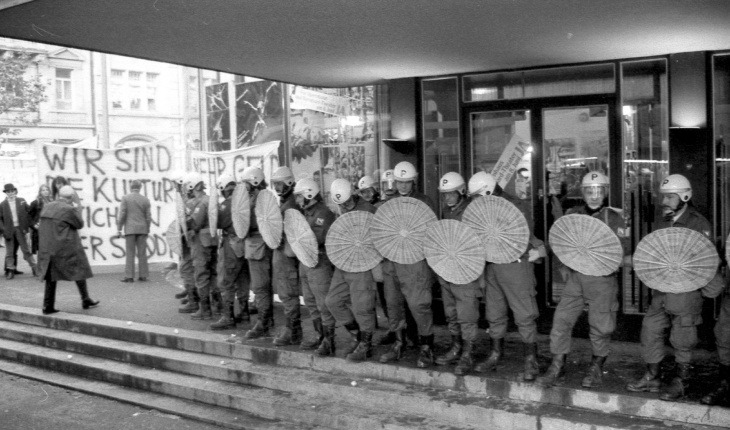
As many stakeholders in the redevelopment process recognise the issue of urban redevelopment is fraught. When young Swiss rioted during the Opera House riots the world wondered “how and why brutal contestation was possible in the land of wealth, stability, civic discipline” and almost full employment.

One Genevan philosopher of Polish heritage believed the riots were the result of youth who “didn’t know what to do with unlimited freedom in a world of unlimited opportunities.”

The disturbances broke out when in 1980 the young people of Zurich were unable to organise rock concerts due to an unavailability of money and accommodation at the same time as “large sums of money went to the renovation of the Zurich Opera House.”

Beneath the idealic view of Swiss society it was reported that young people were cheated out of a right to Utopia by a recession, did not have stable families, had overworked fathers, cramped and impersonal living conditions in large blocks of flats and that the nuclear family which had replaced extended relational groups had become too small.

 http://news.google.com/newspapers?nid=1129&dat=19830528&id=yU0NAAAAIBAJ&sjid=mW0DAAAAIBAJ&pg=4926,6708929


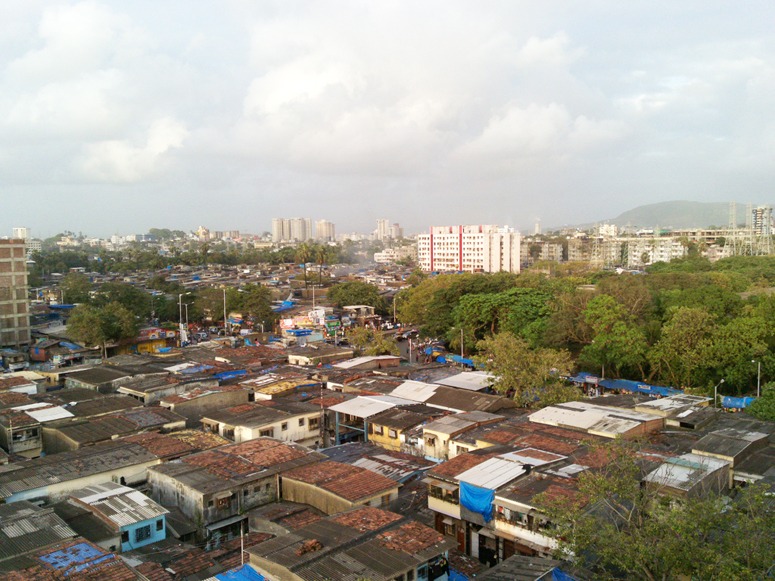
Urban landscape design in Dharavi, a Mumbai slum

The urban landscape of Dharavi, MumbaiKevin McLeod has shifted his gaze from Castleford to Dharavi. Properly critical of the sanitation, he finds much to praise in its community spirit and, like Slumdog Millionaire, criticizes the Bombay policy of trying to move the residents into Corbusian blocks of flats. He finds Dharavi as a happy place where everyone lives together and works together. Most people work within Dharavi so little money wasted on commuting. Kids don’t wear hoods and mug old ladies, because they have work to do. The crime rate is extremely low becuase everyone knows what everyone is doing. Dharavi is in fact like a medieval European town. We got rid of them in the mistaken belief that ‘foul air’ (rather than foul water) was causing infectious diseases. Now that this mistake has been cleared up, we should rid the world of highway regulations and let people build dwellings on narrow lanes if that is what they want to do.  Dharavi is sustainable and will survive unless the police clear it.

I remember spending a morning in a Roman town on the south coast of Turkey. There were no residents and no visitors. It was empty. One day, Dubai will be like this. The owners should have learned something from the Indians about sustainable urban design, instead of paying them peanuts to build Chicagos on the the Gulf.

(Image courtesy markhillary)

Note: Dharavi rhymes with laramie

Learn from wombats: earth sheltered homes have a lower environmental impact


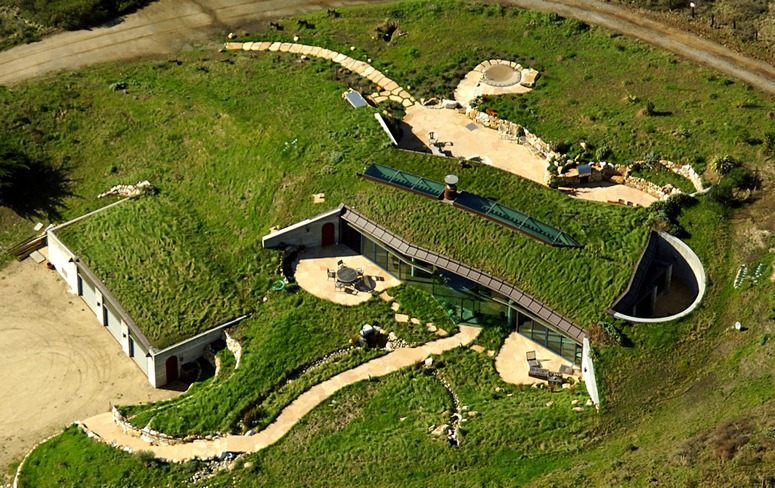
Earth-sheltered dwelling house in California

The sunken garden looks nice but they could have done more with the external space for this earth-sheltered dwelling house in California

When reducing the total impact of humans on the environment becomes a necessity, we may have to learn more from the lifestyles of wombats, teletubbies and hobbits. If so, I hope our species will also become cuter, cuddlier, and friendlier. JRR Tolkien may prove correct in his view that diminutive sausage-eaters will save the world from the black forces of evil.
PS But is that a triple garage?
(image courtesy Christopher Line)


St Anthony's Monastery, in Egypt, and the monastic gardening tradition


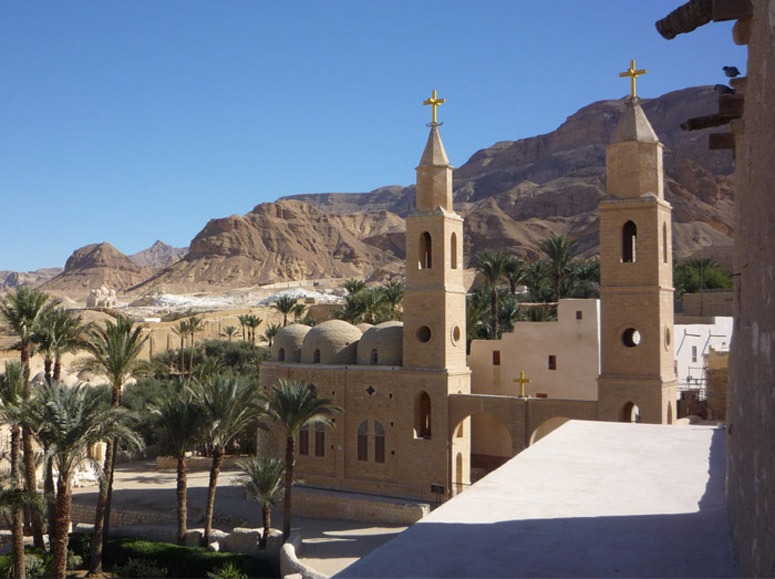
St Anthony's Monastry in Egypt

St Anthony's Monastery in Egypt


Saint Anthony (c 251–356) is known as ‘the Father of All Monks’. Athanasius wrote his biography and it spread monasticism in Western Europe. He was not the ‘first monk’ but he was a Christian ascetic who went into the wilderness. The present monastery was built (c 356) on his burial site and near his retreat. Its fortified character was a response to Bedouin attacks. St Anthony gave his father’s money to the poor and ‘shut himself up in a remote cell upon a mountain’  so that ‘filled with inward peace, simplicity and goodness’ he ‘cultivated and pruned a little garden’. Presumably, the garden was his food supply and the wilderness was the subject of his contemplation. This may well be the origin of a Christian approach to gardens, seeing them primarily as functional places – not as symbolic or luxurious places. Cloister garths belong to a different tradition: they are symbolic; they probably did not have a ‘use’; they became places of luxury. See posts on Certose Cloister, Canterbury Cloister, Salisbury Cloister and a hypothesis concerning the origin of Christian monasticism. Islam does not have a monastic tradition, though there are Dervish brotherhoods, possibly because the Arabs had sufficient experience of living in deserts.

(Image courtesy Miami Love)

A hypothesis concerning the origin of Christian monasticism and cloister gardens

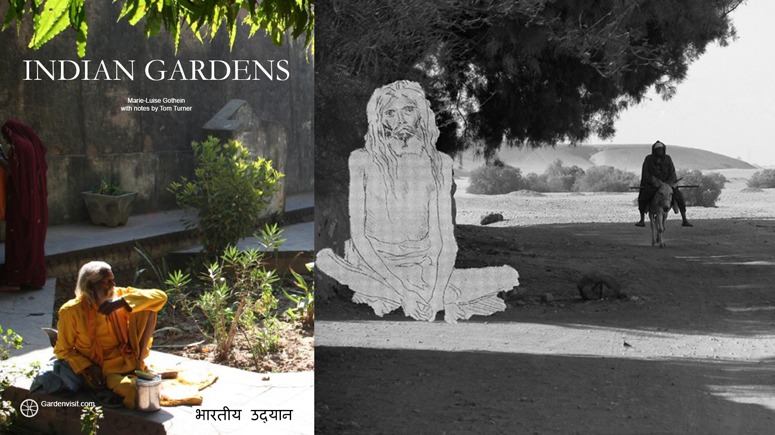
An Indian Rishi or Yogi or Holy man

Indian Rishi or Yogi or Holy man, today and yesterday

It is known that Homo sapiens sapiens evolved in Africa and migrated into Asia but remained an entirely nomadic species until c10,000 BC. Christ was born in 1 AD and monasticism was unknown in Christianity until the end of the third century, with St Anthony of Egypt (251-356) one of the first Christian hermits. The practice of retreating into natural landscapes was much older. It is found in the Bon religion, in Hinduism and in Daoism. Buddhist monks developed monastic communities after 400 BC. One can therefore hypothesize that the roots of Christian monasticism extend back to the habit of retreating into the wilds in Central Asia, as does the architectural practice of arranging residential cells around a square of grass. It is likely that the central square space was a symbol of The Earth, just as a circle was  a symbol of Heaven. Should this hypothesis be correct, there is a powerful case for managing cloisters as green voids with grass and wild flowers. See posts on Certose Cloister, Canterbury Cloister and Salisbury Cloister. If correct, the hypothesis supports the contention that early cloisters were not used as gardens or for any kind of gardening activity.

(The left image is the cover of the Indian Gardens eBook. The right image is a montage of a rishi onto a photograph of Egypt).

The importance of being landed


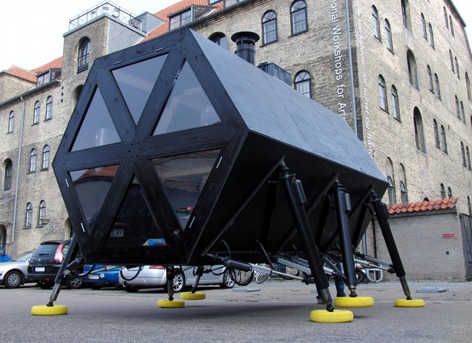
The Danish artistic trio N55 came up with the concept of the walking house based on the gypsy caravan. Although reminiscent of Archigram’s Walking City, walking house is not an aesthetically sophisticated piece of architecture. However N55 have amazingly managed to achieve real life rather than paper mobility via renewable energy sources – a remarkable feat in anybody’s language!

In Archigram’s Walking City on the Ocean Ron Herron addresses the concept of “indeterminacy” or the idea of an architecture that can change. While N55 are more interested in exploring the idea of property ownership. They describe the walking house as follows:

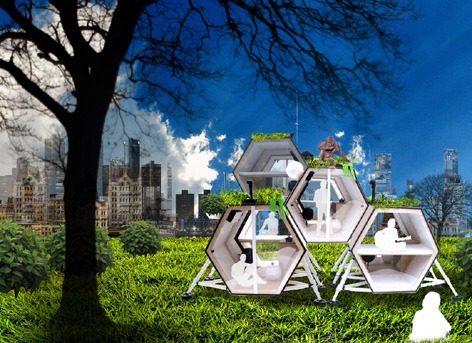
“WALKING HOUSE is a modular dwelling system that enables persons to live a peaceful nomadic life, moving slowly through the landscape or cityscape with minimal impact on the environment. It collects energy from its surroundings using solar cells and small windmills. There is a system for collecting rain water and a system for solar heated hot water. A small greenhouse unit can be added to the basic living module, to provide a substantial part of the food needed by the Inhabitants. A composting toilet system allows sewage produced by the inhabitants to be disposed of. A small wood burning stove could be added to provide CO2 neutral heating. WALKING HOUSE forms various sizes of communities or WALKING VILLAGES when more units are added together. WALKING HOUSE is not dependant on existing infrastructure like roads, but moves on all sorts of terrain.”

Based on the nomadic culture of the Romani the project asks whether land ownership means some people have more right to stay on the surface of the earth than others. This question is fundamentally anthoprocentric. Of course the basic question could be extended to encompass an ecological perspective and indeed is not dissimilar to eco-centric ethical viewpoints espoused by the conservationist luminary Aldo Leopold.

For landscape architecture the value of land as place rather than passage and the capacity to garden and enjoy gardens are central values. Undoubtably the voice of landscape architects will be heard strongly as the debate proceeds and develops.