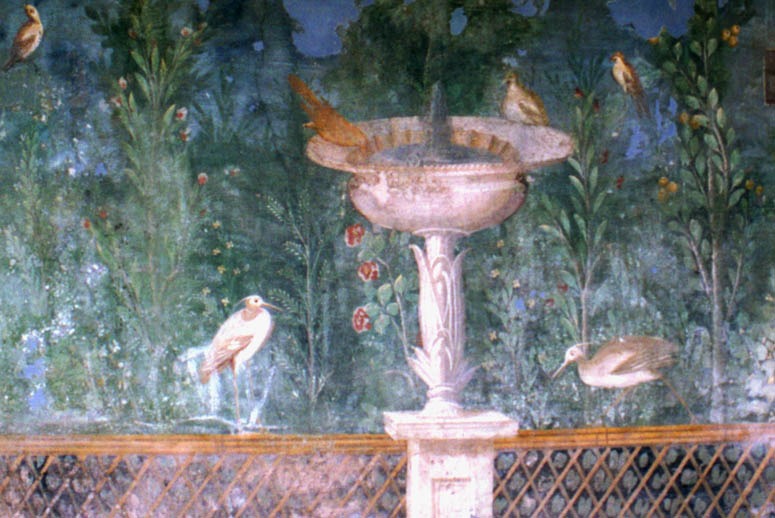
A Persian garden pavilion, with Ardashir and Gulnar

Ardashir with a slave girl, Gulnat

Ardashir with the slave girl, Gulnat, who loved him

I wish Iran would devote less effort to enriching uranium and more to enriching Iranian gardens and conserving  Persian gardens. Persia was one of the central powers in garden history, drawing upon and influencing Mesopotamia, Central Asia, India and Islam. My own modest proposal for conserving the Bagh-e Fin will be the subject of a future blog post.
Omar Khayyám (1048-1131), born in Nishapur, was an astronomer and a garden poet. The Rubiayat of Omar Khayyam, 1120 CE, begins:

I

Wake! For the Sun behind yon Eastern height
Has chased the Session of the Stars from Night;
And to the field of Heav’n ascending, strikes
The Sultan’s Turret with a Shaft of Light.
Awake Morning: For the sun behind yon eastern height.]
II
Before the phantom of False morning died,
Methought a Voice within the Tavern cried,
“When all the Temple is prepared within,
Why lags the drowsy Worshipper outside?”
III
And, as the Cock crew, those who stood before
The Tavern shouted – “Open then the Door!
You know how little while we have to stay,
And, once departed, may return no more.”
IV
Now the New Year reviving old Desires,
The thoughtful Soul to Solitude retires,
Where the White Hand of Moses on the Bough
Puts out, and Jesus from the Ground suspires.
V

Iram indeed is gone with all his Rose,
And Jamshyd’s Sev’n – ring’d Cup where no one knows;
But still a Ruby gushes from the Vine,
And many a Garden by the Water blows.

St Anthony’s Monastery, in Egypt, and the monastic gardening tradition

by Tom Turner @ 9:14 am January 14, 2010 -- Filed under: Asian gardens and landscapes,garden history,landscape and garden archaeology    Tags:


St Anthony's Monastry in Egypt

St Anthony's Monastery in Egypt


Saint Anthony (c 251–356) is known as ‘the Father of All Monks’. Athanasius wrote his biography and it spread monasticism in Western Europe. He was not the ‘first monk’ but he was a Christian ascetic who went into the wilderness. The present monastery was built (c 356) on his burial site and near his retreat. Its fortified character was a response to Bedouin attacks. St Anthony gave his father’s money to the poor and ‘shut himself up in a remote cell upon a mountain’  so that ‘filled with inward peace, simplicity and goodness’ he ‘cultivated and pruned a little garden’. Presumably, the garden was his food supply and the wilderness was the subject of his contemplation. This may well be the origin of a Christian approach to gardens, seeing them primarily as functional places – not as symbolic or luxurious places. Cloister garths belong to a different tradition: they are symbolic; they probably did not have a ‘use’; they became places of luxury. See posts on Certose Cloister, Canterbury Cloister, Salisbury Cloister and a hypothesis concerning the origin of Christian monasticism. Islam does not have a monastic tradition, though there are Dervish brotherhoods, possibly because the Arabs had sufficient experience of living in deserts.

(Image courtesy Miami Love)

A hypothesis concerning the origin of Christian monasticism and cloister gardens

An Indian Rishi or Yogi or Holy man

Indian Rishi or Yogi or Holy man, today and yesterday

It is known that Homo sapiens sapiens evolved in Africa and migrated into Asia but remained an entirely nomadic species until c10,000 BC. Christ was born in 1 AD and monasticism was unknown in Christianity until the end of the third century, with St Anthony of Egypt (251-356) one of the first Christian hermits. The practice of retreating into natural landscapes was much older. It is found in the Bon religion, in Hinduism and in Daoism. Buddhist monks developed monastic communities after 400 BC. One can therefore hypothesize that the roots of Christian monasticism extend back to the habit of retreating into the wilds in Central Asia, as does the architectural practice of arranging residential cells around a square of grass. It is likely that the central square space was a symbol of The Earth, just as a circle was  a symbol of Heaven. Should this hypothesis be correct, there is a powerful case for managing cloisters as green voids with grass and wild flowers. See posts on Certose Cloister, Canterbury Cloister and Salisbury Cloister. If correct, the hypothesis supports the contention that early cloisters were not used as gardens or for any kind of gardening activity.

(The left image is the cover of the Indian Gardens eBook. The right image is a montage of a rishi onto a photograph of Egypt).

Canterbury Cathedral and the social use of cloister gardens in English monasteries

by Tom Turner @ 9:12 am January 7, 2010 -- Filed under: Garden Visiting,Historic garden restoration,landscape and garden archaeology    Tags:
Canterbury Cathedral Cloister garden

Domestic use of Canterbury Cathedral Cloister is appropriate, but I do not think it should have been used as a graveyard


Canterbury Cathedral has beautiful cloisters. They were rebuilt in the fifteenth century on the site of the eleventh century cloisters built by Archbishop Lanfranc (c. 1005–1089) for Christ Church Canterbury. Lanfranc was born in Pavia (Italy) and brought to England by William the Conqueror. A water system was installed and a plan of the cloister drawn c1165. ‘This is a bird’s-eye view of the entire convent, drawn in accordance with the artistic methods of the time, and exhibiting the cathedral and monastic offices, viewed from the north. The water-courses are minutely shewn, with all their arrangements from the source to the convent, and its distribution to the monastic offices, supplying lavatories, cisterns, fish-ponds, etc., and finally flowing, in conjunction with the rain-water from the roofs and the sewerage of the convent, into the town ditch. As the drawing was probably made after the system was completed, we may for convenience assume its date at 1165, two years before the death of Wibert, and five years before the murder of Becket’. But what was the cloister used for? We can discover something from The monastic constitutions of Lanfranc By Lanfranc (Archbishop of Canterbury), trans David Knowles and Christopher Brooke:

p. 27 After their meal they shall sit in the cloister until the servers leave the refectory.
p. 35 There shall be a precession through the cloister as usual on Sundays.
p. 49 On Maundy… the cellarer and almoner and others appointed shall lead the poor into the cloister and cause them to sit
p.65 When all have received Communion the board shall be struck and the evening prayer take place. When this is done they shall go out into the cloister and wash their feet in warm water, and put on their day shoes.
p. 75 On Rogation Days… no sleep is taken in the afternoon… but at a fitting hour the masters shall waken the children as quietly as possible, and when these are reading in the cloister those who are still abed shall rise without delay p. 109 If it be an abbot who is received, he shall stand before the dore of the chapter-house and kiss the bretheren as they come out.
p. 131 Whossoever wishes to speak with the abbot, prior or any monk of the cloister shall use the guestmaster as his ambassador.
p.139 On other days when there is talking in the cloister, he who needs to he shaved may, by permission of the abbot or prior, be shaved in the cloister.

Note1: Technically, the ‘Cloister’ is the part of a monastery to which the public do not normally have access. The ‘Garth’, or garden, was the green space we now call a cloister.

Note2: in view of the appalling revelations of what catholic priests did to children in the 20th century, one worries about how much worse things were in earlier centuries. Rogation Days were set apart for solemn processions to invoke God’s mercy.


Triclinium Roman dining tables

by Tom Turner @ 8:10 pm November 22, 2009 -- Filed under: Garden Design,Garden Visiting,Historic garden restoration,landscape and garden archaeology   
A re-created Triclinium at Fishbourne Roman Garden

A re-created Triclinium at Fishbourne Roman Garden

How did they do it? Romans ate on ‘three couches’ (a triclinium) with a table separating them (see Wiki on triclinium). There is a garden re-creation of a triclinium at Fishbourne Roman Garden and one can find some photos on the web of students eating this way. When I first came across the idea, I assumed the couches were only for orgies, so that you could eat yourself sick and misbehave at will. But no, a triclinium seems to have been the normal way for wealthy people to eat. I tried arranging the sofa to eat in this way. It was not good for my digestion,  drinking was  difficult and I did not explore my earlier ideas. The only advantage I discovered was that if one was eating sloppy food without a knife or fork then it was easy to get one’s mouth vertically above the plate, as one still does for spaghetti. I remain puzzled, but here are some German students with a foodless triclinium and here is a painting of a Roman banquet.


Mass protest against Greenwich Park equestrian event

by Tom Turner @ 2:56 pm October 11, 2009 -- Filed under: Historic garden restoration,landscape and garden archaeology,News,public art   
Protesters shout SAVE GREENWICH PARK on 11 October 2009

Protesters shout SAVE GREENWICH PARK on 11 October 2009

We like to be first with the news. This photo was taken half an hour ago and we estimate there were over a thousand people in Greenwich Park on a wet afternoon, most of them horrified at the prospect of the damage the Olympic Equestrian Event would do to the Park. Those pounding hoofs and crowds of people would damage the Le Notre Parterre and endanger those wonderful old chestnut trees which do so much to feed Chinese chestnut pickers each autumn. See also: Restoration after 2012 Greenwich Olympic Equestrian Event and Olympic Village 2012.

Rescue garden archaeology before the Olympic equestrian event in Greenwich

by Tom Turner @ 5:39 pm October 5, 2009 -- Filed under: Historic garden restoration,landscape and garden archaeology   
The space in front of the Queen's House is the site of the only design by Andre Le Notre for a British park or garden. Le Notre was the greatest garden designer and landscape architect of the seventeenth century.

The space in front of the Queen's House is the site of the only design by Andre Le Notre for a British park or garden. Le Notre was the greatest garden designer and landscape architect of the seventeenth century. Archaeological research should be done before the land is sacrificed to the the 2012 Olympic horses.

Andre Le Notre was the greatest landscape architect of the seventeenth century and, many would say, of any century. He completed only one design in the British Isles. It was for a parterre in Greenwich Park, London. The current proposal is to use this parterre for the 2012 Olympic Equestrian. Two conclusions surely follow:

1) the parterre garden and its periphery should have a full rescue archaeology investigation before any work of any kind begins

2) the Le Notre parterre garden should be fully restored if the Equestrian Event takes place here, because horses and stadia damage land.

LOCOG, the London Organising Committee of the 2012 Olympic Games,  say:

- the ground is to be ‘improved’ and strengthened
– to soften the ground there will be some decompaction/aeration
– as part of recovery programme there will be reseeding or returfing
– tree roots would be protected with materials such as woodchip

What will improvement, strengthening, decompaction and aeration do the archaeological remains? They are no way to treat a site of Grade I Garden Archaeological Importance. The first step should be a non-invasive geophysical survey using a magnetometer. This can map buried building foundations (eg of fountain basins) and can even plot the location of pre-historic paths in certain circumstances. The Le Notre parterre was cultivated during the Second World War but (1) the cultivation is unlikely to have been deep (2) it may well have been limited to the flat area of the parterre (3) evedince may survive below the parterre and near Le Notre’s banks, which are the areas most likely to be damaged by the equestrian competition arena.

Let us hope English Heritage supports the call for an archaeological investigation before further damage is done.

Andre Le Notre's plan for the parterre in Greenwich Park, with handwriting in his own hand. The earthworks were implemented and survive in part. An archaeological investigation is necessary to discover the extent to which the paths were built, and what survives of them.

Andre Le Notre's plan for the parterre in Greenwich Park, with handwriting in his own hand. The earthworks were implemented and survive in part. An archaeological investigation is necessary to discover the extent to which the paths were built, and what survives of them.

The embankment forms part of Andre Le Notre's earthworks in Greenwich Park

The foreground embankment forms part of Andre Le Notre's earthworks in Greenwich Park

Capernaum House of St Peter and landscape archaeology

by Tom Turner @ 12:02 pm September 16, 2009 -- Filed under: context-sensitive design,landscape and garden archaeology   
The Octagon Church is a fine example of context-insensitive design, despite its octagonal shape

The Octagon Church is a fine example of context-insensitive design, despite its octagonal shape

When building a visitor centre on an archaeological site the best policy is assemble a group of experts and ask them to make a reconstruction of the original building. The worst policy is to invite a trendy designer to exercise his or her creative imagination. The Octagon Church at Capernaum shows ‘how not to do it’. The building dominates the ancient town. I find it no comfort at all that visitors can look through the glass floor and see the ruins of the octagonal church which the Byzantines built on the supposed ruins of St Peter’s House.

” According to Luke 4:31-44, Jesus taught in the synagogue in Capernaum on the sabbath days. In Capernaum also, Jesus allegedly healed a man who had the spirit of an unclean devil and healed a fever in Simon Peter’s mother-in-law. According to Matthew 8:5-13, it is also the place where a Roman Centurion asked Jesus to heal his servant… One block of homes, called by the Franciscan excavators the sacra insula or “holy insula” (“insula” refers to a block of homes around a courtyard) was found to have a complex history. ..The excavators concluded that one house in the village was venerated as the house of Peter the fisherman as early as the mid-first century AD, with two churches having been constructed over it (Lofreda, 1984).”  Info from Wiki. Photo courtesy kokorokoko

There is a great need for landscape architects to become involved with archaeological sites. They are far too important to be left to the care of archaeologists.

Glastonbury Tor as a sacred landscape

by Tom Turner @ 6:27 am August 31, 2009 -- Filed under: landscape and garden archaeology   
Glastonbury Tor Sacred Landscape

Glastonbury Tor Sacred Landscape

Glastonbury Tor is a sacred place, in the same region (the Somerset Levels) as the oldest engineered road in north Europe, the Sweet Track (tree-ring dating establishes the construction date at 3806 BCE). Physically, Glastonbury Tor resembles Silbury Hill. My  view (see evidence below) is that it has been a sacred site since Neolithic times. European Christianity grew in opposition to paganism, banning garden luxury and felling sacred trees, but was willing to take advantage of the sacred sites and to use them as sites for church building. We can therefore see some connection with the animism of Central Asia and the custom of building temples on hills and mountains.

The National Trust conservation statement for Glastonbury Tor summarizes what is known of Glastonbury Tor’s history as follows:

1.2. RESEARCH AND CURRENT UNDERSTANDING OF THE SITE
Later Neolithic 2900-2200BC, flint and stone artefacts found from this period. later Bronze Age 1400-600BC. Very little known about this period. Romano-British 43AD-410AD. Prehistoric and Roman finds- early and late Roman pottery.
Dark Age centred on 600 AD, timber building, evidence of metal workings, substantial metal working, Roman Samian pot shards.
Late Saxon-early Medieval 600-1066 AD, monastic settlement, possible wooden church.
Medieval 1066-1485 AD, two or more successive stone churches on summit. Priest’s house and other buildings on shoulder.
Tudor 1485-1603. Very little known about this period.
Stuart 1603-1714. Very little known about this period.
Hanover 1714-1901, rebuilding of the tower in 1848. The 1821 rates map and 1844 tithe map show Tor field (the lower enclosed fields?) were used for arable crops well into the 19th century. St Michaels Tower restored.
1933 National Trust acquires Tor field with St Michaels Tower.
1948 further restoration works on the St Michaels Tower.

Stonehenge theories revisited


Stonehenge Sunrise June 22nd 2009

Stonehenge Sunrise June 22nd 2009

The paperback version of Rosemary Hill’s Stonehenge has just come out. In this witty and erudite volume she unpicks the various theories of the purpose of the stones and shows how they “say more about the theorists and their time than the place itself”. http://www.amazon.co.uk/gp/product/1861978804/ref=sib_rdr_dp

Like Pevsner and among many others I have shared Tom’s disappointment in visiting Stonehenge in the middle of the day with a thousand other tourists, and have done the same visit only once since we were no longer allowed to have picnics on the sacrificial stone.  And no one can tell me that it is not indeed a sacrificial stone, since my own time and place meant I was brought up with the romantic view of Stonehenge as described by Clive King’s immortal ‘Stig of the Dump’. In it the time-misplaced caveman Stig who lives in a chalk pit, leads our adventurous hero out of his long summer holidays and back in time to witness Stonehenge one Midsummer’s Eve. The sense of time and timelessness of the stones are ingrained via the experience of childhood.

It is in the moonlight or early morning that the stones look at their most magical, or in the drama of a storm as portrayed by Turner. One must go out of hours. The only way to visit Stonehenge in my view is then to keep your romantic beliefs, and in the current layout to keep your distance. One must see it without the crowds; the coaches and concessions; barbed wire and information panels – (the latter soon to be redone by English Heritage’s ‘intellectual access scheme’ which apparently involves rewriting all information so that it can be understood by someone with the reading age of ten.)

One of the best views of the Stones and the settings is from the footpaths behind Countess Farm, on the Amesbury roundabout. Walking up behind the Kings Barrows and looking out along the Avenue you get the sense of scale and grandeur which makes the whole plain feel like a cathedral nave with the stone circle as the trancept. One of the fairly recent proposals was to have the visitor centre at Countess Farm, with pedestrian access to the stones from there. This would be a brilliant way of regaining the atmosphere of the place, with the half mile walk allowing the time and space to feel the sense of place. The cars and coaches would be out of the view too. We would then just need to get rid of the barbed wire.

At the poet and philosopher John Michell’s memorial service last month was read this poem:

How Lord Montagu Gave Stonehenge to the Freemasons

By John Michell, Midsummer 1988

WHEN philanthropic Mr Chubb gave Stonehenge to the Nation

(He’d bought it just before he made this generous donation)

He laid down two conditions: public access as of right

And nothing to be built nearby to mar the sacred site.


The answer to these clauses form the government Trustees

Was ‘Bother Mr Chubb, we’ll do exactly as we please.

A few more buildings round Stonehenge aren’t really going to spoil it,

Beginning with a carpark and a gents’ and ladies’ toilet.


The Commissioners of Works who were the first administrators

Were succeeded by another bureaucratic apparatus

Entitled ‘English Heritage’, and what these people do

Is bugger up historic sites; their head’s Lord Montagu.


They made a fence of steel and wire which everyone bemoans

And dug a concrete tunnel from the carpark to the stones.

No one is permitted now to walk inside the ring

You’re kept behind some ropes so you can hardly see a thing.


There used to be a festival to greet the summer sun

And people would assemble there as they had always done.

In 1985 we saw the end of that tradition

Lord Montagu decided on its total abolition.


But ever since he ordered that the festival should cease

Stonehenge has been surrounded by an army of police,

And if you try to join them they get terribly excited

And tell you that it’s private and you haven’t been invited.


Now, I’m not the sort of person who’ll impetuously hasten

To spread the word that every single policeman’s a Freemason,

But many of them are you know, and here’s the subtle dodge;

Stonehenge has now been proved to be an old Masonic Lodge.


The person who revealed this – and he certainly should know-

Is Mr Russell Herner of the Grand Lodge, Ohio.

His book about Stonehenge says it was built for all eternity

To house the Master Mason and the rest of his fraternity.


So when upon the longest day, St John the Baptist’s Feast,

You see a group around Stonehenge who gaze towards the East,

They’re not just simple coppers spoiling other people’s fun,

They’re members of the brotherhood out worshipping the sun.

Perhaps there was a senior officer at the memorial, for we learn this week that all pagan police officers are to be given time off to celebrate the Summer Solstice. And all witches in the force are to be given Halloween for religious parity. Who will police the solstice then?


« Older PostsNewer Posts »