The strange re-birth of liberal England has not reached Windsor Great Park, yet

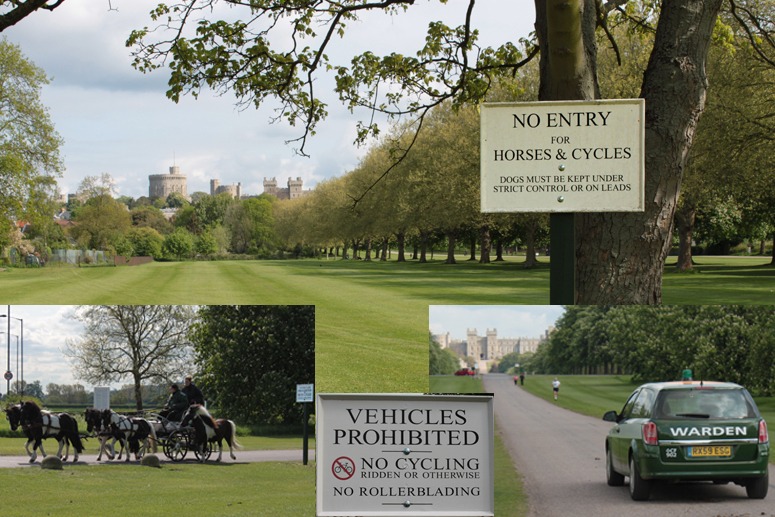
No Vehicles and No Entry for Horses and Cycles onto the Long Walk in Windsor Great Park

No Vehicles and No Entry for Horses and Cycles onto the Long Walk in Windsor Great Park

I re-visited Windsor Great Park on the day, in May 2010, that Britain got a Liberal-Tory government and tried to ride my bike along the 4.26 km Long Walk. A flunky dashed out and told me to stop it. I offered to push the bicycle. He said this was forbidden. ‘Why?’ I asked. ‘The Queen doesn’t like cyclists’, he told me. ‘I think I’ll become a republican’, I told him. ‘Me too’ he said. In the course of a long stroll up the Long Walk I noticed the above signs and was overtaken by many vehicles, including picturesque horse-drawn carriages, for paying guests, and a fleet of warden’s cars with no apparant purpose other than ridding the realm of pestilential cyclists. Those with money and power lord it over the poor plebs who pound their own pedals. ‘Twas ever thus’ you might think.
But there is hope for the future: our current Prime Minister (David Cameron) and the current the Mayor of London (Boris Johnson) are both cycle commuters – and it is hard to see Prince Charles as anything other than a postmodern liberal tory. Nick Clegg could buy a bike too. It’s a pity about the Queen but she does belong to another era and Windsor Castle remains the best symbol of what the best historian of French Gardens (Kenneth Woodbridge) saw as the Norman strand in British life. The Normans conquered England in 1066 and despite their origin in a tribal and pagan region (Scandinavia), what they brought to England was the centralist administration and palace civilization of West Asia (as modified by the Macedonians, the Romans, the Franks and the French). This may add up to a historical justification for banning cyclists from Windsor Great Park. But I hope Prince Charles removes the ban, when and if he acceeds to the British throne. It was the Norman Tendency which converted Anglo-Saxon-Viking England into the imperial power we know as Great Britain and it remains the case that more-recent immigrants think of themselves as ‘British Asians’, ‘Black British’ etc rather than ‘English Asians’, ‘Black English’ etc. ‘Civis Britanicus sum’ may be embedded in their psyches. Though also descended from immigrants, I feel more English than British – possibly because I do not like imperialism. Dunno.
Historians may view the UK’s 2010 election as a key event in the re-birth of the Liberal England. George Dangerfield said it had died (in a 1935 book on The Strange Death of Liberal England). Re-birth would please admirers of John Locke, John Russell, William Cobbett, William Gladstone and David Lloyd George. And it would please me. Liberalism is the grand theme of English politics – and of English garden design in the last 3 or 4 centuries. The best garden and landscape design has often had political themes. So it is very appropriate that English liberalism was reborn in a rose garden – despite the irony of roses being associated with Mary Gardens, Medieval Marianism and Catholic Toryism.

‘What passes for optimism is most often the effect of an intellectual error.’

Note The word ‘warden’ reached England in the early 13th century. It means ‘one who guards’ and derives from the Old Norman French wardein and from the Frankish warding, which derives from wardon ‘to watch or guard’. In about 1300 warden came to mean ‘governor of a prison’.
At last – a use for British rose gardens

The sweet smell of roses may be improving British politics

The sweet smell of roses is improving British politics

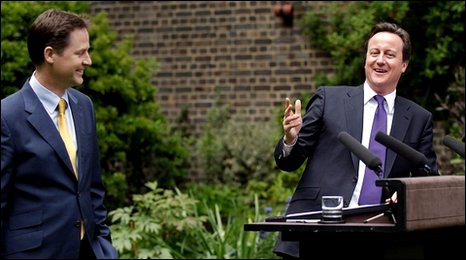
Marvellous that rose gardens are heralding a new age in British politics. Having found the perfect place for ‘getting into bed together’, Nick Clegg and David Cameron consumated their marriage in the garden of 10 Downing Street (after the 2010 UK Election). John Major thought that if the White House had a rose garden then Downing Street should have one too – so the name was changed. These days, a rose garden is more likely to give one a seat at the top table than an independent nuclear deterrant. The political stench has been foul for most of my life, so my hope is that many future political events will take place in thornless rose gardens. One worry though – there are no roses. As I often remark, good garden design requires good garden designers.

Sustainable management of grass in Islamic gardens

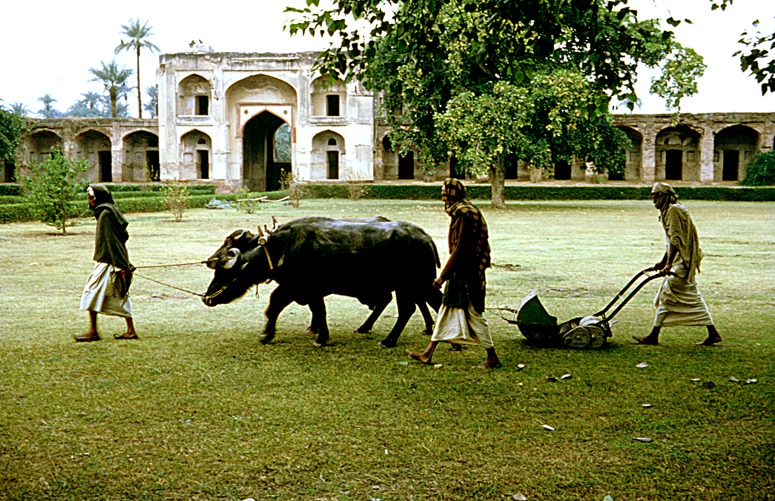
Sustainable management of grass in Islamic gardens This lovely photograph was taken by Michael Lancaster c1968. My first thought, on finding it this morning, was that is showed a sustainable approach to cutting grass. But do the water buffalos emit more C02 than the small amount of hydrocarbon a motor mower would use? Perhaps. But the buffalo C02 would be endlessly re-cycled and the fossil hydrocarbon would be transferred from the earth’s crust to the earth’s atmosphere. Another point evident from Michael’s photograph is that this is not how the greenspace should be managed. It ought to be a lush area of fruit and flowers.

Gazing on planet Earth

If we are not really that sure what is going on with our planet right now – that is not surprising! Just looking at the earth from a distance, even in a satelite photograph is an awesome experience. Add to that the sense that in an unknown galaxy – even on the moon – there are unknown possibilities… and you have fertile ground for a new generation of sci-fi movies about saving the planet from global warming.

Perhaps the middle of the GFC is not the right time to be thinking about space exploration and solutions to a crowded resource poor planet. But perhaps it is the right time to be doing some of the thinking about other planets if not the going. The atmosphere of Mars it is said to be 95.32% carbon dioxide. Yet, sometime in its past it is believed that Mars did support life – fishes, reptiles, birds, small water snakes, microbes etc (even if they were 1/3 the size of ours here on Earth.)

Clearly life on Mars did not die out because of anthropogenic global warming….so what went wrong?


The Landscape Man: Matthew Wilson at Chevington

I was about to give up on the Landscape Man series with the remark that if it had achieved nothing else it had at least proved that you are very unlikely to get a good design if you do not employ an experienced designer. It was therefore a relief to find that ‘property developers Clive and Debbie’ were employing a garden designer, Thomas Hoblyn, to help spend £250,000 on a garden for their old rectory in Suffolk. Tom’s training is actually in horticulture, but this need not be a hindrance – and if the individual has design in his or her blood, the knowledge of plants can be useful.
Clive seemed a pretty hard nut but I had to agree with his scepticism about the use of decking in a cold wet climate. Why do it? Tom Hoblyn seemed to be proposing it on the grounds that it had helped him win a Silver Medal at Chelsea in 2009. Part of the design concept was in fact to bring the Chelsea Garden to Chevington and there is a long tradition of re-cycling Chelsea gardens. I sometimes wonder if it should be a requirement for all Chelsea gardens. So was the design a success? Not really – but it was the best garden design in the series so far. The problem is that it was merely a blown up Chelsea garden – slick-ish but conceptually vacant. You can’t just pile in features and expect to have a whole which is more than a collection of parts ‘Rose garden’, ‘Formal lawn’, ‘Hornbeam Hedge’ etc. Clive seemed to think that perfection of execution would do the trick. Its a good thing to have but, like the assembly of features is not enough. One also needs imagination, creativity and taste.
PS a curious feature of this series is that Matthew Wilson has managed to pick up so many of Kevin McLeod’s speech mannreisms. Is Kevin doing a voice over?

Melting away in time

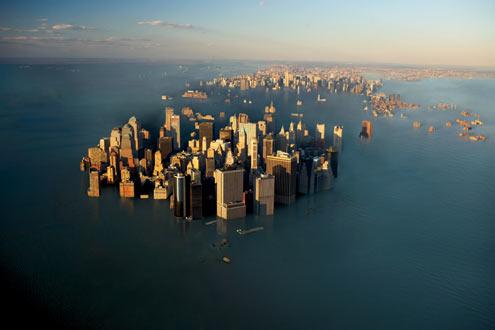
Some predict that as the polar ice caps melt major cities such as London, New York and Bangkok will be flooded.

How are we to determine if such a future is in store? And how quickly it might become reality?

To understand the likelihood of such an event, and perhaps how quickly it might be likely to occur – some understanding of the historical  and contemporary geological setting of the cities is useful.

It is believed that the continent of Britain was formed some 200,000 years ago during a megaflood event.

What is happening today? Does the eruption of the Eyjafjallajokull volcano have any relevance for Londoners apart from air traffic disruption?

(Geology experts most welcome to comment!)