Category Archives: Urban Design

Trafalgar Square as a garden

trafalgar-square31


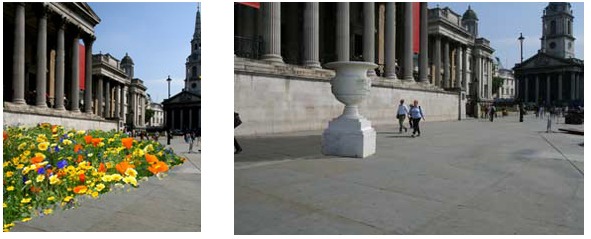
Charles Barry’s design for Trafalgar Square was inspired by the gardens he had seen in Italy and designed in England (including Shrubland Park and Trentham Gardens). In essence, Barry followed Repton’s theory that an important building, like the National Gallery, should be fronted by a terrace. The original idea for a Square in this position had come from from Humphry Repton’s partner (John Nash). A traffic island for 150 years, the Square was rescued by Normal Foster’s part-pedistrianization scheme of 2003. The point Fostor neglected is that garden squares should have flowers.

My suggestion is to grow the flowers in pots and arrange them on the great sandstone slabs in front of the National Gallery. When the space is required for another purpose, the pots can be moved.

If the authorities won’t permit  a radical transformation, perhaps they would allow a Classical Vase to stand in front of the National Gallery.

Pathways


image0021

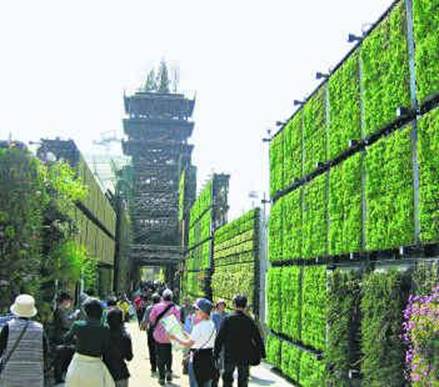
Perhaps our expectations of urban ‘greenspace’ are about to change? This photograph was taken at the AICHI Bampaku expo held in Japan’s Nagoya City in the Aichi Prefecture and published in the Hindu Business Line. The purpose of the Expo was to “generate awareness on issues of pollution, global warming and energy use.”

It raises an interesting question. How far do we want go down the technology route and how far do we want to go in being smarter about how we do things? Perhaps there is a middle way between the two alternatives? How should designers respond to the twentyfirst century challenges of carbon trading and carbon sequestration?


Will Alsop Martha Schwartz debate landscape architecture

Having criticized Martha Schwartz and long considered Will Alsop the ‘Clown Prince of Architecture’ I was curious to hear them discuss Alsop’s philosophical notion that ‘No landscape architect should ever get hold of these [landscape] commissions because they have completely institutionalized the idea of public space’. As you can see, Alsop’s main complaints against the landscape profession are (1) there are too many about  (2) they do not know their trees (3) they are doing too much urban design and master planning (which Alsop would rather do himself?).

Schwartz does a passable job of defending her turf but eventually blurts out the truth ‘You and I are very much alike in how we work’. It would also be interesting to hear Hitler and Stalin debating the philosophical notion that ‘Dictators should never be allowed to run countries’. They might even have agreed to design a Satellite Town – in Poland.

I was sorry to hear Schwartz slagging off garden design. It is a fine art of the highest order and it has laid the basis for the world’s most admired urban designs: Isfahan, Rome, Paris, Georgian London, Beijing and Washington DC. I would also like to refer them both to my proposed definition of landscape architecture.

Can anyone dispute that buildings must be designed in relation to landform, water, planting, and paving? Or that outdoor space should be beautiful, ecological and and socially useful? Are architects or landscape architects able to achieve this? Some are; some are not. Martha Schwartz seems better at aesthetic composition than at dealing with social and ecological issues. Alsop is a bozo: all sop with a dash of pop.

Greenways and Green Infrastructure

Noticing that the Landscape Institute (LI) has produced a draft policy statement on Green Infrastructure which does not contain the word Greenway, I did Google searches on the two terms. The results were:

This inclines me to the view that, at present, the Greenway Concept has more public visibility. There are three problems with the Green Infrastructure Concept: (1) the literature is thin (2) it is unclear whether “green” means “vegetated” or whether it is used as in “green politics” (3) the term “infrastructure” is much better understood by the built environment professions than by the general public. London has many greenways.  Some are excellent and others in urgent need of better landscape planning and design.

A landscape of ambiguity

wine_bar_landscape2

Here is an approach to creating a space. This is just the first post…so watch the design develop in this blog space… I am not able to visit the site, so I may be using considerable creative license! (Anyone who knows the site is welcome to assist me.)

FIRST MOVEMENT

The initial idea was to acknowledge the bleak surroundings [See Tom’s post ‘Barking Town Square’s Elder Brother‘] and compliment them with fine elements: crystallized glass and an enclosing wall of screens. The colour accent is an iridescent blue. This is to illuminate the night sky and to connect with colours in the deepest ocean. Warmer tones of apricot and honey-wood are used to balance the cool colours. At present they will be used to theme the day time appearance of the space with naturals and neutrals. Planting is used to soften the space and to define different sections, giving privacy and a sense of ambiguity as to whether the space is inside or out. The furniture is comfortable and modern. The sound mood is set by the music of the string quartet – a leisurely evening pace for sipping wine and conversation.

SECOND MOVEMENT

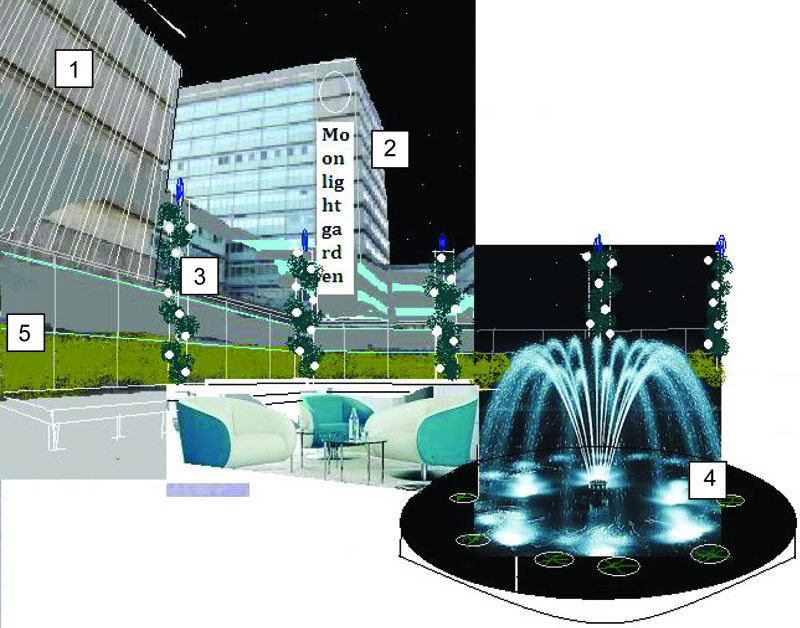
The space is a moonlight garden or Moon Garden. All planting is white. At present the screens may be 1) actual visual screens in which case they can display any scenery or create any mood OR they may be 2) a projective surface OR 3) merely a textured surface. Conceptual elements further define the space.

1. A water curtain on the side of the building suggests a water fall over a cliff face – and can be used for visual screenings.

2. Vertical signage on a building identifies the space.

3. Vertical planting also provides perimeter lighting. [This element is inspired by the Great Beech Hedge at Miekleour – height – and Stefan’s blog.] The aesthetic is not literal… I am aiming for ‘ultra contemporary’…so we have a way to go! [I was thinking Stefan might help here.]

4. A central water feature, with a black base [see Ethel Anderson’s article on Moon Gardens], has an active inner pool and and a passive outer pool with planting. The outer pool is a flat rim; and the inner pool has with a wide but shallow V-sloped basin in solid stone.

5. There is perimeter bench seating – possibly white.

THIRD MOVEMENT

Outdoor spaces have a long existence – which is a preferred as a sustainability strategy. The design is conceived as a semi-public semi-park. It functions at night as a wine bar and during the lunch hour as a formal cafe space. The park elements need to be considered as permanent. While the cafe elements are temporary.

There can for example be:

1. Exterior paving AND a removable wooden platform with rubber inlay for wine bars etc.

2. Permanent public lighting and seating for a Moon Garden.

3. Removable task specific lighting for the wine bar and seating islands.

4. Removable commercial seating islands for wine bar patrons.

5. Permanent planting for the Moon Garden.

6. Removable planting for lunch venues/wine bars.

The space should be ambiguous: is it landscape or architecture; is it interior or exterior? Is it for day or night? Is it a park to be in or a space to eat in?

Landscape architecture and urban design

A friend with enviable portfolio of major projects, says that ‘We have to call ourselves urban designers to get the work. But we have to employ landscape architects to get the work done’. Another friend who spent many years teaching urban design to architects, planners and landscape architects remarks that ‘the landscape architects were the best’. 

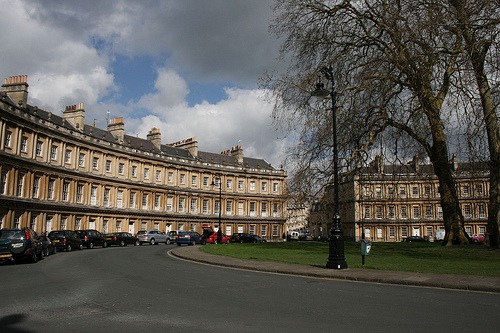
The Circus in Bath (UK) is a fine example of architecture+landscape but the idea (from John Wood) was of course inspired by Bramham Park (photograph of The Circus courtesy Casey Picker).

One can easily understand why the name ‘landscape architect’ is such a non-starter for clients. Most of them think landscape architects must either be garden contractors or the  artistic inheritors of Capability Brown. So why should they be so good at urban design? I think it is because they are trained to think about SPACE rather than about the OBJECTS WHICH CONTAIN AND DEFINE SPACE (buildings, walls, trees, mounds etc).  In urban design it is good practice to think about what type of space is required BEFORE thinking about what elements can be used to contain and define the space. As Laozi wrote:

Thirty spokes share a single hub,
And the central void makes the cartwheel useful.
Clay is moulded into a vessel,
And the empty space makes it valuable.
Doors and windows are cut out in the walls,
And these openings make the room livable.

Were Laozi to visit Bath he might comment that:

The central void makes The Circus useful.
Buildings are moulded into a vessel. 

Or would he have noted that The Circus is more Visual Space than Social Space and remarked  that landscape+architecture= urban design?