
Category Archives: Asian gardens and landscapes

Urban landscape design in Dharavi, a Mumbai slum

The urban landscape of Dharavi, MumbaiKevin McLeod has shifted his gaze from Castleford to Dharavi. Properly critical of the sanitation, he finds much to praise in its community spirit and, like Slumdog Millionaire, criticizes the Bombay policy of trying to move the residents into Corbusian blocks of flats. He finds Dharavi as a happy place where everyone lives together and works together. Most people work within Dharavi so little money wasted on commuting. Kids don’t wear hoods and mug old ladies, because they have work to do. The crime rate is extremely low becuase everyone knows what everyone is doing. Dharavi is in fact like a medieval European town. We got rid of them in the mistaken belief that ‘foul air’ (rather than foul water) was causing infectious diseases. Now that this mistake has been cleared up, we should rid the world of highway regulations and let people build dwellings on narrow lanes if that is what they want to do.  Dharavi is sustainable and will survive unless the police clear it.

I remember spending a morning in a Roman town on the south coast of Turkey. There were no residents and no visitors. It was empty. One day, Dubai will be like this. The owners should have learned something from the Indians about sustainable urban design, instead of paying them peanuts to build Chicagos on the the Gulf.

(Image courtesy markhillary)

Note: Dharavi rhymes with laramie

St Anthony's Monastery, in Egypt, and the monastic gardening tradition


St Anthony's Monastry in Egypt

St Anthony's Monastery in Egypt


Saint Anthony (c 251–356) is known as ‘the Father of All Monks’. Athanasius wrote his biography and it spread monasticism in Western Europe. He was not the ‘first monk’ but he was a Christian ascetic who went into the wilderness. The present monastery was built (c 356) on his burial site and near his retreat. Its fortified character was a response to Bedouin attacks. St Anthony gave his father’s money to the poor and ‘shut himself up in a remote cell upon a mountain’  so that ‘filled with inward peace, simplicity and goodness’ he ‘cultivated and pruned a little garden’. Presumably, the garden was his food supply and the wilderness was the subject of his contemplation. This may well be the origin of a Christian approach to gardens, seeing them primarily as functional places – not as symbolic or luxurious places. Cloister garths belong to a different tradition: they are symbolic; they probably did not have a ‘use’; they became places of luxury. See posts on Certose Cloister, Canterbury Cloister, Salisbury Cloister and a hypothesis concerning the origin of Christian monasticism. Islam does not have a monastic tradition, though there are Dervish brotherhoods, possibly because the Arabs had sufficient experience of living in deserts.

(Image courtesy Miami Love)

A hypothesis concerning the origin of Christian monasticism and cloister gardens

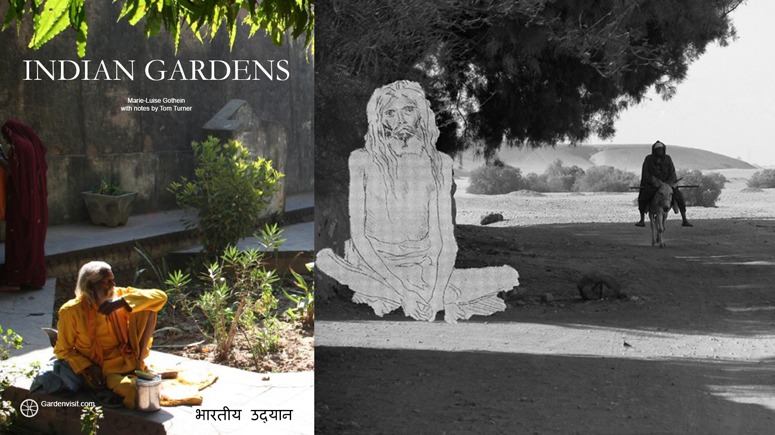
An Indian Rishi or Yogi or Holy man

Indian Rishi or Yogi or Holy man, today and yesterday

It is known that Homo sapiens sapiens evolved in Africa and migrated into Asia but remained an entirely nomadic species until c10,000 BC. Christ was born in 1 AD and monasticism was unknown in Christianity until the end of the third century, with St Anthony of Egypt (251-356) one of the first Christian hermits. The practice of retreating into natural landscapes was much older. It is found in the Bon religion, in Hinduism and in Daoism. Buddhist monks developed monastic communities after 400 BC. One can therefore hypothesize that the roots of Christian monasticism extend back to the habit of retreating into the wilds in Central Asia, as does the architectural practice of arranging residential cells around a square of grass. It is likely that the central square space was a symbol of The Earth, just as a circle was  a symbol of Heaven. Should this hypothesis be correct, there is a powerful case for managing cloisters as green voids with grass and wild flowers. See posts on Certose Cloister, Canterbury Cloister and Salisbury Cloister. If correct, the hypothesis supports the contention that early cloisters were not used as gardens or for any kind of gardening activity.

(The left image is the cover of the Indian Gardens eBook. The right image is a montage of a rishi onto a photograph of Egypt).

Zen: garden as house

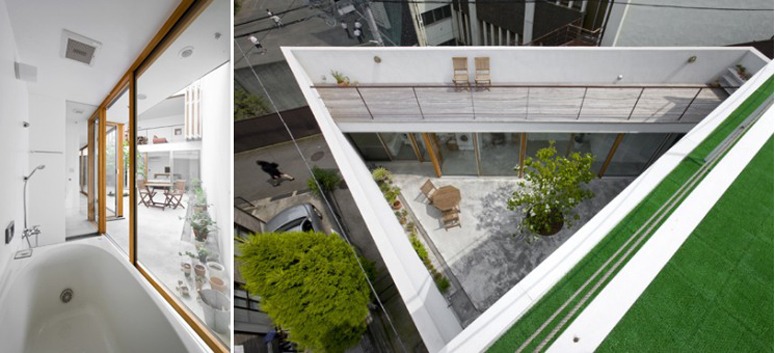
the-garden-house1

http://www.archtracker.com/the-garden-house-takeshi-hosaka-architects/2009/04/

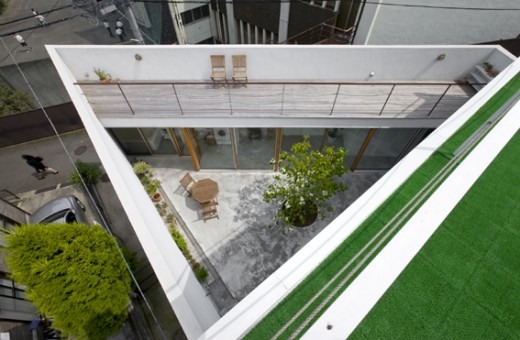
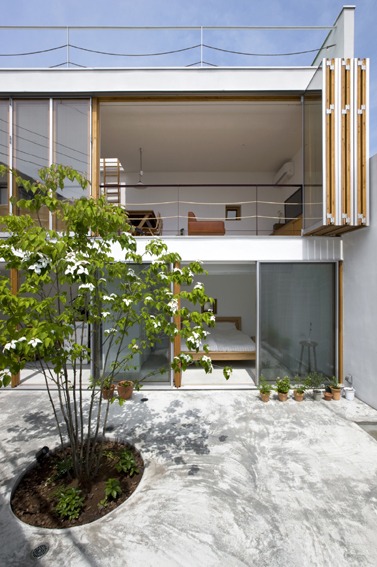
Apart from what looks what looks unfortuneately like artifical turf on the roof – the Garden House by Takeshi Hosaka Architects with its tight triangular plan is a surprise and delight! Definitely a garden for my soul! The living spaces are designed around the edges of an enclosed garden courtyard, cleverly stacked and arranged to take advantage of every square mm of space, create privacy and capture views. In the photographs the garden is very young…it would be fantastic to revisit the house as the tree grows and the potted garden matures.

If you can’t resist viewing more  maybe a trip to Japan is in order…


First entries for Tiananmen Square Landscape Architecture Competition

Witney Hedges entry for the Tiananmen Square competition would be invisible by day and spectacular after dark

Witney Hedges entry for the Tiananmen Square competition would be invisible by day and spectacular as dusk turns to dark

The landscape architecture compeition for Tiananmen Square was announced in March 2009 and, seven months later, we are pleased to see the first entries coming in. There are still eight months to go (till June 2010) and we hope for many more. All the competition entries can be seen on Flickr, because it is a Web 2.0 design competition.  A Chinese commentator has said, in effect, ‘leave Tiananmen Square as it is: it is a ‘holy place’ belonging to the PRC and foreigners should leave it alone’. I can understand this attitude! – but the conclusion that ‘nothing should ever change’ does not follow and two of the early entries. from Witney Hedges and Henrychung, go for a ‘sensitive intervention’ approach which leaves the use and spatial character of the Square very much as they are today. Other entries, perhaps inspired by the famous Chinese architect Ma Yansong, go for a radical greening of the space. My own view is that all options should be considered and that they should be discussed both within China and outside China. Civilization, to which China has made an inestimable contribution, belongs to the whole world, not to a group of people who occupy a small geographical zone for a short period in time: they have the right and the power to decide but they can and should welcome debate.

Eroticism in garden art and design

song_of_songs_solomon2

This chaste and charming engraving does not do justice to what is widely regarded as the most beautiful and the most erotic poem in world literature: the Song of Songs (or Song of Solomon) from the Old Testament of the Bible. Its beauty comes from the genius of the poet, who might have been King Solomon. Its eroticism comes from treating the garden as a locale for sex and a metaphor for the female genitalia. Exploration of these themes has delighted generations of scholars and produced a vast literature. Here, in the King James version, is the section of most interest to gardeners:

12     A garden inclosed is my sister, my spouse;          
a spring shut up, a fountain sealed.
13     Thy plants are an orchard of pomegranates, with pleasant fruits;           
camphire, with spikenard,
14     spikenard and saffron;           
calamus and cinnamon,
with all trees of frankincense;
myrrh and aloes,
with all the chief spices:
15     a fountain of gardens,           
a well of living waters,
and streams from Lebanon.
16     Awake, O north wind;           
and come, thou south;
blow upon my garden,
that the spices thereof may flow out.
Let my beloved come into his garden,
and eat his pleasant fruits.

The influence of these famous lines on garden design has been profound. In Europe this came about through the Roman de la Rose and its influence on the design of enclosed gardens. The Song of Songs is also likely to have influenced the Qu’ranic account of the delights awaiting the faithful in paradise, which are far from chaste.