Category Archives: Asian gardens and landscapes

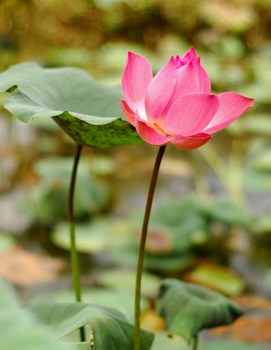
The sacred lotus, Nelumbo nucifera, is the Flower Sermon and the holy flower of West, South and East Asia

Nelumbo nucifera, the Sacred Lotus, is an important symbol in Asian gardens

Nelumbo nucifera, the Sacred Lotus, is an important symbol in Asian gardens

Zen Buddhism grew from the Flower Sermon and thus from the growing habit of the Sacred Lotus, Nelumbo nucifera. Towards the end of his life, the Buddha took his disciples to a pond, possibly in the Jetavana. They were expecting a sermon but the Blessed One only pulled a lotus flower from the waters and held it before them, its roots dripping mud. Holding it before Mahakashyapa, he told the group:

‘What can be said I have said to you. What cannot be said, I have given to Mahakashyapa.’

Mahakashyapa became Buddha’s successor. The Sacred Lotus has importance in Buddhism because it grows from murky waters and struggles to raise its pure and beautiful flower into the sunlight, with the lesson that humans should do likewise.  Asians thought this was a truth worthy of contemplation – leading to Zen Buddhism. The lotus was also a sacred flower in Ancient Egypt and, probably through the influence of Buddhism, became sacred in China, Japan and South East Asia.

Perhaps we will be able to grow the lotus outdoors in London when global warming has gone a little further – but the winter of 2009-10 is not pointing in this direction. Meanwhile, I am wondering if I could rig up a solar panel to keep a tub warm enough for the lotus. But we would need more sunlight for this to work.
Chinese garden history, garden types and garden historians

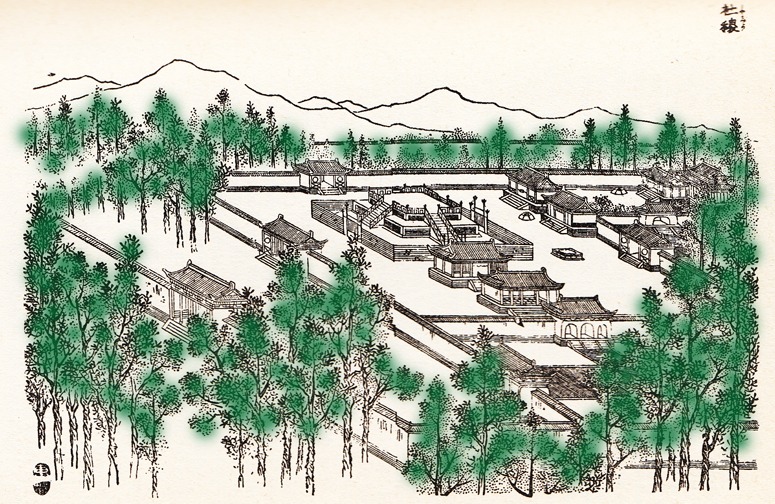
Altar of Land and Grain in Zhongshan Park

The Altar of Land and Grain (now Zhongshan Park or the Sun Yat-Sen Memorial Park in Bejing) had what western historians call a 'formal' layout. It is neither the garden type nor the design style which features in histories of 'the' Chinese Garden.

There is a regrettable tendency for garden historians to write about the Chinese Garden as though it were one thing which was invented about 5000 years ago, which was made for a single purpose and which has never changed. It puts one in mind of Edward Said’s comment on Orientalism (regarding the Middle East). He wrote of “a misrepresentation of some Oriental essence — in which I do not for a moment believe”. We are therefore pleased to publish a classification of Chinese garden types by Xiaomin Wu. The next stage in developing a systematic history of garden design in China should be to trace the evolution of each of these types through the millennia. This should be done in parallel with studies of the influence of Chinese gardens on neighbouring countries and the influence of neighbouring countries on China. One of the many neglected aspects of Chinese garden history concerns the influence of Buddhism. Maggie Keswick, who wrote by far the most influential western book on Chinese garden history, scarcely mentions the subject.
Another puzzling aspect of Chinese garden history is that it is normally studied without reference to Japan or Korea. To me, this is like writing compartmentalised histories of French and Italian gardens or of Italian and English gardens. It should not be done. With regard to China, Japan, India and Korea, part of the explanation is that the countries were not friendly during the twentieth century – American garden historians have considered the influence of Chinese on Japanese gardens, but they have given far more attention to Japan than to China or India or Korea.
The Altar of Land and Grain (now Zhongshan Park and the Sun Yat-Sen Memorial in Bejing) (drawing above) had what western garden historians call a ‘formal’ layout’. It is neither ‘the’ garden type nor ‘the’ design style which features in histories of ‘the‘ Chinese Garden.

Adam, Eve and planting design in the Garden of Eden

What type of plants grew in Eden, apart from apples and figs?

What type of plants grew in Eden, apart from apples and figs?

Apart from fig leaves, bougainvillia and sin, what was planted in the Garden of Eden? We can say little  about the layout  but something about the location and something about the planting design. It may be argued that ‘every tree that is pleasant to the sight, and good for food’ (Genesis Chapter 1) meant those plants which grow wild, while the the Garden of Eden (as described in Genesis Chapter 2) might have contained only those plants that grow as a result of cultivation. Cultivated varieties of plants have existed since approximately 10,000 years ago the description of the Garden of Eden in Genesis took its final form approximately 2,500 years ago, when the distinction between wild and cultivated species was well known – though its scientific origin was of course unknown.
On the wider question, we should consider whether Adam and Eve were wrong to seek knowledge – and whether we are wrong to continue the quest. George Steiner wrote, in Bluebeard’s Castle, that ‘We cannot turn back. We cannot choose the dreams of unknowing. We shall, I expect, open the last door in the castle, even if it leads, perhaps because it leads, on to realities which are beyond the reach of human comprehension and control.’ He thought it possible that humanity is engaged on an endless quest for knowledge and that, as in Bluebeard’s Castle, opening the last door will lead to doom.
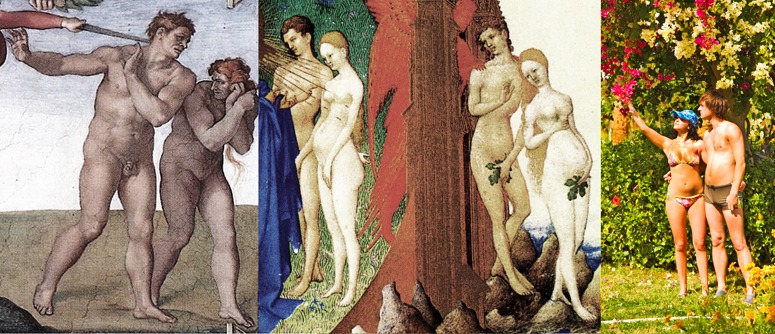
And is humanity descending ever-further into a morass of sin? I hope not – but Eve on the left (by Michaelangelo) does not look as though she has been leading the good life and Adam on the right looks emasculated as a result of eating too much factory-farmed chicken. I prefer the medieval Adam and Eve (from the Très riches heures) and believe that the planners and designers of more sustainable ways of living have much to learn from the middle ages and medieval gardens.

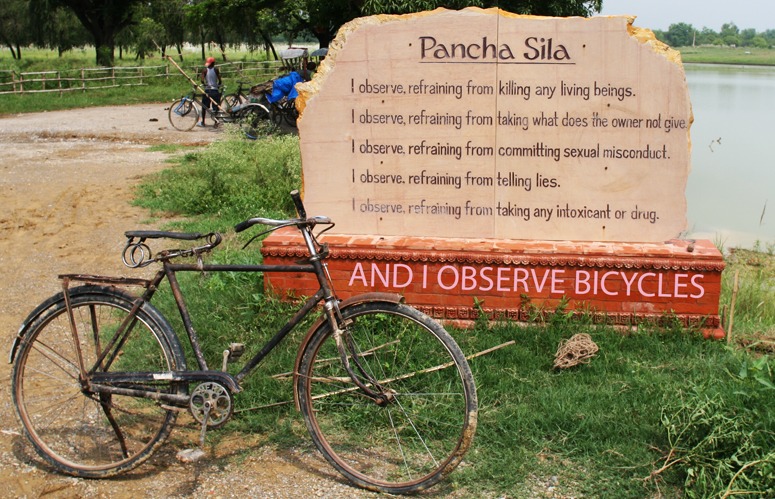
Buddhists and the bicycle: use of the Great Green Machine could join the Pancha Sila

Buddhist urban design and bicycle planning“It must be asserted that the Pancha Sila (Five Precepts) do not necessarily make a person a Buddhist, but to be a real Buddhist, one has to observe the five precepts”. Furthermore, to be a good Buddhist one should ride a bicycle instead of driving a car. Is there such a thing as a Buddhist approach to urban design? I wish there were: urban design based on bare scientific rationalism has produced, and is producing, ugly and unsustainable cities throughout Asia. The above photograph of the Great Green Machine was taken beside the canal in Kenzo Tange’s preposterously bombastic baroque design for the Buddha’s birthplace: Lumbini.

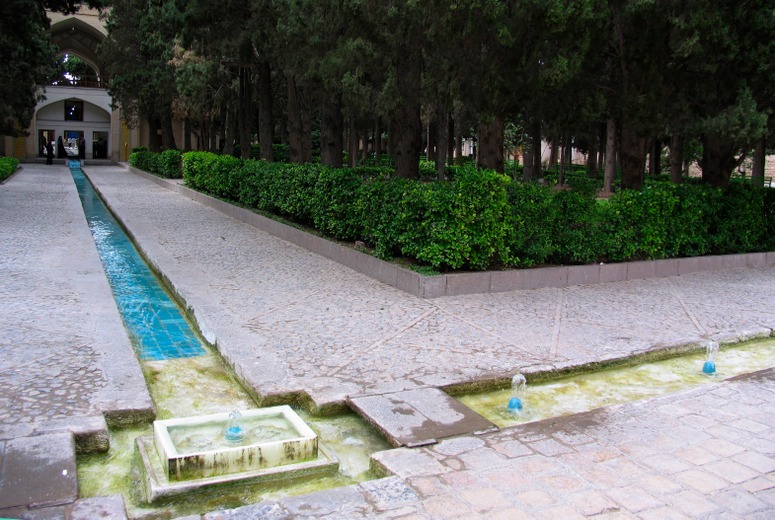
Bagh-e Fin garden in Iran – restoration and conservation plan

Bagh-e Fin garden in Kashan, Iran

An interesting conservation resulted from shoving myself into the wall of a garden pavilion in order to take this photograph of the Bagh-e Fin garden in Kashan, Iran


When visiting the Bagh-e Fin, on 15th June 2004, one of the curators noticed me in a painful position outside his office. I was taking a photograph. He asked why I was doing it. I said I was interested in garden history. He asked if I thought the Bagh-e Fin was of equal historical importance to the great gardens of Europe. I said ‘Yes – probally more so, because it is the best surviving example of the world’s oldest garden design tradition, originating in the Fertile Crescent’. But, I said, it could be looked after even better than was then the case. ‘What should we do?’, he asked. I said I would make a proposal and send it to him. As we drove north into the desert, I sketched in the back of the car. A friend translated my comment into Farsi and we posted it to him. A reply is still awaited. In case the Bagh-e Fin Conservation Plan has been mislaid, it is now  published it on the Gardenvisit website.

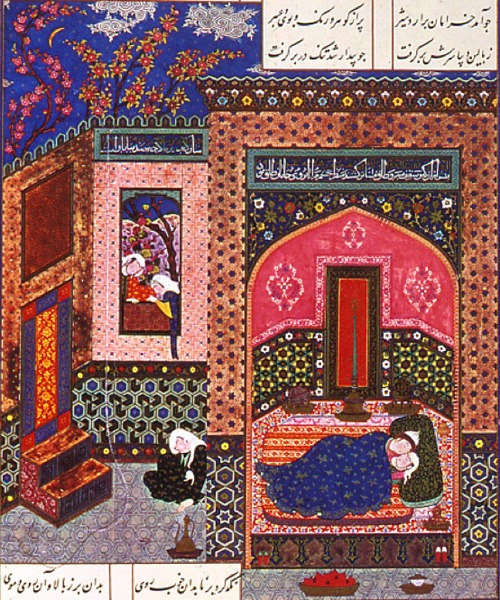
A Persian garden pavilion, with Ardashir and Gulnar

Ardashir with a slave girl, Gulnat

Ardashir with the slave girl, Gulnat, who loved him

I wish Iran would devote less effort to enriching uranium and more to enriching Iranian gardens and conserving  Persian gardens. Persia was one of the central powers in garden history, drawing upon and influencing Mesopotamia, Central Asia, India and Islam. My own modest proposal for conserving the Bagh-e Fin will be the subject of a future blog post.
Omar Khayyám (1048-1131), born in Nishapur, was an astronomer and a garden poet. The Rubiayat of Omar Khayyam, 1120 CE, begins:

I

Wake! For the Sun behind yon Eastern height
Has chased the Session of the Stars from Night;
And to the field of Heav’n ascending, strikes
The Sultan’s Turret with a Shaft of Light.
Awake Morning: For the sun behind yon eastern height.]
II
Before the phantom of False morning died,
Methought a Voice within the Tavern cried,
“When all the Temple is prepared within,
Why lags the drowsy Worshipper outside?”
III
And, as the Cock crew, those who stood before
The Tavern shouted – “Open then the Door!
You know how little while we have to stay,
And, once departed, may return no more.”
IV
Now the New Year reviving old Desires,
The thoughtful Soul to Solitude retires,
Where the White Hand of Moses on the Bough
Puts out, and Jesus from the Ground suspires.
V

Iram indeed is gone with all his Rose,
And Jamshyd’s Sev’n – ring’d Cup where no one knows;
But still a Ruby gushes from the Vine,
And many a Garden by the Water blows.