Towards a greener London – with help from sheep

by Tom Turner @ 1:48 pm April 24, 2010 -- Filed under: Sustainable design,Sustainable Green Roofs,Urban Design   

London green roofs with flock of sheep to calm bankers

London green roofscape with flock of sheep to calm bankers

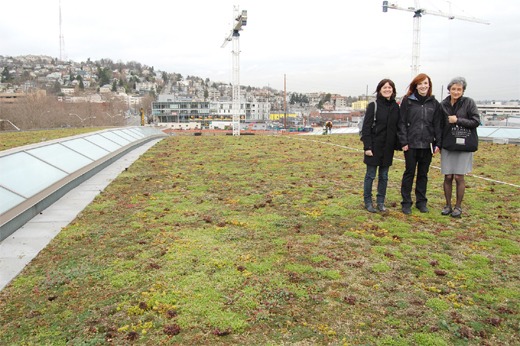
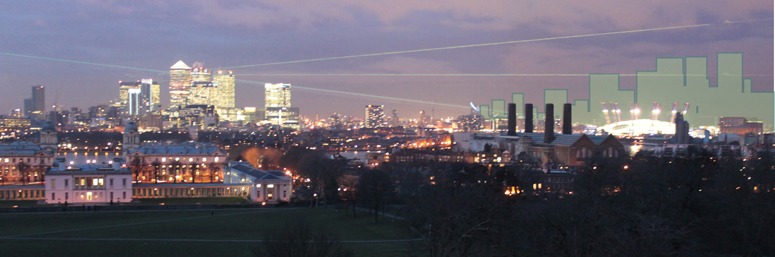
In 1992 I wrote a report, Towards a green strategy for London. Many of the proposals are being implemented, but too slowly and with too little drama or imagination. With this in mind, and as my contribution to solving the City of London’s banking problems, I propose keeping a flock of sheep over and above London. They would make a more useful contribution to the sustainablity of the City than any works now in progress but the primary objective would be to restore calm to London’s market traders. With their minds on higher, greener and better things, I believe they would be less frenzied and that we taxpayers would be able to devote more of our savings to our families and a lower proportion to baling out frenzied bankers.

Note: the curvey-roofed building just north of the rooftop meadow, No 54 Lombard Street, is on the site of London’s Roman Forum. So the proposed meadow would be outside the Forum and on an appropriate site.

Talking gardens, roses, the language of symbols, sustainability and Christianity

by Tom Turner @ 7:09 am April 5, 2010 -- Filed under: Garden Design,Sustainable design,Sustainable Green Roofs   
The green walls being made in gardens have more significance as symbols than as practical contributions to sustainability

The green walls being made in gardens have more significance as symbols than as practical contributions to sustainability

Garden designs can communicate with words and images – or they can continue with the silence of abstract modernism.

The drift from modernism to postmodernism continues, but with little knowledge and less thought. A recent post on The Fower Sermon, recalled that the dying Buddha used a single flower to speak volumes. He also advised: “All conditioned things are impermanent. Work out your salvation with diligence.” Christianity has been more concerned with relationships between humans than with the HUMANITY:ENVIRONMENT relationship.
During Europe’s Middle Age, the Rose was an eloquent Christian symbol. The five petals of the rose symbolised the five books of Moses (the Pentateuch), the five wounds of Christ and other pentads. Gazing at a rose, the garden owner could feel inspired and re-assured, as when remembering a famous quotation, a line of poetry, a proverb or the heroic deed of a saint or martyr.
So are there symbols of comparable power for current garden designers to explore? I think many green roofs and green walls fall into this category. Presently, they have more value as symbols than actual contributions to sustaining life on earth. I make no complaint about this – but am deeply skeptical about any practical contribution they might make to saving the planet from climate change, forest clearance, rising sea levels, interruption of the Atlantic heat conveyor – or sin. And if green walls use electric pumps they aggravate the risks we face.

Masdar City Two & Abu Dhabi landscape planning

by Tom Turner @ 2:20 pm March 14, 2010 -- Filed under: Asian gardens and landscapes,Cycle planning,Sustainable design,Sustainable Green Roofs   

Hasan Fathy design for New Gourna (photo 1975)

Hasan Fathy design for New Gourna (photo 1975)


Without knowing too much about Masdar City, I am sceptical about Norman Foster’s proposals. So my suggestion is to develop a Masdar City Two with its focus on using a happy blend of traditional technology with as-little-as-necessary high technology. I would have David MacKay as the energy supremo and Hasan Fathy (had he not died in 1989) as the chief architect – and a landscape planner responsibile for the strategic direction of the new city. I guess there would be lots of mud walls, planting, and shade with excellent provision for cycling and electric floats for transport (as in Nanjing Street, Shanghai). All the roof space would be roof gardens with retractable awnings and limited vegetation supported by grey water. The gardens would be legendary – and related to the lost gardens of Ancient Mesopotamia. I think the result would be cheaper, better, more sustainable and more popular than Masdar City One. It might get less coverage in the architectural press but we could live with this.
Sorry about the quality of the above photograph, taken in 1975. I went to re-take the photo 30 years later and could not find the place – I guess it has been destroyed. The residents of Old Gourna (or Kurna or Qurna) did not want to leave their homes amongst the tombs of the nobles, which had rich pickings and many tourists. Fathy was unpopular in Egypt but designed some beautiful and environmentally appropriate homes for Saudi princes.
Odd that Iran should want nuclear power and Abu Dhabi should want solar power. What next? Will Iceland start making artificial snow? Or is Masdar City One really, as I will assume, an enlightened example of a rich country using its resources to develop technology which will benefit the world? The competition between Masdar City One and Masdar City Two would be very healthy and there should be a prize for the winning design team. Success would be judged from three criteria (1) construction costs (2) measures of sustainability (3) popularity with residents.

Turf roof gardens for back to nature sustainable ecohouse living in the twenty-first century

by Tom Turner @ 3:15 pm February 25, 2010 -- Filed under: Sustainable design,Sustainable Green Roofs,Urban Design   

Turf roof gardens for the twentyfirst century?

Turf roof gardens for the twentyfirst century?

Iceland is the most recently made country and has a great-and-abandonned tradition of turf building. Dwellings were built with stone foundations, birch frames and turf cladding for the roofs and walls. Interiors were probably damp but now that waterproof membranes are available they should go back to to cladding their buildings in turf. It would be good for insulation, sound-proofing, wildlife etc and could create jobs for an icy land now down on its uppers.
I expect the greatest difference between the cities of the 20th and 21st centuries to be the prevelance of a vegetative cladding on cities of the 21st century. Icelanders could export consultancy skills instead of cod – and we should all remember that this was the classic building technique in Neolithic Europe.

Learn from wombats: earth sheltered homes have a lower environmental impact

by Tom Turner @ 6:17 am January 16, 2010 -- Filed under: context-sensitive design,Sustainable design,Sustainable Green Roofs   


Earth-sheltered dwelling house in California

The sunken garden looks nice but they could have done more with the external space for this earth-sheltered dwelling house in California

When reducing the total impact of humans on the environment becomes a necessity, we may have to learn more from the lifestyles of wombats, teletubbies and hobbits. If so, I hope our species will also become cuter, cuddlier, and friendlier. JRR Tolkien may prove correct in his view that diminutive sausage-eaters will save the world from the black forces of evil.
PS But is that a triple garage?
(image courtesy Christopher Line)


Can sustainable urban design and landscape architecture help combat global warming?

by Tom Turner @ 2:13 pm January 4, 2010 -- Filed under: landscape planning,Sustainable design,Sustainable Green Roofs,Urban Design   
Designing urban landscapes for motor vehicles discourages human-powered transport

Designing urban landscapes for motor vehicles discourages human-powered transport


Watching Al Gore’s Inconvenient Truth at one sitting led me to the following conclusions:

  1. The film is excellent and has much to teach college lecturers, both about the analysis of complex issues and about the the use of words & images in presenting an argument.
  2. Gore’s argument is weakened by his homepage link to a Buy Now button on climatecrisis.net – regardless of how he shares the profits. It makes him seem like a greedy evangelist on TV.
  3. Gore’s list (below) of Thing’s You Can Do Now, is ultra-trivial and may have set back the cause by encouraging politicians to believe that little change is necessary. The film mentions population growth but it is not on the list, doubtless for ‘political’ reasons.
  4. The best commentary on the issues comes from Justice Burton. He said the film is ‘broadly accurate’ but listed nine inaccuracies
  5. A landscape approach to urban design can do more to combat climate change than Al Gore can imagine. We can and should:
  • use all roofspace:  for vegetation, gardens, power generation or the daylighting of interior space
  • plan cities for extensive use of human-powered and solar-powered transport (above image courtesy TouringCyclist) – but see my recent post on White Commuting
  • compost as much as possible within the boundaries of each and every property
  • infiltrate as much water as possible within the boundaries of each and every property
  • make all buildings energy efficient, by orientation, vegetation, insulation, durability, daylighting, avoidance of lifts and escalators etc
  • design new homes so they can become home offices, when eCommuting becomes the norm, with a smooth transition from indoor to outdoor spaces with differential climatic and temperature characteristics

For landscape architects and urban designers thinking about new jobs and professional opportunities in sustainable urban design, the above are  very convenient truths.


Al Gore does not say enough about urban design

Al Gore does not say enough about urban design


Another ‘inconvenient truth’ ignored by Gore, is that the environmental impact of bottled water has been calculated, by SGWA, to be 1000 times greater than that of tap water. So ban it, as a small town in Australia has done: Bundanoon, in New South Wales. Perhaps the American language needs a new word: an ‘ingored truth’

Green vegetated roofs in the theory of landscape and architecture

by Tom Turner @ 9:26 pm November 28, 2009 -- Filed under: Historic garden restoration,Sustainable design,Sustainable Green Roofs   
Ecological space + a little social space: Green roof on California Academy of Sciences

Ecological space + (a little) Social Space (Green roof on California Academy of Sciences)

In Germany, vegetated green roofs are often classified as:

  • intensive (ie treated as a garden, typically with exotic plants, irrigation, turf and social use)
  • extensive (ie treated as habitat, without irrigation or maintenance)

I prefer to look at green roofs from a more Vitruvian standpoint and consider their roles as:

  • visual space [Delight]
  • ecological space [Firmness]
  • social space [Commodity]

Image courtesy clickykbd.  The California Academy of Sciences designed by Renzo Piano and ‘The Living Roof´s 1.7 million native plants were specially chosen to flourish in Golden Gate Park´s climate.’  There is a small terrace for viewers but the predominant role of the green roof is Ecological Space.

Visual space+ social space: Singapore School of Art Media and Design

Visual space+ Social Space (Singapore School of Art Media and Design)

” This 5 story facility sweeps a wooded corner of the campus with an organic, vegetated form that blends landscape and structure, nature and high-tech and symbolizes the creativity it houses.”  The  green roof is open to the public and, like the roof of Australia’s Parliament Building in Canberra, is surfaced with mown grass. Image courtesy teddy-rised It is  not ecological space:  the grass is irrigated and  mown. The building was designed by CPG Consultants.

Ecological space only: University of Illinois at Springfield

Ecological Space only (University of Illinois at Springfield)

The Springfield Illinois green roof is ecological space, only. It is not visual space or social space. Image courtesy jeremywillburn,

Visual space + Social space: Roof on the HQ of the American Society of Landscape Architects

Visual space + Social space:Roof ( HQ of the American Society of Landscape Architects in Washington DC)

The green roof on the American Society of Landscape Architects is visual space and social space but not ecological space – at leasst not as shown in this photograph (the roof has other eco-friendly characteristics).  Image courtesy drewbsaunders.


Zen: garden as house

the-garden-house1

http://www.archtracker.com/the-garden-house-takeshi-hosaka-architects/2009/04/

Apart from what looks what looks unfortuneately like artifical turf on the roof – the Garden House by Takeshi Hosaka Architects with its tight triangular plan is a surprise and delight! Definitely a garden for my soul! The living spaces are designed around the edges of an enclosed garden courtyard, cleverly stacked and arranged to take advantage of every square mm of space, create privacy and capture views. In the photographs the garden is very young…it would be fantastic to revisit the house as the tree grows and the potted garden matures.

If you can’t resist viewing more  maybe a trip to Japan is in order…


London 2012 Olympic Village: Landscape & Garden

by Tom Turner @ 11:32 am October 16, 2009 -- Filed under: Sustainable Green Roofs,Urban Design   

olympic_village_london_2012Here is a CGI image of London’s 2012 Olympic ‘Village’ flanked by photos of the Student ‘Village’ it is replacing. One regrets that the Trade Descriptions Act does not apply to the word ‘Village’. The Online Etymological Dictionary entry for Village has: “late 14c., “inhabited place larger than a hamlet but smaller than a town,” from O.Fr. village “houses and other buildings in a group” (usually smaller than a town), from L. villaticum “farmstead” (with outbuildings), noun use of neut. sing. of villaticus “having to do with a farmstead or villa,” from villa “country house” (see villa)” with Villa coming from from PIE *weik- “clan” (cf. Skt. vesah “house,” vit “dwelling, house, settlement;” Avestan vis “house, village, clan;”

So “village” is one of our most ancient words and it should mean a group of dwellings occupied by people who are related to each other and who relate to the surrounding land. The design for the London 2012 Olympic Village looks as though it might be in the valley of the Yellow River, providing modern blocks for groups of workers who no longer have any cultural or horticultural connection to the land on which they live.  Where are the sustainable green roofs on the Olympic ‘Village’? Or do they plan to build a new Pruitt-Igoe in London?

Sustainable energy, landscape architecture and the carbon cycle

by Tom Turner @ 5:50 pm October 2, 2009 -- Filed under: carbon cycle balance,Landscape Architecture,Sustainable design,Sustainable Green Roofs   

The landscape architecture should consider the implications for the landscape of supplying the UK's energy demand when the oil runs out

The landscape architecture should consider the implications for the landscape of supplying the UK's energy demand when the oil runs out (image from the 10-page Synopsis, reproduced courtesy David Mackay)


So far as I know, there is only one excellent book on Sustainable Energy. It is available free and the author, David MacKay, has become a government advisor. Everyone should read the 10-page synopsis. My question is this: how will solar power affect the landscape and what can landscape architects do to help the shift to sustainable energy? Solar, Clean Coal, Nuclear, Tide, Wave, Hydro, Waste, Pumped Heat, Wood, Biofuel, Wind.

The European average for energy use is 125 kWh/day.  Covering the windiest 10% of Britain with onshore windfarms would yield 20 kWh/ day per person; covering every south-facing roof with solar water-heating panels would capture 13 kWh/day per person; wave machines intercepting Atlantic waves over 500 km of coastline would provide 4 kWh per day per person.

Do landscape architects have anything to say about the layout of giant solar farms? David MacKay believes they are the most promising solution in the longer term. And what about giant wind farms?

« Older PostsNewer Posts »