Category Archives: Asian gardens and landscapes

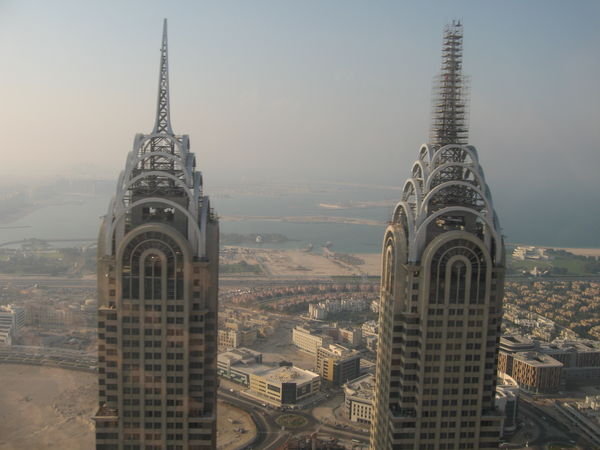
Seeing double in Dubai

the-empire-state-bldg-dubai

Source: http://www.travelblog.org/Photos/1726246.html

New York continues to inspire with reports that an investment company in Abu Dhabi is looking for a 75% stake in one of the cities most iconic buildings the Chrysler Building. http://www.therealestatebloggers.com/2008/06/12/chrysler-building-for-sale-to-abu-dhabi-investment-company/ While in Dubai the impression is of seeing double…..

When Japan finally opened up to foreigners in 1854 after being “impenetrable to the western world” the fascination with Japanese gardens immediately made itself felt within English high culture and by the beginning of the twentieth century Japanese garden styles were still setting trends for popular gardens as well as inspiring a reconsideration of the early Japanoiserie gardens as cultural heritage in Britian. http://www.humanflowerproject.com/index.php/weblog/comments/1681/
Fishbourne Roman Palace Garden

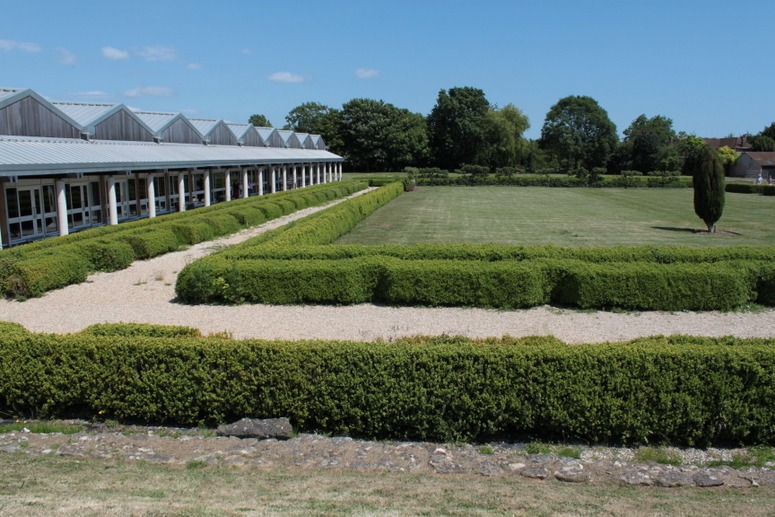
The re-created Fishbourne Roman Garden looks too much like a renaissance garden, with a 'formal' hedge and mown lawn

The re-created Fishbourne Roman Garden looks too much like a renaissance garden, with a 'formal' hedge and a mown lawn. The museum building, left, is passable but it would have been a much better idea to use the columns to make a proper peristyle with a tiled roof. Terracotta-coloured sheet steel would be an improvement.

Barry Cunliffe led the excavations at Fishbourne from 1961-8 and wrote a most useful book on the subject. Located near Chichester on the south coast, Fishbourne is the best example of a Roman garden in England. But I am doubtful about Cunliffe’s interpretation.  He began with the proposition that ‘there was a formal and it was discoverable by excavation’ (Cunliffe’s italics). This assumes his conclusion and the term ‘formal garden’ comes from a much later period in garden history. This has been a problem with much that has been written about Roman gardens. Since the term ‘Renaissance’ means ‘re-birth’ too many people have concluded that we can discover the form of  Roman gardens by studying renaissance re-incarnations. But there are several other sources of information about Roman gardens and they do not seem to confirm this picture (or ‘formal’ hedges and a ‘formal’ lawn : (1)  the frescos at Pompeii, Herculaneum and elsewhere; (2) excavation of garden sites in Southern Europe; (3) texts, such as Pliny’s letters. None of these sources confirm the above re-creation of Fishourne. The planting design  comes from a pattern of trenches, but there is no evidence that box was planted in these trenches. Cunliffe calls them ‘bedding trenches’ (p.134) and my experience of growing hedges and flowers inclines me to the belief that they were more likely to have been planted with flowers. Pollen analysis yielded no information but box is of course a tree (Buxus sempervirens). It can grow on very dry soils and it has has strong fibrous roots. Digging up one of the box trees shown on the photograph ( planted at Fishbourne in the 1960s) would provide useful evidence – my guess is that the roots would be found to have outgrown and destroyed the archaeological Roman ‘bedding trenches’ (in fact I do not think they should have been planted, for this very reason – who knows what information future archaeological techniques might otherwise have discovered?). William Melmoth’s translation of Pliny’s Letter LII to Domitius Apollinaris [ Bosanquet, 1909 edn] includes this passage:  ‘You descend, from the terrace, by an easy slope adorned with the figures of animals in box, facing each other, to a lawn overspread with the soft, I had almost said the liquid, Acanthus: this is surrounded by a walk enclosed with evergreens, shaped into a variety of forms.’   I wonder if the tree, shown as a conical specimen on the photograph, was box clipped into an animal form. Conical specimen trees and lawns are modern concepts.  Like everyone, I  would like to know more.

Garden Hotel or Garden B&B?


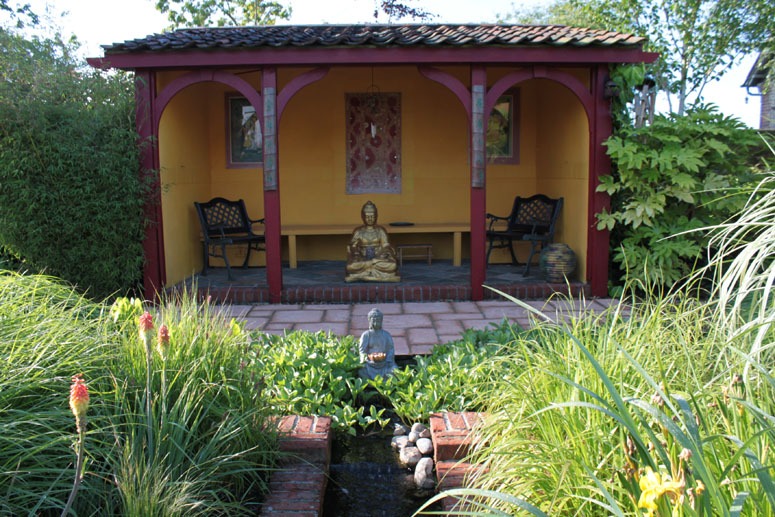
An India-inspired pavilion in the garden of the Corner House B7B in Maiden Bradley

An India-inspired pavilion in the garden of the Corner House B&B in Maiden Bradley

The latest  Gardenvisit.com Newsletter recommends holidays at home for this year of recession – and with the best summer weather for several years (so far!) the idea is working well in the UK.

I too have been visiting a lot of English gardens this summer – and looking for places to stay. My preference, always, is for accommodation with interesting gardens. Grand garden hotels, like Cliveden and Ston Easton, are luxuriously OK but not in keeping with the recession theme, or my arrive-late-leave-early habits – or my budget.

So what about B&B accommodation? I had some intersting experiences ten years ago, with greasy food, greasy carpets and odd landladies. But the property development boom of the last decade has produced some very comfortable places run by charming people with an interest in garden design. For example, I have stayed recently in Millgate House and, last week, in the Corner House in Maiden Bradley where I was very interested in the Indian garden. Most people’s idea of an Indian garden, especially in India, is an Islamic garden. But the Hindus and Buddhists had a far older and far more Indian approach to garden design – which involved roofed pavilions, garden shrines and pools.

Please email us if you run or can recommend, good accommodation with  interesting gardens, and we will put together a list.

250 Congratulations to Kew Gardens

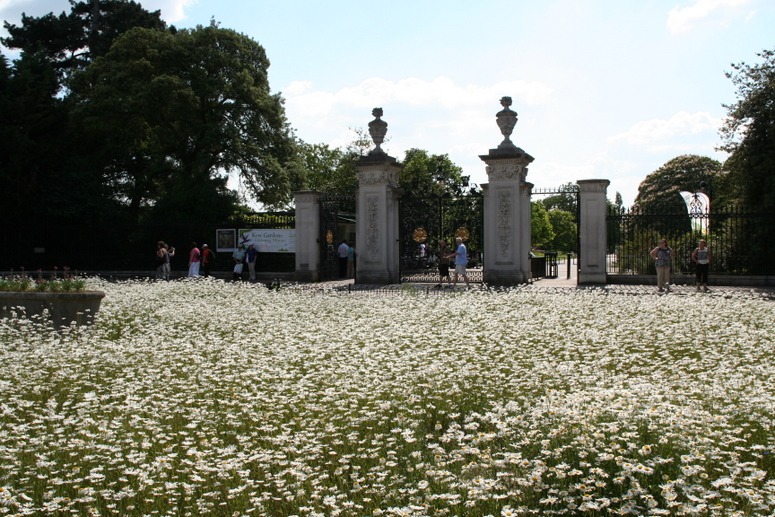
Wildflower planting outside Kew Gardens

Wildflower planting outside Kew Gardens

Kew Gardens are 250 years old this year and far more beautiful and interesting than at the time of my first visit. But if the quality is twice as good as it was, it  still less than half as good as it could be. I was therefore delighted to learn that an excellent landscape architecture firm (Gross Max, of Edinburgh) has been appointed to advise on the development of Kew Gardens.

The change which has made the greatest difference, so far, is the adoption of a ‘sustainable Kew’ policy. You see this in the wildflower meadow outside the main gate (photo above, taken today) and you see it in the long grass under the trees covering perhaps 50% of the garden area.  The other big changes are the restoration of old features (eg the garden of Kew Palace) and the creation of new features, including the Sackler Crossing and the Tree Walk.

The two missing elements, which Gross Max may be able to provide, are a connection with the River Thames and an overall sense of spatial composition. The latter problem is difficult, because so much of the tree and shrub planting is ‘spotty’ and the new features are being dotted about like rides in a theme park. But the problems are not insuperable and I much look forward to seeing them resolved.

One other point: the increase in quality has has been accompanied by a rise in the entry price from one penny to thirteen pounds sterling. There being 240 old pennies in an old pound, this equates (see comment below) to an increase of  three thousand one hundred and twenty percent. Kew will be a very great garden when the visual quality has risen proportionately!

Abu Dhabi and sustainable landscape architecture in the Gulf

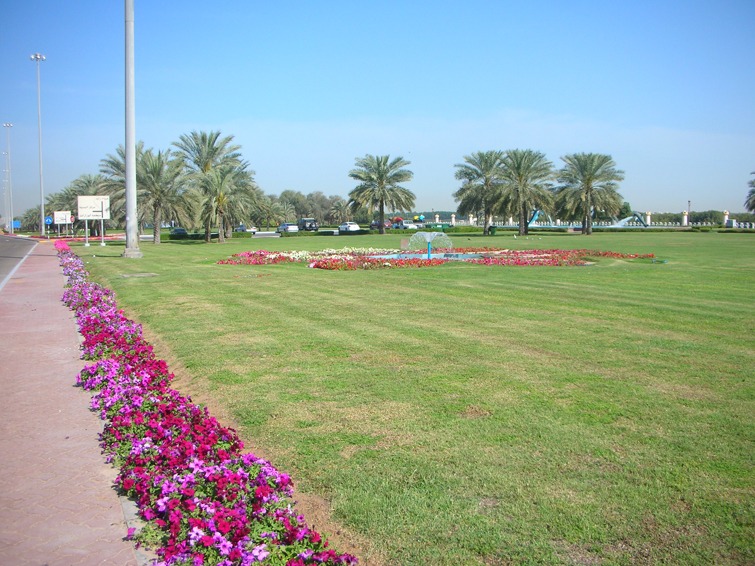
abu_dhabi_corniche_eastSince Gulf and Asian landscape architecture are improving, it may be a good time to dwell on past mistakes. The above  photo is of the east corniche in Abu Dhabi. It was designed in conjunction with major traffic routes and exemplifies what goes wrong when landscape architecture work is supervised by firms of engineering consultants. The east corniche ‘park’ lies beside a 12 lane carriageway and flyover. It is a horrible place to be, especially during the rushhour. Pedestrian access just about impossible.  Abu Dhabi is not short of money but this is a terrible way to waste water, space and resources. The ‘park’, better described as a ‘GARK‘, is ‘decorated’ with petunias, lawns and a fountain. Abu Dhabi is developing a grey water mains water supply but many lawns of this type are watered with drinking water. Grassland irrigation is calculated at 12 litres per square meter per day, which is 4,380 litres of water per square metre per year. Since there are about 58,000 sq m of grass, it must require about 250 million litres of water per year. In desert conditions, petunias probably require more water. Desalination plants dump their excess salt back into the Gulf. This will turn the mangroves yellow in perhaps 50 years.  Beyond the gark, to the right, you can see the tops of the mangrove swamps which border the Abu Dhabi Gulf coast. The mangroves grow practically without maintenance in seawater. They are an ecological treasure chest and very beautiful. One wonders if the ‘designer’ of the Corniche east park ever woke up and felt really stupid about what he or she had done. It is not too late to commission a landscape architecture firm to claim the gark for the mangroves.

The landscape architecture of bicycling in China

526297738_e8cf7e2b9f_bThe BBC broadcast a programme on the Fall and Rise of the Bicycle in China http://www.bbc.co.uk/radio4/fallandriseofthebicycle/ which was actually about the Rise and Fall of the Bicycle in China. The main point was that the world’s greatest cycling country aims to become the world’s greatest motoring country. In Beijing the cycle lanes are being narrowed and cars are being allowed to obstruct them. I don’t know if the presenter has experience of cycling in Beijing but I can tell him about another problem: many of the cycle lanes are full of near-silent electric motor bikes. To people like me, who are in the habit of using their ears to discover when a motorbike is about to overtake, this can be very dangerous. I would not want any westerners to be in the position of appearing to say ‘you can’t live as we live’. But I am happy to pronounce that ‘most western countries made a terrible mistake when they switched from bikes to cars (eg from 1920-1960) so please think a thousand times before you make the same mistake. Beijing still has some of  the best cycle paths in any capital city (photo courtesy Rich & Cheryl)

A Chinese contributor to the programme explained that riding a bicycle is a working class and driving  a car shows that you are an important person. That is why the Chinese landscape architecture profession needs to become involved. Landscape architects can design such safe and beautiful cycle lanes that using them becomes a mark of what used to be the distinghishing characteristic of China’s scholar-officials: GOOD TASTE. Come my Chinese friends and colleagues: show the world what you can do and we should do.  Cycle planning should be incorporated with greenway planning and design, in China and everywhere.