
Author Archives: Tom Turner

The landscape of housing: Smithsons design and site planning for Robin Hood Gardens


Zaha Hadid: ‘Personally, Robin Hood Gardens is one of my favourite projects.’
Richard Rogers: ‘It has heroic scale with beautiful human proportions and has a magical quality. It practically hugs the ground, yet it has also a majestic sense of scale, reminiscent of a Nash terrace.’
Simon Smithson: ‘I believe Robin Hood Gardens to be the most significant building completed by my parents. ‘
Tom Turner: ‘Sao Paolo could learn a lot from the Smithsons’ approach to planning urban landscape’
Here are 3 videos, by Alison and Peter Smithson, by Jonathan Glancey and by me. I am impressed by the Smithsons and in full agreement with Glancey that (1) I would not choose to live there (2) the scheme should not be demolished – as has been decided (3) it should become student housing, because it is so well suited to communal use. The Smithsons account of the scheme justifies slapping a preservation order on Robin Hood Gardens. The English Heritage commissioners were right about the building architecture being mediocre: the elevations are elegant but the roofs are leaking, the concrete is spalling so that the rebars are exposed, the stairways are pokey, the balconies are usable only for drying clothes (so the residents protect them with bird netting) and a ‘street in the air’ (often with hoodies) is not a nice thing to have outside your living room window. BUT the site planning is excellent. London’s ‘tower blocks’ are usually planned like tombstones in plots of grass. The Smithsons protected against noise and used their buildings, as in London’s Georgian Squares, to define and create outdoor space. I have never seen their hill well used but attribute this to its not being a safe protected space. I also agree with their comment, on the video, that using Robin Hood Gardens as a ‘sink estate’ was not wise. Both these mistakes can be attributed to the housing managers: Tower Hamlets Borough Council. So what should be done now? (1) keep the Smithsons excellent site planning (2) implement Glancey’s idea if it feasible – and convert the buildings for use by a student community (3) otherwise, replace their shoddy architecture with better buildings on the same footprint (4) manage the central space as a garden, instead of as a public park.


Alison Smithson has a strange manner and makes some strange remarks (eg ‘Any African state would have as good a chance of joining the Common Market as London’). But the two of them speak wisely about what should happen to London Docklands.

Jonathan Glancey presents a well-reasoned and well-balanced account of the design.
Thames foreshore and beaches – the need for a landscape strategy

The previous video argued that London’s Thames beaches are much safer than the beaches below the Seven Sisters and Dover white cliffs. This video looks in more detail at the availability of public stairs down to the foreshore. They have been in decline for 3 centuries and the twentieth century was the period of sharpest decline. ‘The Authorities’ by which I mean the London boroughs and the Port of London Authority, discouraged access for reasons of health and safety. If logic ruled, these Authorities would be even more opposed to horse riding, boxing, crossing roads, cycling and foreign travel. Fortunately, logic guides this blog – which therefore calls for a landscape strategy for the visual, ecological, archaeological and functional aspects of London’s Thames foreshore and beaches.
The Health and Safety Executive believes that ‘complying with health and safety regulations was often used as a “convenient excuse” for organisations to justify unnecessary decisions.’

Chelsea Fringe Alternative Garden Festival 2014 Review


Very nice to see the Chelsea Fringe going from strength to strength. It began in London and this year it has events in in London, Brighton, Bristol, Vienna, Ljubljana, Turin, Kent, Norwich and online.
My only criticism is of the Chelsea Fringe website. The graphics are fine but it does not seem to have been user-tested. I find:
– the search facility far too complicated
– the search returns repetitive
– the website unhelpful for finding a group of events in a visitable geographical area
What the Fringe needs is a sponsor which could provide a user-friendly website. It could be great publicity for the firm.
This year, I was lucky to pick up a leaflet for the Nine Elms contribution to the Chelsea Fringe. It was a paper map with a list of events. Wonderful! But I would have been just as happy to download it as a pdf.

Garden designs at the 2014 Chelsea Flower Show

Here is a video of the gardens which caught my eye at Chelsea. The aim was to balance the designers’ accounts with critical comments but I have given too much time to their puffs and not enough to myself (!). Shooting the video gives me a keen appreciation of the BBC videographers’ skills – and an envy for the 25 person crews they use for the ‘filming’.

My first impression of the gardens on the Main Avenue was of a nineteenth century style revivalism. ‘Is 1850 the future of British garden design?’ I asked myself? The M&G revival of ‘Persian’ ideas was a prime example in this category – and is not included on my video. My vote for the best Show Garden goes to the Cloudy Bay garden and, nearby, my vote for the worst garden on the Main Avenue goes to Alan Titschmarsh (also not on the video). The ‘hilly bit’ at the back of his design was quite nice but the ‘summer house’ and ‘pond’ were awful. The BBC was right to replace him with Monty Don as their lead presenter but Monty looked frail and I worry that he is taking on too much work. If Monty finds it too much it will be a real pity if they go for Joe Swift as his replacement. Joe’s horticultural knowledge may be OK but his design judgement is jejune. OK, I know it is the Chelsea Flower Show, but I find the gardens more interesting than the flowers and a goodly proportion of the TV coverage is about the show gardens.
See also: Review of garden designs at the 2014 Chelsea Flower Show

The landscape architecture of greenways and cycling to school and to everywhere

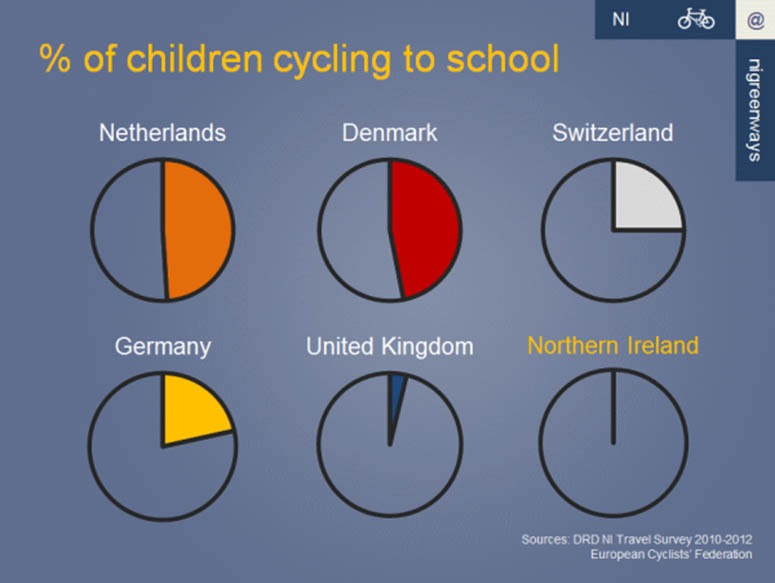
Why do so few children cycle to school in the UK?

Why do so few children cycle to school in the UK?

Congratulations to Northern Ireland Greenways for a super set of infographics (+ thanks for permission to reproduce the above pic). Of the chosen countries, why does the UK have the lowest figures for cycling to school? Does the UK have colder weather and higher mountains than Switzerland? Is it windier than Denmark and Holland? Is the UK’s GDP so much higher than Germany’s that we all have big cars? Or is the UK governed by blockheads who prefer cars to bikes and therefore employ legions of highwaymen and hardly any landscape architects to plan the country’s transport infrastructure? I incline to the last of these explanations – but we have a Mayor of London and a Prime Minister who are both keen cyclists. So there may be another explanation: the UK has over-strong central government and lapdog local government. The Whitehall bullies and barons keep asking themselves ‘What does THE COUNTRY need?’, Nobody can take locally relevant decisions to benefit local people. Switzerland has the best system for subsidiarity and local decision making. My guess is that were it not for those pesky Alps and snowdrifts it would have the best cycle infrastructure in Europe.

The landscape architecture of London's beaches and foreshore


Londoner’s require a right to roam on London’s beaches and, wherever possible, a public access route along the entire foreshore.

The Port of London Authority PLA does not encourage access because it was set up to manage the port, commercially, for maritime shipping. It gives safety considerations as a reason for not spending money on public goods. But the Seven Sisters Country Park is a much more dangerous place and is managed for recreation, conservation and wildlife. My suggestion is to transfer the amenity responsibilities of the PLA to a Landscape Agency and to bring both bodies within the GLA Greater London Authority family of public authorities. Construction of the Thames Tideway Tunnel will make the water much cleaner and the beaches more desirable.

See also: