Chinese garden history, garden types and garden historians

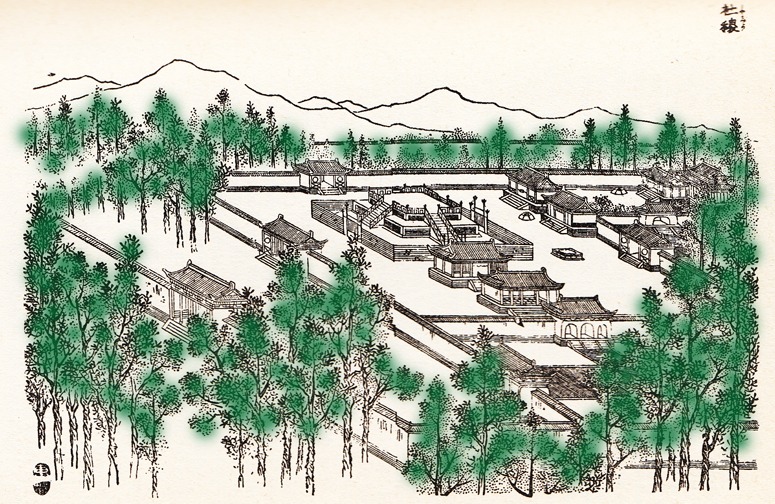
Altar of Land and Grain in Zhongshan Park

The Altar of Land and Grain (now Zhongshan Park or the Sun Yat-Sen Memorial Park in Bejing) had what western historians call a 'formal' layout. It is neither the garden type nor the design style which features in histories of 'the' Chinese Garden.

There is a regrettable tendency for garden historians to write about the Chinese Garden as though it were one thing which was invented about 5000 years ago, which was made for a single purpose and which has never changed. It puts one in mind of Edward Said’s comment on Orientalism (regarding the Middle East). He wrote of “a misrepresentation of some Oriental essence — in which I do not for a moment believe”. We are therefore pleased to publish a classification of Chinese garden types by Xiaomin Wu. The next stage in developing a systematic history of garden design in China should be to trace the evolution of each of these types through the millennia. This should be done in parallel with studies of the influence of Chinese gardens on neighbouring countries and the influence of neighbouring countries on China. One of the many neglected aspects of Chinese garden history concerns the influence of Buddhism. Maggie Keswick, who wrote by far the most influential western book on Chinese garden history, scarcely mentions the subject.
Another puzzling aspect of Chinese garden history is that it is normally studied without reference to Japan or Korea. To me, this is like writing compartmentalised histories of French and Italian gardens or of Italian and English gardens. It should not be done. With regard to China, Japan, India and Korea, part of the explanation is that the countries were not friendly during the twentieth century – American garden historians have considered the influence of Chinese on Japanese gardens, but they have given far more attention to Japan than to China or India or Korea.
The Altar of Land and Grain (now Zhongshan Park and the Sun Yat-Sen Memorial in Bejing) (drawing above) had what western garden historians call a ‘formal’ layout’. It is neither ‘the’ garden type nor ‘the’ design style which features in histories of ‘the‘ Chinese Garden.
What is landscape urbanism?

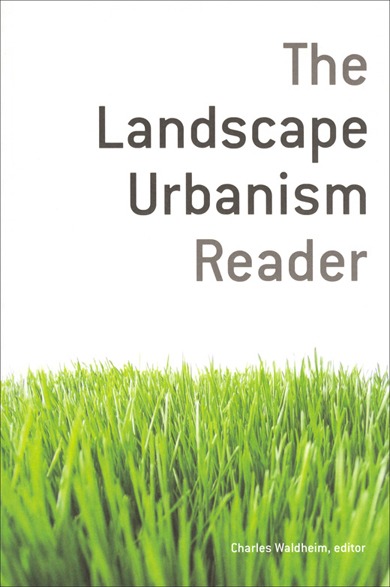
Charles Waldheim Landscape urbanism reader

Charles Waldheim's Landscape urbanism reader

[See notes on Urban design and landscape urbanism]

London’s Architectural Association has picked up the term landscape urbanism and come near to draining it of meaning. The programme’s ‘rationale’ states that landscape urbanism is understood as ‘a model of connective, scalar and temporal operations through with the urban is conceived and engaged with: the urban is conceived and engaged with: the urban is diagrammed as a landscape; a complex and processual ecology’. In social science, ‘processual’ means ‘of or relating to a process, especially to the methodological study of processes’. In physics ‘A scalar is a quantity with a magnitude but no direction’. So I would describe the above ‘rationale’ as profoundly vague.
Wikipedia defines landscape urbanism as ‘a theory of urbanism arguing that landscape, rather than architecture, is more capable of organizing the city and enhancing the urban experience’. This definition comes from The landscape urbanism reader edited by Charles Waldheim (Princeton Architectural Press, 2006). Waldheim associates the term landscape urbanism with James Corner’s essay Terra Fluxus. Corner, in turn, associates the term with a conference organized by Waldheim in 1997. But Corner’s essay, unlike the AA statement, is cogent and useful and has a simple underlying message: buildings and landscapes must be considered together, planned together and designed together (my phrasing). They comprise a ‘field’ on which we operate. Corner works with an architect (Stan Alan) and their firm has the name Field Operations. Corner’s essay allows one to understand what the AA means by processual. City planning should rest on an understanding of the ecological and social processes which underpin Ian McHarg’s Design with nature approach. The term Terra Fluxus is therefore a contrast with Terra Firma: the world is not firm – it is a flux (as Heraclitus observed). I commend James Corner for his clarity and abhor the AA’s obfuscation of the term.

For more discussion see Jason King’s landscape + urbanism blog. It is an important debate and I have provisionally added Charles Waldheim’s reader to the list of 100 Best Books on landscape architecture.

See also: the definition of landscape urbanism

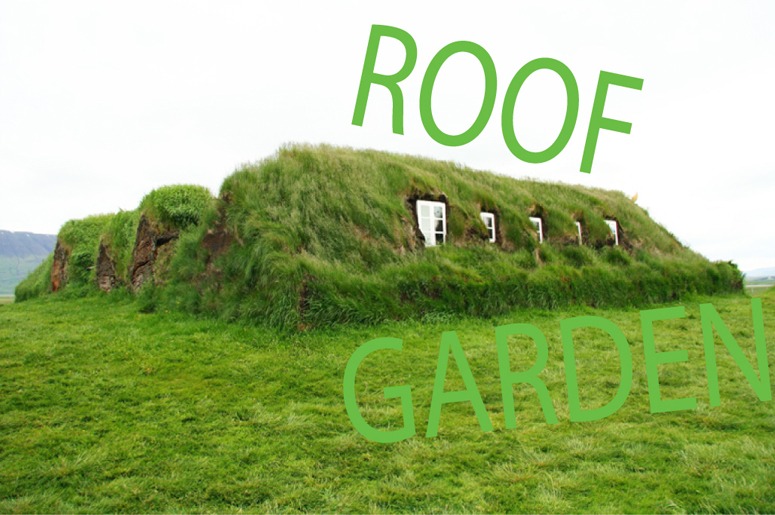
Turf roof gardens for back to nature sustainable ecohouse living in the twenty-first century

Turf roof gardens for the twentyfirst century?

Turf roof gardens for the twentyfirst century?

Iceland is the most recently made country and has a great-and-abandonned tradition of turf building. Dwellings were built with stone foundations, birch frames and turf cladding for the roofs and walls. Interiors were probably damp but now that waterproof membranes are available they should go back to to cladding their buildings in turf. It would be good for insulation, sound-proofing, wildlife etc and could create jobs for an icy land now down on its uppers.
I expect the greatest difference between the cities of the 20th and 21st centuries to be the prevelance of a vegetative cladding on cities of the 21st century. Icelanders could export consultancy skills instead of cod – and we should all remember that this was the classic building technique in Neolithic Europe.

Adam, Eve and planting design in the Garden of Eden

What type of plants grew in Eden, apart from apples and figs?

What type of plants grew in Eden, apart from apples and figs?

Apart from fig leaves, bougainvillia and sin, what was planted in the Garden of Eden? We can say little  about the layout  but something about the location and something about the planting design. It may be argued that ‘every tree that is pleasant to the sight, and good for food’ (Genesis Chapter 1) meant those plants which grow wild, while the the Garden of Eden (as described in Genesis Chapter 2) might have contained only those plants that grow as a result of cultivation. Cultivated varieties of plants have existed since approximately 10,000 years ago the description of the Garden of Eden in Genesis took its final form approximately 2,500 years ago, when the distinction between wild and cultivated species was well known – though its scientific origin was of course unknown.
On the wider question, we should consider whether Adam and Eve were wrong to seek knowledge – and whether we are wrong to continue the quest. George Steiner wrote, in Bluebeard’s Castle, that ‘We cannot turn back. We cannot choose the dreams of unknowing. We shall, I expect, open the last door in the castle, even if it leads, perhaps because it leads, on to realities which are beyond the reach of human comprehension and control.’ He thought it possible that humanity is engaged on an endless quest for knowledge and that, as in Bluebeard’s Castle, opening the last door will lead to doom.
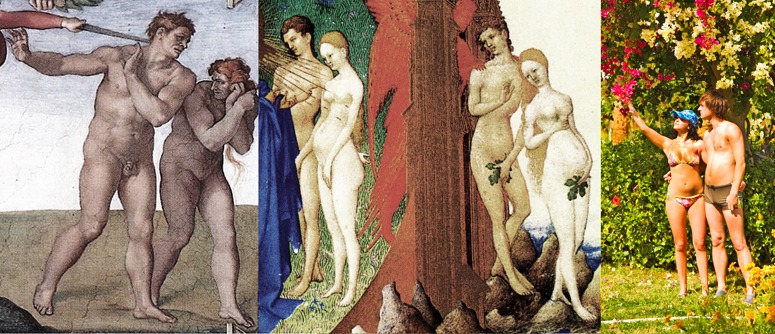
And is humanity descending ever-further into a morass of sin? I hope not – but Eve on the left (by Michaelangelo) does not look as though she has been leading the good life and Adam on the right looks emasculated as a result of eating too much factory-farmed chicken. I prefer the medieval Adam and Eve (from the Très riches heures) and believe that the planners and designers of more sustainable ways of living have much to learn from the middle ages and medieval gardens.

Brilliant design for public safety in London's Finsbury Park contrasts with horrific design in Germany

Safety conscious park design in London

Wonderfully safety conscious park design in London

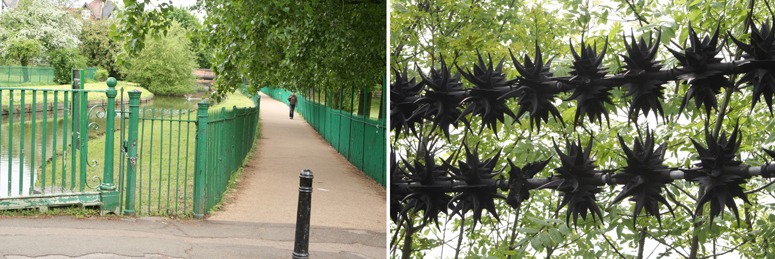
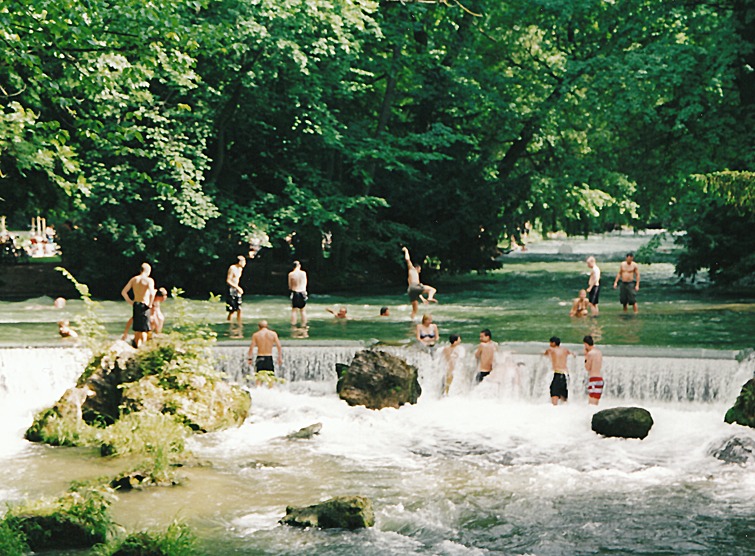
Here are two great ideas for protecting the public from the natural hazards of life in parks. The left photograph is of the New River. It is more than 150mm deep and therefore a considerable risk to public health and safety. Trees can also be very dangerous if one tries to climb them and one has an accident. Thank goodness for London’s vigilant park managers. Sadly, the Germans have no idea how to protect the public from danger. As the below photograph shows, Germany has so much to learn from England. We hope and expect that the 2012 London Olympic Park will show how the 1972 Munich Olympiapark should have been designed. It was such a good idea to assess the quality of English landscape design – and then hire an American landscape architect to oversee the project. The Germans had to make do with local talent back in ’72. Phew. And isn’t it disgusting that nudity is permitted in German parks? One might as well start putting beer gardens in parks and allow people to have BBQs and eat sausages. It makes one so proud to be unenlightened – but I am not that “one”.
Dangerous behaviour in Munich's Englischer Garten

Dangerous behaviour in Munich's Englischer Garten

.