Please protect the Museum of Egyptian Antiquities


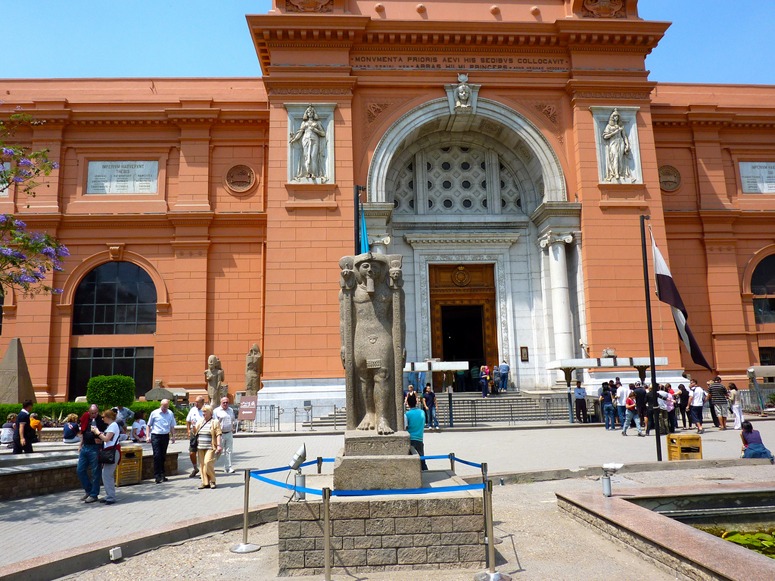
This is not a railway station: it is the Museum of Egyptian Antiquities – and a nearby building is on fire today. The thought of the antiquities being damaged is horrific and it makes me think they should be copied for public view and placed in secure underground bunkers. In fact they should make two copies. In the case of statues, one should go on display in a museum and the other should go in the place where it was found. This should be the normal procedure. For example, large numbers of statues were found at Hadrian’s Villa. Copies should be sited in their original locations.
I would love to see the Egyptians changing their government. But waiting till the old devil dies would be better than damaging the fabulous antiquities. Dr. Zahi Hawass, Secretary General of the Supreme Council of Antiquities (SCA), said two mummies were damaged by demonstrators. But his job came from Mubarak – so can he trusted?
It seems a petty point to add, but the Egyptian Museum also has material of the first importance to the study of garden history.

Image courtesy jkannenberg
Getting wet: staying on the edge

As we await two expected tropical cyclones in North Queensland the following questions have a particular poignancy. What is the solution to coast inundation? Are there ways in which we can get used to getting wet and enjoy it as part of the experience – akin to playing in the surf?

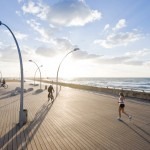
While the Israeli port project may not offer the solution to the landfall of tropical cyclones, it might inspire ways to accommodate a slightly less defined and changeable boundary between the sea and land.

Mayslits Kassif Architects urban regeneration of the Tel Aviv Port is a landmark project which saw “the suspension of all the area’s rezoning plans” and set a precedent for “transformation not propelled by building rights, but by a unique urban design strategy.” The project received the 2010 Rosa Barba European Landscape Prize.

The geography and topography of place

Urban designers in the port city of Copenhagen are making quite a splash for themselves with the design of several exciting new urban spaces.

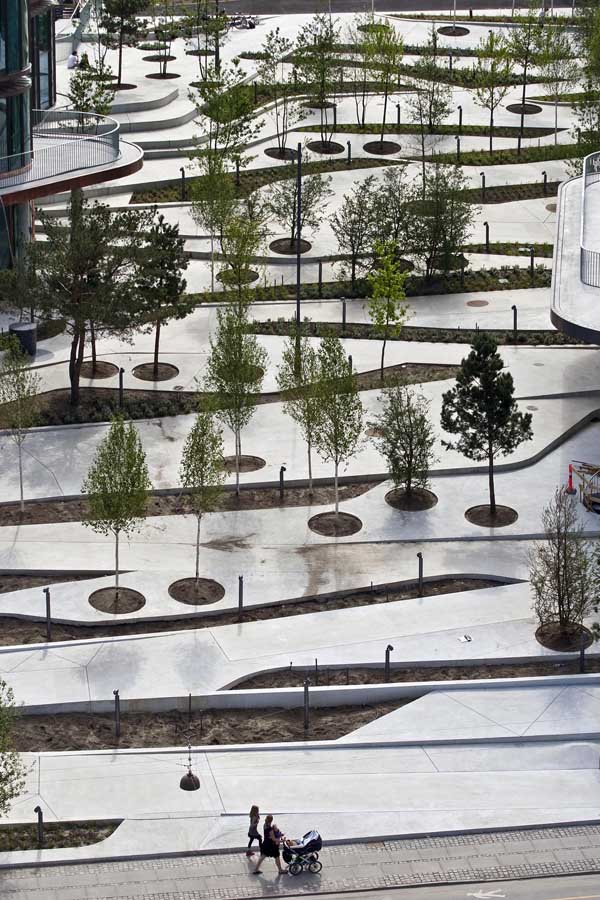
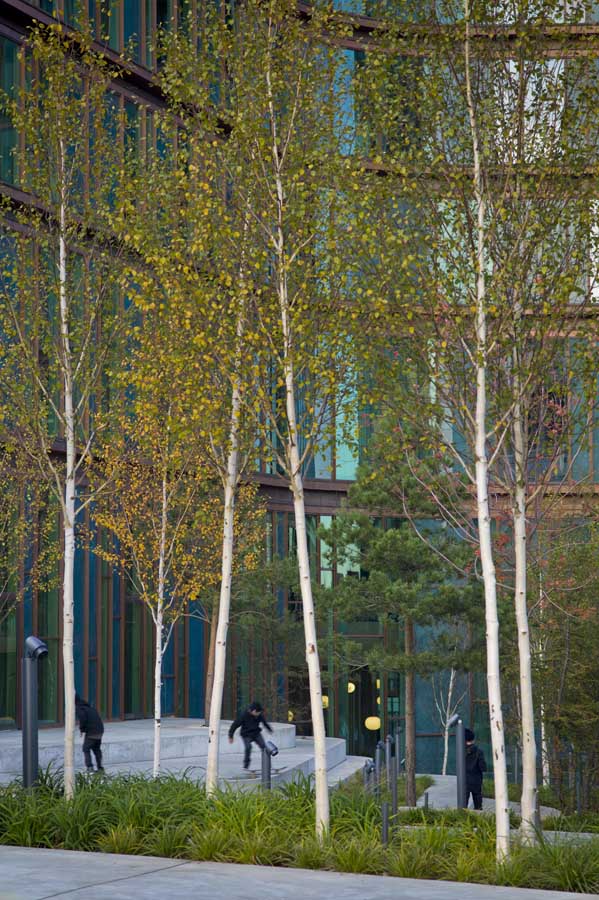
Dune city is the latest urban design offering by SLA in Copenhagen. “Like a giant dune of sand or snow it slips in between and clings around the buildings, thereby creating a spatial coherence in the design.”

The foldedplate design enables the visitor (pedestrians, cyclists, skaters and the walking impaired) to tranverse the elevated landscape between the buildings amidst a vegetated space of reedy grasses and trees. The landscape has been designed to appear flat and two dimensional from a distance but to reveal its true three dimensional character as you move through its spaces. The high albredo effect is said to produce a cooler microclimate during the warmer periods by reflecting the incoming heat and radiation.

Can the the world’s model climate citizen lead the way also with climate sensitive urban design and by its example also change the fate of nations like Mongolia?

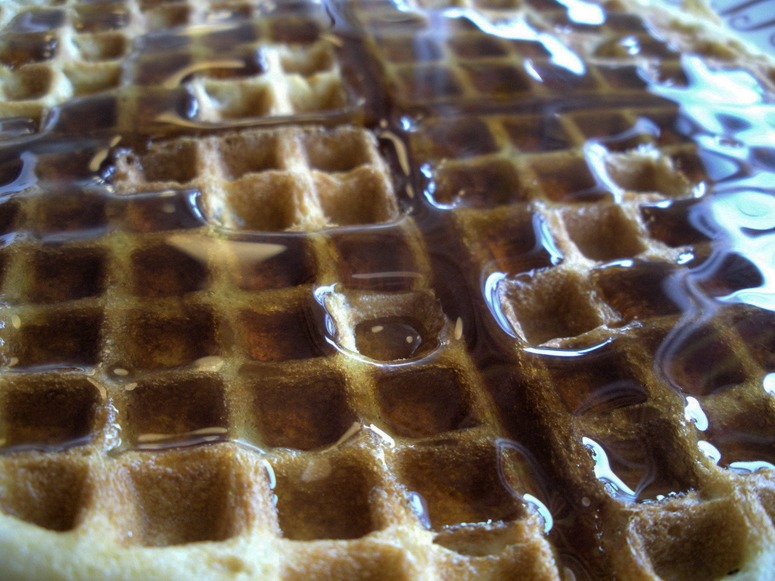
Waffle cities: landscape planning, urban design and architecture for flood-prone regions and global warming

Long term landscape planning for the type of floods which have afflicted Australia could involve designing the landscape in the manner of a regional waffle. Much of the problem seems to have been caused by flows of water on an almost continental scale. The principles, as for Sustainable Urban Drainage Schemes, (SUDS) should be to detain, infiltrate and evapo-transpire flood waters. This process would be assisted by raising embankments where possible: field boundaries, roads, garden boundaries etc should all become dykes. In some cases the dykes would protect against floods but the main objective would be to stop the flood water cascading from zone to zone. Also, the dykes would serve as wild-life corridors and sanctuaries. My guess is that waffle-type measures would be cheaper and more effective than building large dams. The next stage would be to move from flood landscape planning to flood landscape architecture, by finding other uses for the dykes and by making them beautiful as well as useful. Individual properties would gain some similarities to motte-and-bailey Norman castles. Another advantage of waffle landscape planning is that when the rains come there will be more time for water to infiltrate into the ground and re-charge aquifers – in preparation for the next long period of drought. Does anyone know if waffle landscape planning has been considered, and if the engineering calculations have been done?

Image courtesy mhaithaca

Viewing the bigger picture

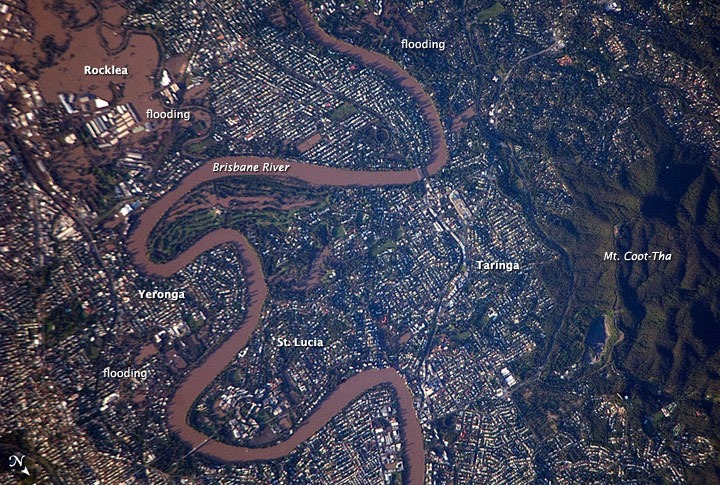
The big question for what happens next for the city of Brisbane and for many cities worldwide is the role of climate change in flood events.

The previous big flood event in the city was in 1974. Since then a dam has been built as flood mitigation and in 2011 it has protected the city from more severe flooding.

However, with climate change, the expected frequency and severity of flooding could be expected to increase. So yes, a competition too – looking at the bigger picture – to design floodable spaces and places for cities would be a great contribution to urban flood defences and urban design.

>

Saving the prickly and cute…

…And all creatures great and small.

Having recently experienced the flooding of my city I am keen to help some of the less visible victims as well. Having spotted a dead echidna by a tree next to a usually busy road in a flood affected inner city suburb, and realizing that he was most probably washed there in the flood waters from Toowoomba, I am keen to start an online charity to assist wildlife.

I am proposing an Ark Appeal for Wildlife. Would gardenvisit be happy to sponsor a charity and gardenvisit readers happy to contribute to it?