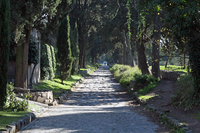
 Appian Way Park
Appian Way Park »
The Appian Way Park has the best preserved section the Rome's imperial roads and travelling along it gives some idea of the Roman campagnia (landscape) in ancient times. It has been designated a regional park and deserves wider recognition as a prime example of a Greenway: it was designed for human- and animal-powered traffic and has been returned to this use. The best possible to way to arrive in Rome is by foot (or bicycle) from Ciampino Airport to the San Sebastiano Gate. It is about 500m from the airport to the Appian Way and one can then tramp, like a centurian or prisioner, to the gates of Rome. For garden historians, part of the interest of the Appian Way landscape lies in its influenc.....
Read more on Appian Way Park
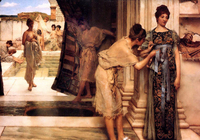 Baths of Caracalla Gardens
Baths of Caracalla Gardens »
<p>The Baths of Caracalla took the form of a large open garden with vast vaulted buildings for public bathing and swimming. They were built c217 A.D. by the emperor Marcus Aurelius Antoninus (also known as Caracalla). Water was supplied by a branch of the Aqua Marcia aqueduct, which brought pure water to Rome from the hills near Subiaco, over 90 km away. It flowed into a large cistern and then through pipes the gardens and buildings. The whole complex, known as a Therme, resembled a modern leisure centre. It had shops, bars and brothels. A garden was laid out around the Baths during the twentieth century but nothing is known about the ancient planting arrangement. Roman Baths were a favourite.....
Read more on Baths of Caracalla Gardens
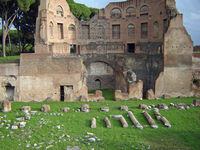 Emperors' Palace (Flavian Palace, Palatine Hill)
Emperors' Palace (Flavian Palace, Palatine Hill) »
Our word 'palace' comes from the Palatine Hill on which the palace of the Roman Emperors was built. Deriving from earlier palaces in Macedonia, Mycenae, Crete and West Asia, the Emperors' Palace was an interpenetration of buildings, roofed colonades and outdoor courts. The surviving courts are among the most easily identifiable features of the Palatine ruins: (1) Augustus Court, in the House of Livia, (2) the oval Nymphaeum in Augustus' palace, originally one of a pair (3) the Labyrinth Court, occupied by a maze-like garden feature, (4) the Fountain Court, now viewed from above, with a rectangular outer canal and semi-circular inner canals, (5) the two Peristyle Courts, one of which contained.....
Read more on Emperors' Palace (Flavian Palace, Palatine Hill)
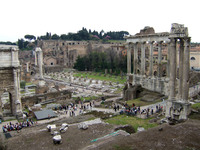 The Forum, Rome
The Forum, Rome »
Every landscape architect should visit the Agora in Athens and the Forum in Rome: they are the most historically important urban open spaces in Europe. Its site is a natural crossing, between the Palatine Hill and the Capitol. The Sacred Way runs between these features and is fronted by public buildings of the first importance. There could be no more significant exemplification of Bill Hillier's theory of Space Syntax: the Forum was highly integrated into Ancient Rome and, partly because there is no entrance charge, remains highly integrated into the modern tourist circuit.
Read more on The Forum, Rome
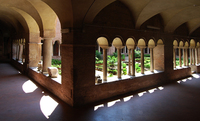 San Lorenzo fuori le Mura
San Lorenzo fuori le Mura »
The north part of the church was built in the 6th century with San Lorenzo's tomb in the catacomb beneath the structure. The south section of the church, on a different alignment, was built in the 12th century. They were joined in 1216. The cloister, also dating from the 12th century has an unusually intimate scale. An illustration from 1924 shows it with a renaissance pattern of gravel and low box hedging. The pattern has been retained and the cloister is now stocked with flowering herbaceous plants, creating a fresh and sweet atmosphere.
Read more on San Lorenzo fuori le Mura
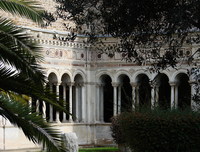 San Giovanni in Laterano
San Giovanni in Laterano »
The Basilica of St John Lateran is Rome's cathedral and oldest church. It has a famous cloister with wonderful twisted columns. The layout of the internal space is, to say the least, disappointing. The obilisk in the Piazza outside the church was brought to Rome, from Thebes, by Constantine. The vestibule of the Basilica houses his statue.
Read more on San Giovanni in Laterano
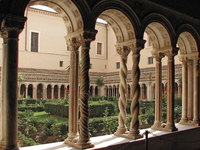 St Paul's Outside the Walls - Cloisters
St Paul's Outside the Walls - Cloisters »
The church, built above the tomb of St Paul, suffered damage over many centuries and a large part of the structure was burnt in 1823. The old cloister, built 1208-1235 with Cosmatesque decoration survived and has an inscription describing the importance of cloisters in the life of a monk - as a place for meditative study. A new and rather boastful cloister was built as part of the new church after 1823.
Read more on St Paul's Outside the Walls - Cloisters
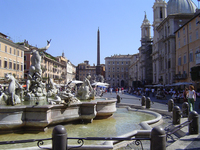 Piazza Navona
Piazza Navona »
The great baroque piazza is on the site of the ancient Circus Domitianus (Domitian's stadium, 86 AD) used for the Agonal games, from which the piazza takes its name ('in agone' - the agony of competitive games - became 'navone' and then 'navona'). Bernini's fountain Fontana dei Quattro Fiumi (Fountain of Four Rivers) was made in 1651 representing the four quarters of the world by rivers (Nile, Danube, Ganges, Plata). The statues at the base of the rock support an obelisk taken from the Circus Massenzio. The piazza is an extremely successful and popular urban space. Some would say it is not a garden, because it lacks vegetation. Others would say it is a public garden, because it has water, scu.....
Read more on Piazza Navona
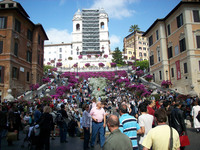 Spanish Steps
Spanish Steps »
The Spanish Steps (la Scalinata) ascend from the Piazza Spagna to the church of Trinita dei Monti. The name came from the Spanish Embassy which used to be in the piazza. The steps were built 1723-1726 to a baroque design by De Specchi. Gian Lorenzo Bernini's Barcaccia Fountain is at the foot of the steps. They became a place for flower sellers and are now strewn with tourists sitting amongst flowers. It is a fine example of how ideas drawn from garden design can lead to a brilliant urban design.
Read more on Spanish Steps
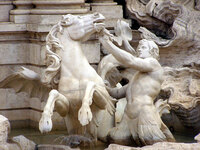 Trevi Fountain
Trevi Fountain »
The Trevi Fountain takes its name from being at the meeting point of three roads (tre vie). It was at the end point of an aqueduct and the Roman custom of building a fountain at the end of an aqueduct was revived. The fountain adjoins Palazzo Poli. A competition for design led to the appointment of Nicola Salvi and the fountain was built 1732-62. The theme is Taming of the waters, realised through a brilliant composition of architecture, rockwork, sculpture and waterworks.The fountain dominates the piazza which is treated by visitors as an outdoor theatre.
Read more on Trevi Fountain
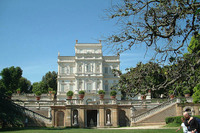 Villa Doria Pamphili
Villa Doria Pamphili »
<p>The estate was laid out by Prince Camilo Pamphili after 1650. Today, the Casino del Bel Respiro is at the centre of a large Serpentine Style Park. Since 1965 it has been Rome's largest public park with a fine hilltop site. A renaissance-type garden survives by the Casino.</p>
Read more on Villa Doria Pamphili
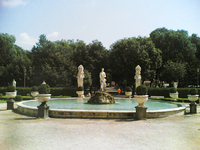 Villa Borghese
Villa Borghese »
<p>The villa was built by a nephew of Scipio Borghese (Pope Paul V ) with a celebrated baroque garden. In the nineteenth century it became an 'English garden' and in 1901 a state-owned public park. One can glimpse the former magnificance and restoration works are being undertaken. It is a cool place on a hot day.</p>
<p>
<object classid="clsid:D27CDB6E-AE6D-11cf-96B8-444553540000" width="400" height="300" type="application/x-shockwave-flash" data="http://www.flickr.com/apps/video/stewart.swf?v=63881">
<param name="flashvars" value="intl_lang=en-us&photo_secret=aeaf7f0f85&photo_id=2597911910&show_info_box=true" />
<param name="movie" value="http://www.flickr.com/apps/video/stew.....
Read more on Villa Borghese
 Vatican Palace
Vatican Palace »
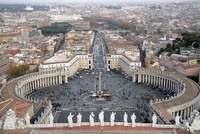
<p>The Vatican has a central place in the history of garden design. As Macaulay pointed out, the papacy was the only institution to live from ancient times to modern times. St Peter's Basilica was built in the 4th century. When re-built in the 16th century the Vatican City became, in essence, a renaissance castle garden. Visitors should note the fortified garden, the Belvedere Court (1505) , the Villa Pia (1560) , the Piazza of St Peter (1656) and the nineteenth century English garden. [The Piazza can be seen at any time. The remains of the Belvedere Court can be seen when visiting the Vatican Museum. The Villa Pia and the English Garden can be seen only by arrangement or during a booked tour.....
Read more on Vatican Palace