London recreational looting in August 2011

by Tom Turner @ 7:11 pm August 10, 2011 -- Filed under: urban food   

Hozinja took this photo and made this comment ‘Caught in the middle of rioting on my way home last night. Fortunately the trouble was brief on Walworth Road and no buildings were set alight. Just young kids sensessly looting. These two girls stormed out of Boots with a few pickings as the police were making their way down the road.’ The two girls are wicked but they are not ‘senseless’. They are looting a shop and they know that they are unlikely to be arrested. If, as elsewhere, a large group is involved then it would be riot (‘A violent disturbance of the peace by a crowd’) and I agree with Christine that the Riot Act should be read and enforced. This act was a British statue from 1715-1973. It may have been in need of modification but it should not have been repealed. Our forebears were right to involve a non-policeman in the decision. Typically a magistrate would read the Riot Act and anyone who remained at the scene would be guilty for that reason alone. The wording was ‘Our Sovereign Lord the King chargeth and commandeth all persons, being assembled, immediately to disperse themselves, and peaceably to depart to their habitations, or to their lawful business, upon the pains contained in the act made in the first year of King George, for preventing tumults and riotous assemblies. God Save the King!’
But how to deal with the riot is less important than the prevention of future riots. I agree with John Bird (founder of the Big Issue magazine) that every person who receives unemployment benefit should do something in return for the money. But what could they do? My suggestion, thinking about my area of interest, is that 20% of the greenspace in London could be used for urban agriculture and that the work could be done by the presently unemployed.
Straying outside my professional interests, there are many elderly and infirm people who could stay on in their own homes, instead of being brutalised in ‘care’ homes, if they had personal helpers.
The underlying truth is that ‘the devil makes work for idle hands’ – assuming he counts looting a Boots shop as ‘work’.

When landscape design becomes city cosmetics…

by Jerry @ 1:49 pm August 2, 2011 -- Filed under: Asian gardens and landscapes,Sustainable design,Urban Design   


Please have a lookat the left illustration: a young lady is applying a red lipstick.  It is widely known that the love for beauty is part of the nature of all human beings,  so making up becomes the most direct way to help ladies become prettier.  They  choose different kinds of cosmetics and use various ways to ‘design’ their faces.  Cosmetics are very good at changing the visual quality of a face, but it has no relationship with a person’s health.  Although everyone knows this truth, they still insist doing the decoration job.

These days,  it seems that a cosmetic method has started in urban design and that a lot of landscape works are like the right-hand photo. A great deal of decorative flowers are put in public open spaces insead of big trees.  The gardeners say that the flowers do not stay in position more than three months and they have to change them very often to get a good shape of the landscape design!  The gardeners also have to irrigate them properly every day. So, the whole process costs plenty of money and labour.  This kind of public open space may be beautiful, but the main problem is that people can not do anything except watch it all the time!  If the rain comes, people could not sit there, similarly, when the sun comes out there is either no space for people to stay. Even worse, when the flood comes there is no doubt that this landscape design will not be helpful at all. Becasue it has no difference as the cosmetics to a lady’s health!

Therefore, when landscape design becomes city’s cosmetics it is a big disaster for the citizens.  The landscape profession in the 21st century should pay more attention to urban safty, sustainability and ecology in order to create a healthy and livable cities – and escape form the role of city cosmetics.

GM Green Wall in Trafalgar Square designed by Shelley Mosco landscape architect

by Tom Turner @ 10:33 am June 11, 2011 -- Filed under: Garden Design,green walls   

It is a pleasure to have a green wall in Trafalgar Square this summer, to cover some scaffolding. The green wall was sponsored by GE and the National Gallery, as part of its Carbon Plan. It was designed by landscape architect Shelley Mosco. It is based on Van Gogh’s Wheat Field with Cypresses (below left). Shelley’s planting design (below right) uses pointillist planting blocks for texture. The wall has 36 different species in 250x500mm modules, each containing 14 cells of 125x76mm). The living green wall is 4.8m x 7m and has over 8000 plants. Shelley is also interested in living green walls made with native plants,using a GIS system to guide plant selection for particular localities.

Waffle levee flood planning for the Mississippi

by Tom Turner @ 6:06 pm May 24, 2011 -- Filed under: landscape planning,Sustainable design,urban design flooding   

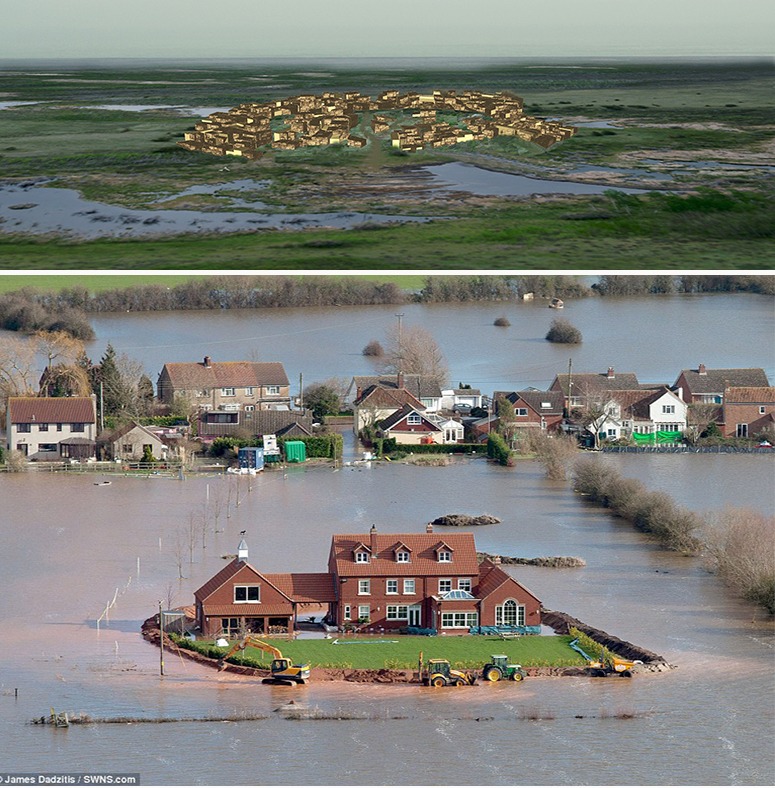
I was pleased to see that our post on Waffle cities: landscape planning, urban design and architecture for flood-prone regions and global warming has been verified as feasible. The snippet (courtesy of London Evening Standard 20.05.2011) shows that a homeowner in Vicksburg has made his home into the ‘cell of a waffle’ and that the self-build levee protected his home from the Mississippi floods of spring 2011. Congratulations!

Grow your own food with sunlight – instead of eating oil

by Tom Turner @ 5:27 am May 17, 2011 -- Filed under: Garden Design,urban food   

It takes four glasses of oil to make one hamburger


Most of the oil is used to produce the nitrogen used to grow the ingredients for the burger – according to Michael Pollan. The alternative is to eat locally grown food for which the energy comes from the sun – and from human labour. If there was to be a return to ‘sun-grown’, instead of ‘oil-grown’ food then agriculural employment would have to rise again after a long fall.
The other point about a burger-rich diet is that it is extremely bad for your health. The US healthcare crisis is said to be is a consequence of the US diet which is a consequence of the US pattern of agricultural subsidies. In Europe, the pattern is similar but not so severe.
Landscape architects and garden designers can do a little to ameliorate the problem: they can include food plants in their planting designs.

Above image courtesy Pete Foley. Below image, of a local garden in Berkeley, California, courtesy hfordsa

Is Turenscape’s Qiaoyuan Park in Tianjin a model for Chinese landscape architecture? 请看一看土人景观事务所的作品-天津桥园公园

by Tom Turner @ 8:04 am May 10, 2011 -- Filed under: Asian gardens and landscapes,context-sensitive design,Garden Design,SUDS urban water   


Please have a look at Turenscape’s photographs of Tianjin Qiaoyuan Park – you can see why the American Society of Landscape Architects (ASLA) gave Tianjin Qiaoyuan Park an award.  Then please consider the above photographs. They were taken on a crisp Sunday in April: the park is bare, dry and without people. Did the ASLA act in haste? Did the ASLA judges visit Tianjin? Are the ASLA judges regretting their decision? If the design was as good as it looks on the designers’ photographs, shouldn’t it be full of people on a spring day?  North China has long hard winters. When spring arrives, everyone wants to warm their bones, stock up on Vitamin D, and admire the spring blossom. So where were all the people? Presumably they are in other parks, with water features which do not dry up and with flowers which smile at their admirers in spring.
My second thought concerns the sources for the design ideas. Designers always borrow, so where might the  ideas have come from? I sense three parents, which is an unusual number: (1) Bernard Tschumi’s design for Parc de laVillette (2) Peter Latz’ design for Duisberg Nord (3) Herbert Dreiseitl’s Waterscape approach. The use of red paint is traditional in China but it is also found at Parc la Villette.
My third thought is that borrowing visual imagery is rarely enough to make a good design. Duisborg Nord relates to the industrial history of Germany. Parc de la Villette relates to the structuralist theorizing of Gitanes cigarettes and Left Bank Paris. The Dreiseitl Waterscape approach may have a worldwide relevance – but it must be adjusted to the rainfall regimen of every locality: water cannot, should not, must not be the aesthetic focus of a design if a place which is going to be dry for half the year.
My conclusion is that the Single Agreed Law of Landscape Design should be applied as rigorously in China as in ever other square millimetre of land which the gods have made. Alexander Pope expressed it thus:

That tells the waters or to rise, or fall;
Or helps th’ ambitious hill the heav’ns to scale,
Or scoops in circling theatres the vale;
Calls in the country, catches opening glades,
Joins willing woods, and varies shades from shades,
Now breaks, or now directs, th’ intending lines;
Paints as you plant, and, as you work, designs.

请看一案土人景观事务所设计的天津桥园公园的照片, 然后你就知道为什么美国风景园林师协会授予天津桥园公园授奖。然后请再考虑一下上面的几幅图片。这组照片拍摄于今年四月一个舒爽的周日:天津桥园公园几乎是“赤裸裸”,干旱而鲜见游客。是不是ASLA草率地授奖了呢?ASLA的评审专家是否来天津参观过呢?ASLA的评委现在是不是在对他们的评审懊悔不已呢? 如果这个设计真的像设计师所拍摄的照片那样,为什么在春季美好的日子里公园中不是充满了游客呢?中国北方的冬季漫长而寒冷。当春季来临,每一个人都希望到户外晒晒太阳,贮存更多维他命D,并欣赏花开。但是,这里的人们都哪里去了呢?或者,他们都去了其它公园了吧,那里有春水和鲜花的微笑。

我的第二点思考是关于桥园公园设计理念的来源。设计师们总是喜欢“借用”。所以这个公园设计理念从何而来呢? 我感觉它至少有三个“家长”,这个数量还挺不寻常的:(1)伯纳德·曲米的維葉特公園设计 (2)彼得·拉兹的杜伊斯堡·诺德设计(3)赫伯特·德莱赛特尔的理水方法。红色是中国传统的象征,但是在维葉特公园也使用了红色。

我的结论是“园林设计单一约定法规”应该在中国被严格执行,正如在上帝创造的其余哪怕是一平方毫米的土地上执行一样。正如亚历山大·蒲柏(Alexander Pope)所言。

Understanding density?

Density is much more complex than its seems. U-Thant 7 Residences in Malaysia are described as luxury “low density condominiums.” In terms of their built form they would usually be considered a medium density form of living. The context, however, is more typical of low density or even rural or semi-rural settings with a formal park-like foreground setting and a natural background setting.

Undoubtably there are many more examples of this kind. The Cultural Centre design by Paul Eluard in Cugnaux, France attempts to address the contemporary needs of an historical low density city within the landscape.

Dublin is considered to be a low density city. The economic challenges it faces and the resulting contemporary waves of youth emigration suggests that Dublin may remain low density for some time into the future.

So, are we really viewing a population redistribution in global terms with some areas de-populating and others re-populating or increasing in population? What does this trend suggest for the future of our cities, for greenspaces and for wilderness?

Might King Will and Queen Kate restore pagan tree-worship to its rightful place in British culture?

by Tom Turner @ 8:00 am April 29, 2011 -- Filed under: Asian gardens and landscapes,garden history,urban forestry   

Sacred trees entering Westminster Abbey and contemporary Britain?


The Daily Mail reports that ‘Miss Middleton, 29, who studied history of art at St Andrew’s, has devised a theme which she says ‘pays tribute to the Language of Flowers’ – an idea that is bound to have gone down well with her gardening-obsessed father-in-law, Prince Charles, who famously admitted that he talks to his plants’.
One wonders if her history of art course included what little is known of paganism in the British Isles. Prince Charles wanted to become the ‘defender of faiths’ (instead of merely the Defender of Faith (Fidei Defensor). As the AP photograph shows, she has used trees to decorate Westminster Abbey. Tree worship was common throughout Europe before the advent of Christianity. I might become a strong supporter of the monarchy if the King Will and Queen Kate restore paganism to its proper place as one of the world’s major ‘religions’. It has a kinship with Hinduism, Daoism, Shinto and the religions of pre-Islamic West Asia.
I wish the young couple well but was not pleased to hear that the Metropolitan Police would deal harshly with protestors. Why shouldn’t we protest against vicious despots being invited to Britain and protected with millions of pounds from the public purse? It made me wonder about a small protest of my own. The best I could think of was sticking a postage stamp to the pavement outside Westminster Abbey and taking a video of people treading upon it. Instead, I will remember the trees and send and send Will & Kate every good wish from Gardenvisit.com. Like them, I am an alumni if St Andrews University.

City farming with Castanea sativa, the sweet, beautiful and delicious chestnut

by Tom Turner @ 6:30 am April 15, 2011 -- Filed under: Sustainable design,urban food,urban forestry   
Charles II planted avenues of sweet chestnut in Greenwich Park in 1660 - and they continue to yield a good crop of delicious nuts

Charles II planted avenues of sweet chestnut in Greenwich Park in 1660 - and they continue to yield a good crop of delicious nuts

The yield from a mature woodland of Castanea sativa is similar to the yield of rice from a paddy field, both nutritionally and in terms of harvested weight:

  • Chestunt yields range from 1-5 tonnes per hectare (this figure could be raised by careful management).
  • A good individual chestnut tree may yield up to 25 kg per year.
  • Rice yields, in the Phillipines, were raised from 1.16 tons per hectare in 1960 (according to the United Nations Food and Agriculture Organization) to 3.59 tons per hectare in 2009. The yield from organic rice is about one third the yield for intensively farmed rice.
  • Chestnut timber is highly valued and is said to be more durable that oak when used outdoors.
  • The land beneath and around the chestnut trees in Greenwich Park was used for grazing deer, which provided organic  meat.
  • When growing chestnuts, you do not need to spend half your life bent double in muddy water being eaten alive by insects which enjoy the hot steamy conditions more than you do
  • Harvesting chestnuts provides healthy autumn exercise for urban populations

So here is my call to the world’s landscape architects: plant parks and road verges with Castanea sativa, the Sweet, Beautiful and Nutricious Chestnut Tree! You can make a substantial contribution to (1) world food supply (2) world biodiversity (3) combating global warming (4) nutrition, exercise and health. The health benefits of chestnuts are as follows:

  • Chestnuts, unlike other nuts and seeds, are relatively low in calories; contain less fat but are rich in minerals, vitamins and phyto-nutrients that benefit health.
  • Nutritionally, chestnuts are similar to other starchy foods such as sweet potato, sweet corn, potatoes etc, consisting of mainly starch. However, they also contain high quality proteins.
  • Chestnuts are good source of dietary fiber; they provide 8.1 g (about 21% of RDI) per 100 g. Fiber diet helps lower blood cholesterol levels by remove excess cholesterol absorbing in the intestines.
  • Chestnuts stand out from other nuts and seeds because of their nutrition contents. They are exceptionally rich in vitamin-C. 100 g nuts provide 43 mg of vitamin C (72 % of DRI). Vitamin C is essential for the formation of matrix in teeth, bones and blood vessels. Being a strong anti-oxidant, it offers protection from harmful free radicals.
  • Chestnuts are the one of the nuts rich in folates. 100 g nuts provide 62 mg of folates (or 15.5%). Folic acid is required for the formation of red blood cells, DNA synthesis. Adequate consumption of food rich in folates during peri-conception period helps prevent neural tube defects in the fetus.
  • Chestnuts are a rich source of mono-unsaturated fatty like oleic acid (18:1) and palmitoleic acids (16:1). Studies suggest that monounsaturated fats in the diet help lower total as well as LDL (bad cholesterol) and increase HDL (good cholesterol) levels in the blood. Mediterranean diet which is rich in dietary fiber, monounsaturated fatty acids, omega fatty acids and antioxidants help prevent coronary artery disease and strokes by favoring healthy blood lipid profile.
  • Chestnuts are an excellent source of minerals such as iron, calcium, potassium, magnesium, manganese, phosphorus and zinc. Provide very good amount of potassium (518 mcg / 100 g). Potassium helps counter hypertensive action of sodium, lowers heart rate and blood pressure. Iron helps prevent microcytic-anemia. Magnesium and phosphorus are important components of bone metabolism.
  • Chestnuts are also rich in many important B-complex groups of vitamins. 100 g of nuts provide 11% of niacin, 29% of pyridoxine (vit.B-6), 100% of thiamin, and 12% of riboflavin.
  • Chestnuts, like hazelnuts and almonds, are free in gluten and therefore popular ingredient in the preparation of gluten free food formulas for gluten-sensitive, wheat allergy and celiac disease persons.
  • The Chinese Chestnut (Castanea mollissima) is particularly rich in vitamin A. It provides 202 IU per 100 g.

Price comparison: organic rice and organic chestnuts:

AND DON’T FORGET: Chestnuts are delicious.


Food glorious food

Modern life presents numerous paradoxes. Perhaps the first is the widespread trade in food produce and the convenience of supermarket shopping, that has somehow alienated society from the concept that all food is land or sea based. And this means – land area & sea area – must be used, managed and preserved for this purpose, generally in some direct relationship with the population that must be feed.

Can all nations feed their own populations within the bounds of their own land and sea resources?

“Some countries just do not have the land to feed their year-2000 populations even at high yields. They include Afghanistan, Bangladesh, Algeria, Somalia, Lesotho, Haiti, and much of the Middle East. Some of these countries have resources they can trade for food; others do not. After the year 2000, if populations go on growing, other countries come onto the critical list, including Egypt, Ethiopia, Kenya, Nigeria, India, Pakistan, Iran, Iraq, Syria.”

How is sustainable agriculture and aquaculture to be understood?

« Older PostsNewer Posts »