
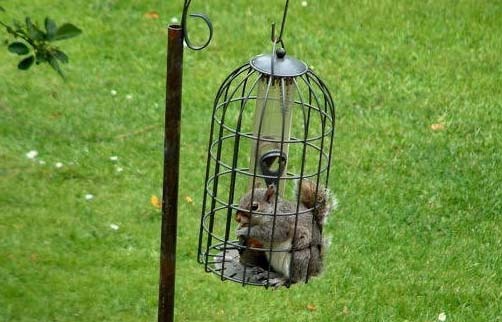
This well-made and potentially useful garden product was advertised and sold as a “squirrel-proof bird feeder” – or was it a “bird-proof squirrel feeder”?
This well-made and potentially useful garden product was advertised and sold as a “squirrel-proof bird feeder” – or was it a “bird-proof squirrel feeder”?
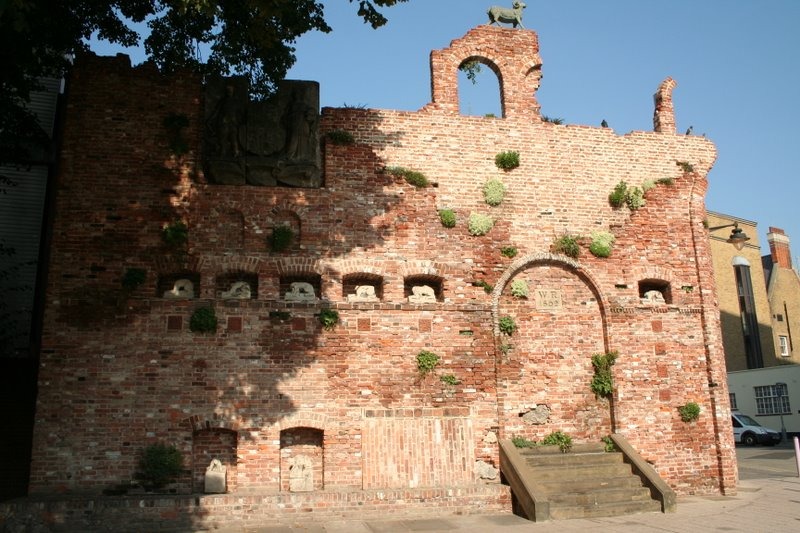
Nothwithstanding our criticism of the urban design of Barking Town Square, Muf deserve an award for an excellent piece of public art on the northeast side of the Square. Muf state that ‘The folly screens the flank wall of Iceland supermarket and makes the fourth elevation to the town square. The folly is comprised of architectural salvage and recovers the texture of lost historic fabric of the town centre; it stands as a mementomori to this current cycle of regeneration.’
Unlike the usual ‘Turd in the Plaza’ approach to public art, this wall:
(1) serves an urban design objective by enclosing the space
(2) picks up on the historic context of Barking
(3) pleases the eye without being attention-seeking
I wish we could have more context-sensitive public art.
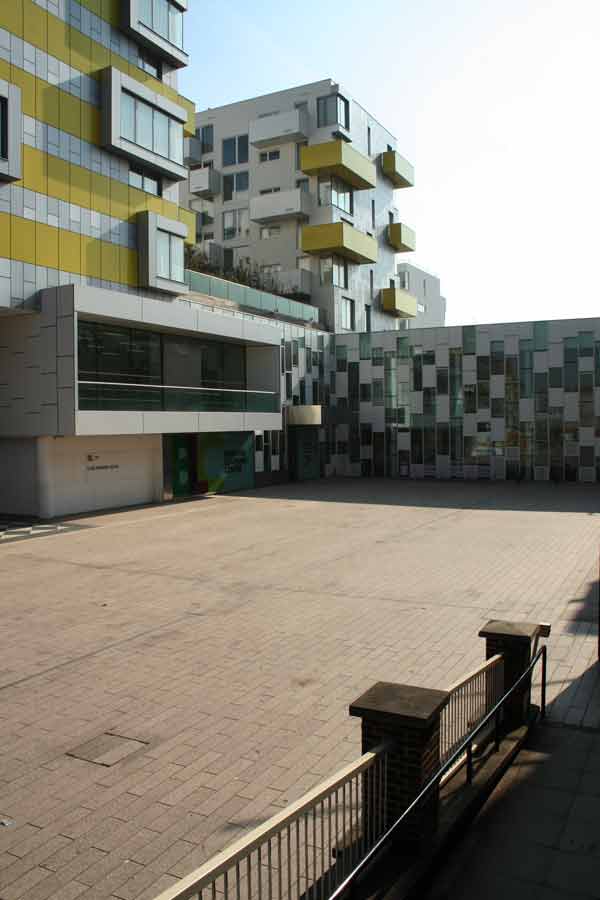
I’d never been to Barking. But in 2008 Barking Town Square won the the 5th European Prize for Urban Public Space so I went to have a look. Sorry about the weak pun, but the judges are Barking Mad. The main building has a sentimental Bauhaus-ey charm but the urban space is a plain rectangle of pink Spanish granite, laid in stretcher bond for no good reason. The hoardings illustrate some planting to come but the “Public Open Space” is a void, an empty space, a nothing. The judges all represent organizations which promote the art of architecture, which is fair enough, because the building is OK, but this is NOT a good urban square. It is as though Jane Jacobs and William H Whyte had never lived. There is no mixed use: the adjoining buildings are all municipal, without the shops and cafes which might have provided users. There is nowhere to sit, ignoring wisdom of Jan Ghel. The ‘square’ is almost a cul-de-sac, ignoring Ed Bacon and Bill Hillier. The paving is non-SUDS. The only redeeming feature is a piece of public art described as a “7 metre high folly [which] recreates a fragment of the imaginary lost past of Barking”. But why re-create an imaginary lost past? Barking had a medieval abbey. Captain Cook was married in a Barking church. Then there is the cultural context. Barking has one of the largest immigrant communities in London, with many from the Punjab and Sub-Saharan Africa – neither of which region is known to admire the Bauhaus. Some architects show genius in urban design. Muf muffed it.
Note: The photograph was taken at about 11.30 am on an unseasonably warm autumn day (28th September 2008). The good urban spaces in London were overflowing with people. The places which remind one of pre-1989 East Berlin were empty.
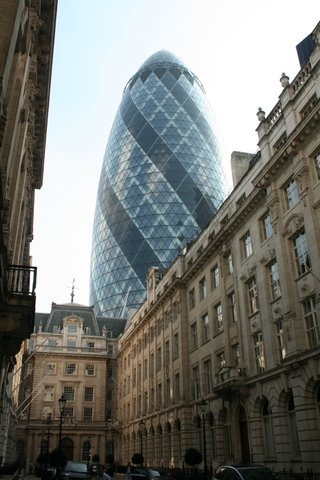
Although the historic and modern medium density London is not visible from Bishops Square in this photograph, Foster thankfully has provided the city with a Landmark building which orientates us within a largely visually undifferentiated urban environment; and the green space and water garden provide the amenity so beloved of London’s inner city squares.
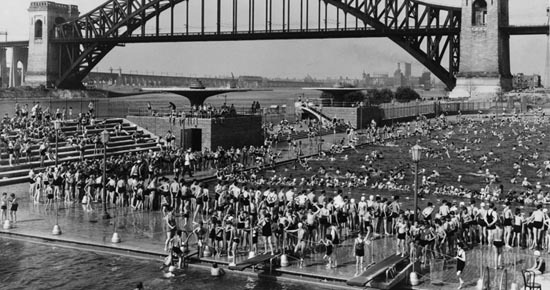
Visions of Sydney at Hells Gate
A case of de ja vu. Sometimes a familiar landmark isn’t quite what you think it is. And you experience a sense of disorientation…haven’t I seen this place before? It is somehow familiar yet very strangely different…
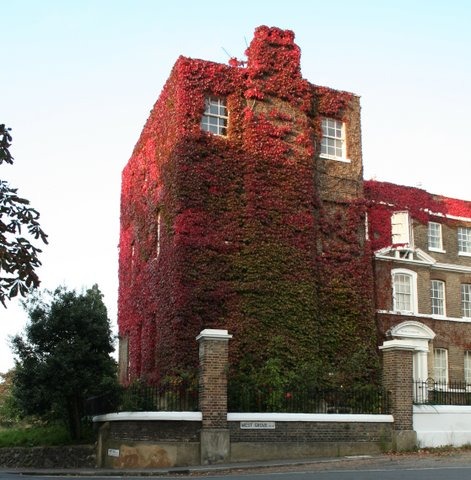 This building is green in summer and red in autumn. It makes a useful contribution to re-balancing the carbon cycle, by absorbing CO2. Undesirable particulates (dust!) stick to leaves and are swept up in autumn. The leaves shield the building from undue solar gain in summer. Traffic noise is absorbed. Birds and insects find habitats amongst the vegetation. It is a beautiful building (Point House facing Blackheath in South London). Why can’t we have more facades treated like this? Call them vertical gardens if it would help. Co-ordinated planting on discordant buildings would harmonize argumentative buildings.