
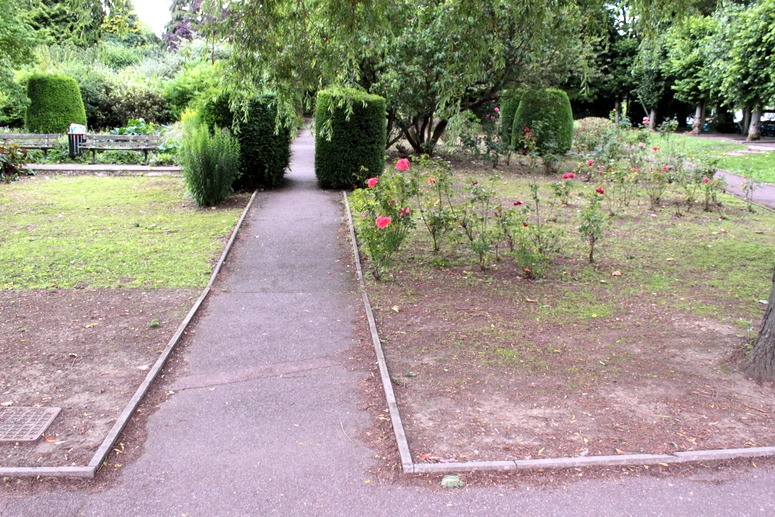
Is this a lawn, a rose garden or a slum? No. It is one of Susan Jellicoe's favourite planting designs - as 'managed' by Dacorum District Council
Geoffrey Jellicoe was an optimist. Susan, who did the planting design, was a pessimist. Their friend, Brenda Colvin, was even more of a pessimist. Remembering how many of her planting designs had been wrecked, Brenda Colvin remarked that ‘landscape architecture is a depressing profession – and the older you get the more depressing it gets’. As an optimist, I believe the Water Gardens will be restored. The Garden History Society held a 1-day conference about them last year. But the management needs to change. Why doesn’t Dacorum District Council use volunteers? Three of the truths to be universially acknowledged are (1) a volunteer is worth ten pressed men (2) two old ladies can maintain a garden more effectively than 10 well-equipped youths in green sweatshirts – because they know WHAT to do (3) in this world, you get more for love than you get for money.
Why don’t UK parks departments make more use of volunteers? It is very common in the US; it works well in Chiswick Park; it is normal practice in National Trust gardens. The reason, I wearily suppose, is that our trades unions do not like volunteers. They want more jobs for their own members. So the Hemel Hempstead Water Gardens can go to hell – or, better, they can extend the hellish car parks which have become the main ‘feature’ of the park since DDC took over from Hemel Hempsted Development Corporation. Parking costs about 60p/hour and they have 750 spaces, open 24 hours/day. If one assumes an occupancy of 30% then the weekly income (7x24x0.3×0.6×750) is £22,680. My suggestion is to give the £680 to the two old ladies, who would probably give it to a good cause.
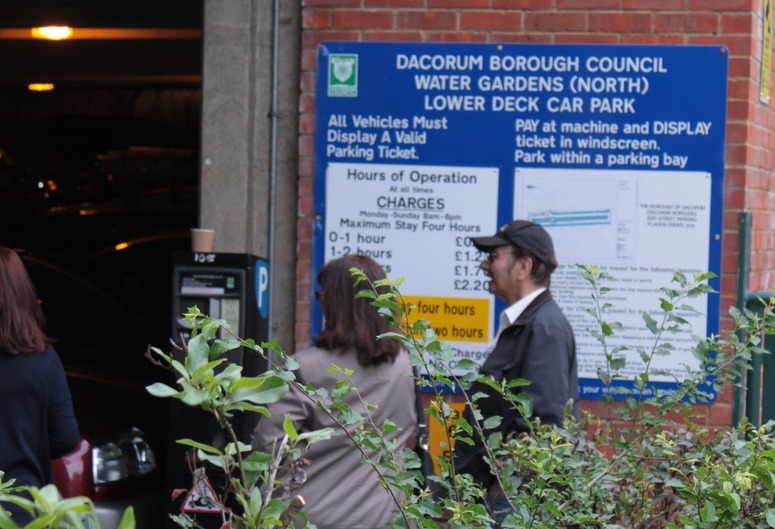
Hemel Hempstead have muddled the ideas of 'car park' and 'public park'. Since this place is called a Water GARDEN the mistake should not have been made.
The water gardens by Jellicoe are characterised as ornamental. [ http://images.francisfrith.com/c10/450/19/H255041.jpg ] Taking inspiration from Paul Klee, Jellicoe’s intention was “to create a place for pleasure and relaxation, by way of a sophisticated, well-arranged linear public park to create certain illusions and impressions.” [ http://www.parksandgardens.ac.uk/component/option,com_parksandgardens/task,site/id,6949/tab,history/Itemid,292/ ]
Garden management is every bit as important as garden design to garden history, and ultimately to the experience of garden heritage.
[ http://www.flickr.com/photos/33299771@N05/3103801013/ ]
I love the b&w photograph – and what a contrast with the 2009 and 2011 photographs. The optimism and idealism of the 1950s can be seen to have given way to the sleazy materialism of the early twenty-first century. Perhaps one can also say this of the Bauhaus. The healthy bright ‘crystal new world’ they envisaged gave rise to a million now-decrepit blocks inhabited, one imagines, by families who would rather live at ground level and salarymen who, one imagines, are looking forward to their next game of golf. They should give some of their spare time to working as volunteers on the maintenance of public gardens!
Yes. It does seem that the early twentyfirst century is a difficult era, yet perhaps there are signs of optimism that here too. [ http://www.buga-2009.de/en/garden-festival/the-buga-site/the-seven-gardens/21st-century-garden/ ]. See slideshow [ http://www.flickr.com/groups/buga2009/pool/show/ ]
mmmm need a ‘friends of…’ for this Park. there are a lot of successful societies in and around London (including avery Hill) so precedents have been set. Just needs local enthusiastic ‘Old Ladies, keen students and and a busy body to organise it all (think Linda Snell of the Archers R4).
Definitely, the Water Gardens needs friends. But they could also benefit from the local parks department giving some up of its power and resources to the people (including old ladies and enthusiastic students).
Unfortunately ,Cameron has hijacked this with his big society push , so the park staff are probably (and rightly ) suspicious. So it needs to be handled with wisdom, so the budget and jobs remain with volunteers seen as a bonus…Call me Red Grant!
The problem with maintenance undertaken by councils or by their contractors is firstly cost, whoever has the contract has to cut costs to the point that only basic maintenance will be undertaken, for instance, mulching, spraying and weeding go out the window. Secondly, the men or women that turn up each morning have their daily round or targets which leaves no time to undertake a proper job, and they get into their trucks with second rate tools and little knowledge of horticulture. Give them a lawn mower and they will mow all day, give them pruning tools and they do untold damage. In my experience of this kind of maintenance I have rarely found a worker truely knowledgable (roses deadheaded by just clipping of the flower heads is common) and proud of what they do.
What to do, instill pride by the knowledge that the gardeners are maintaining our heritage and what they do is of worth, instigate a policy of professional development allowing time out for horticultural courses and allow the correct amount of time for maintenance and the correct amount of funding. If the workers see that the council values this park and puts in the proper support things will change. Its a shame that councils hold the purse strings and are happy to take the lowest tender. If this park is restored it will just be a circle around to the next time, once the work is finished its count down to the next restoration due to the same maintenance regime still in place.
I dont hold out any hope of change, most parks and gardens maintenance contractors are more than happy to pay poor wages and take anybody off the dole queue and plonk them in a truck and send them off to look after our parks and gardens. The gardeners are doing mainly as instructed, its not there fault that the council is only interested in token input, another case of cost over what is really important. I suppose blaming the council is also a little unfair when the last goverments must also take the blame.
Stephen, true we live in a privatised world thus the ‘buck of blame’ is passed around.
Training and Pride good observation.
So as usual a lot of grey for government to side step.
The whole system of funding needs a re-think.
Any idea’s?
Stephen’s account of how parks are maintained co-incides exactly with my observation of Hemel Hempstead’s Water Gardens. The current system is not working and it therefore has to change. I entirely agree that there is no point whatsoever in undertaking an expensive ‘restoration’ and then following it with 25 years of neglect.
Grant, I have an idea: involve volunteers in park maintenance. This is normal practice in the US. Why shouldn’t it work as well in Britain’s public parks as it does in Britain’s National Trust gardens? You could even call it a Big Society initiative to make it politically correct.
The current park maintainance and management arrangements have to change if they are not working. Greenwich Council has improved its system in the past decade but still lacks responsiveness and, so far as I know, does not involve volunteers. Why shouldn’t Dacorum District Council change its ways? Have they commissioned a parks strategy in recent years? If not, why not?
Don’t expect councils to do any more than the basic minimum – they don’t have the money – especially Dacorum. Remember that “the council” is only your representative, doing things for the ‘public good’ on your behalf. If you want to make improvements to your environment, you should be able to do it – after consultation – by yourself (or through a ‘Friends’ group). I’m a firm believer in ‘driect action’ and I would support the ‘Friends of the Water Gardens’ if such a group was set up.
I agree: the best hope for the Water Gardens is for volunteers to take over the work. Anyone who does not have their own garden is likely to find the work a great pleasure.
Is there a historical plan of these gardens available anywhere?
I do not have a copy to hand, but there must be a plan in Michael Spens’ book The complete works of Geoffrey Jellicoe
Tom, thank you…. I’m sitting in Australia, and feel your frustration and passion. I would want to volunteer to activate the human energy needed for this garden, to create the feeling of love and connection the water gardens were created. Water has a metaphysical connection with the human energy. The space of our surroundings is just as important as a Picasso that rests on a wall. Keep up the passion!
I think the only disgrace is that these ‘Water Gardens’ are going to be restored! What flows through the centre of the gardens is the River Gade – a chalk stream. There are only 200 chalk streams in the world. Their main characteristics are high flows, riffles and pools and clean gravel beds. None of these characteristics still exist with the River Gade through Jellicoe’s garden.
The destruction of the natural river channel through canalisation (i.e. concrete-lining the channel) and weirs has lead to slow flows, causing all of the silt to deposit on the bed of the channel. This is why without regular, ongoing, expensive maintenance, the channels look dirty and attract the geese. I think everyone who has seen them can agree that the geese have caused a lot of problems.
Surely as keen gardeners you would rather see a natural river channel with native planting to the banks, and improved green infrastructure in the town? Much of the actual ‘gardens’ can of course be retained and enhanced – in any style people wish.
Thank you for raising the issue of the chalk stream, which needs to be considered and discussed. Would you also argue that the River Thames in London should be restored to its condition when the Roman’s arrived? It was perhaps twice its present width and flanked by water marshes. I am pleased that landscape architects are doing habitat re-creation work on the river margins (eg on the east side of the Greenwich Peninsula) but I would not argue for the demolition of the buildings between the river and its old margin in Central London. The Strand, for example, was given this name because it was a waterfront route.
Giving the example of the Thames is completely off the point and a red herring. The Thames is NOT a chalk stream. The Gade that makes up the Water Gardens is.
The weirs placed in the water gardens cause the flows to slow almost to a standstill, releasing all of the silt and leaving not a nice looking channel. So ultimately, to keep Jellicoe’s ‘vision’ looking pristine is going to take a lot of time and expense. Not only that, but ecology does not benefit from the concrete channel, low flows and warmer water – except for the annoying and messy geese of course!
Why not restore the chalk stream to a naturalised course with huge benefits for ecology and amenity values too. How much nicer would it be to see an otter or a water vole rather than all those geese.
Perhaps Jellicoe’s vision could be recreated elsewhere in the town, and using water fed off the river, rather than being part of the river channel.
In the nearby town of Aylesbury, there is a huge monstrosity of a 60’s concrete tower block in the town centre. No doubt this is considered a good example of the brutalist architecture that was so prevalent at the time. Of course, the majority of residents think it is ugly and needs to be replaced with something more fitting for the 21st century. I think the same applies to the Water Gardens.
The only people who really care about the Water Gardens being restored to their original vision are older people with 50’s memories, ‘garden’ enthusiasts, and architecture scholars. I guarantee that if you gave Mr & Mrs Bloggs the choice of Jellicoe’s vision or a naturalised watercourse – the green, natural watercourse would win hands down.
The london reach of Thames was never a chalk stream but it WAS a natural watercourse. Nobody suggests restoring its natural condition but work is being done to create habitats on its shores eg round the Greenwich Peninsula as part of the Millennium celebrations.
When my mum took first took me to a zoo, when I was about 8 years old, she took a tin of syrup and I was allowed to throw it to a polar bear in a pit. Lots of people fed the animals and this has been completely stopped. This, I suggest, is the first thing to try with the Gade in the Water Gardens. People must be educated to stop feeding the geese and ducks. This is certain to bring about an improvement in the water quality. My guess is that avian excrement is a much greater problem than weirs. When the main problem has been solved we can see what else needs to be done. But if you were to rely entirely on a vox pop to decide how to care for habitats and great works of art then Hemel Hempstead would have few of either.
The Water Gardens could be both a wonderful habitat and a famous work of art – and the people would surely love both.