
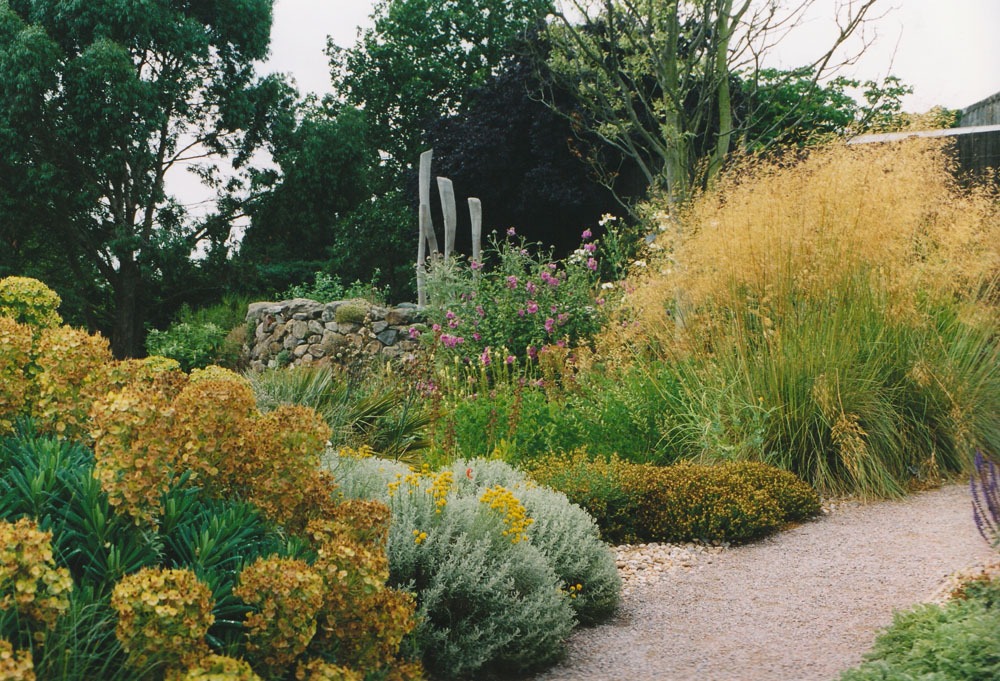
BBC Radio 4’s Woman’s Hour was broadcast from Beth Chatto’s garden today. You can find the Podcast at http://www.bbc.co.uk/radio4/womanshour/01/2008_34_mon.shtml. Beth Chatto was introduced as ‘one of England’s best-loved and most influential gardeners’. She explained that the two main influences on her garden had been her husband, who studied how plants grow in their natural habitats, and Sir Cederic Morris, an artist and gardener who lived at Benton End. Beth Chatto said she did not give much thought to colour harmonies and that her interest in plant groupings derived from an earlier love of flower arranging. She then made friends with, and was influenced by, Christopher Lloyd and Graham Stuart Thomas. Her correspondence with Christopher Lloyd, who became her friend, began when he told her off for being ‘cruel’ to her Dry Garden – by not watering the plants. I guess history will judge Christo wrong on this issue. Beth Chatto also remarked that ‘I didn’t read Gertrude Jekyll for, oh, years. But when I did, I felt a real warmth for her’.
She came over as a plain-speaking gardener. On the layout of her garden, the most telling remark was that ‘A path needs to go somewhere’. While full of admiration for her plants, I find the design of Beth Chatto’s Garden disappointing. It is flower arranging on the scale of a garden. There is little imagination and the spatial composition is weak. Indeed, one has to wonder if Christopher Lloyd’s approach to garden design was similar. It could well be that it was the work of his father, and of Lutyens, which give Great Dixter its charm. A dress can be made out of the most beautiful fabric without being well-cut or stylish.
I disagree totally with the final critique of the garden design being weak!
“Spatial composition means using the available space in order to create the desired environment and convey the mood that the owner or builders picture”.
How can you critise it as being weak, when it reflects the moods and picture in the mind of the ownwer. It is not weak but well composed as a flower arranging on a garden scale, “.. her interest in plant groupings derived from an earlier love of flower arranging.””.
That is where the design is aiming for and it does it well. Not Tom Turner’s view of a garden design, or experience, but it’s patial composition is very well done in the context of the owner’s objective.
Thank you for your comment. I admit to being somewhat puzzled by Beth Chatto’s garden and like to clarify my views through discussion.
Individually, I regard Beth Chatto’s plant compositions as good. But, to draw an analogy with interior design, they are like good pieces of furniture which are badly placed in a room. What I mean by ‘badly’ is that they do not contribute to making a good space. Similarly, one might have a Monet painting in a room but place it very badly. This would not detract from the value of Monet’s painting but it would mean that the room is not as good as it would be if the painting were well chosen or well hung.
Designing a garden is just like creating a painting, people see the outcome in different way. I agree with you Tom sometimes it’s not the design that wasn’t really good it was just how it was done.;-)
Tom’s initial comments are pretty strong but I found them refreshing as it’s the first time I’ve come across anyone trying to express what doesn’t quite work at Beth Chatto’s. I’ve just visited, so maybe the plants in the gravel garden aren’t at their best. However, the plants in the big borders by the water garden are full and healthy.
I think there isn’t enough repetition of planting. Chatto wasn’t trained as most designers are, to use a geometric grid; a hosepipe adjusted to what looked good was her way. So the unity of design has to come from the planting. It comes across as a dazzling free-form tapestry. The eye doesn’t know where to look next. Especially for plant lovers, it’s like being in a sweet shop. The eye wanders greedily. I even felt a bit sick after a while. It’s over stimulating. Using repetition of planting groups could produce a more relaxing experience.
Having said all that, Chatto’s contribution to garden design cannot be underestimated. Her understanding of plant ecology and the plant palletts she therefore introduced revolutionised garden design and informed other significant late 20th century developments/designers, Oudolf, for example.
I was mightily inspired and can’t wait to put some of the planting ideas in place, using repetition, of course.
Fiona, thank you for the comment. The mention of a sweet shop is interesting and confirms my view that the attraction of Beth Chatto’s garden is excellence of the plants, and their cultivation, rather than the spatial design. She also applies an appreciation of plant ecology but I do not see this as an original contribution. Its just a sensible thing to do.
Note: I am not happy with Alec’s definition (above) of spatial design as “Spatial composition means using the available space in order to create the desired environment and convey the mood that the owner or builders picture” because I understand spatial design as the ‘design of space’, as a deliberate contrast to the design of the objects (landform, planting, structures etc) which enclose the space.
I know this is an old post but I was trying to find more info about chatto after visiting the garden today.
My own view was that I found much to admire and like and yet I had reservations. There were areas that I loved but there were others that were distinctly ordinary. Some of the ponds are beyond ropes marked private, well that’s great but I can still see the things and if they are scruffy it spoils the bits that are truly lovely.
The wooded garden didn’t “flow” and seemed a tadge dull (maybe the time of the year).
Its patchy a bit like going to an art gallery finding some great paintings with the odd amateur work thrown in for good measure.
It is like going to a craft fair: one is often amazed by the craftsmanship but disappointed by the result. This is because there is a world of difference between being a craftsman and being an artist.
These comments are helpful and compel one to clarify in one’s own mind what is that missing factor in an otherwise lovely location. Is it that the planting is on a domestic garden scale using only a few of each plant in a group, whereas the size of the garden begs for bigger more dramatic planting to make one really swoon over the lovely colours of the plants?
Ironically as one emerged on the hill top on the boundary of the nursery there was a stunning view over big groups of various Crocosmia’s and Agapanthus in the nursery [picture available on request]..those big groups would have given the ‘hit’ we are looking for in the garden..as big sweeps of underplanting to the lovely and choice shrubs and trees.. perhaps !
Adam – you would be welcome to do a blog post on Beth Chatto. I agree about the ‘domestic’ character of her garden. It is much closer to a scaled-up suburban garden than to a country-house garden.
Agreed, Tom. You have hit the nail on the head. Akin to this is the difference between multiple chef’s preparing the exact same recipe. Why is it that Batali’s dish taste’s so much better than mine? Art, not science.
I always understood that Beth Chatto is a gardener rather than a designer and that putting plants together is her strength as well as her love and enthusiasm for gardens. Her idea of choosing plants which will flourish in their given position is what I know her for – this makes such good sense but was ‘new’ thinking. An overall master plan is I am sure the best way to create a garden but not everyone knows about garden design or even thinks it necessary. I visited this garden before I trained as a garden designer and really loved it – I must go again now and see what difference my garden design training makes.