
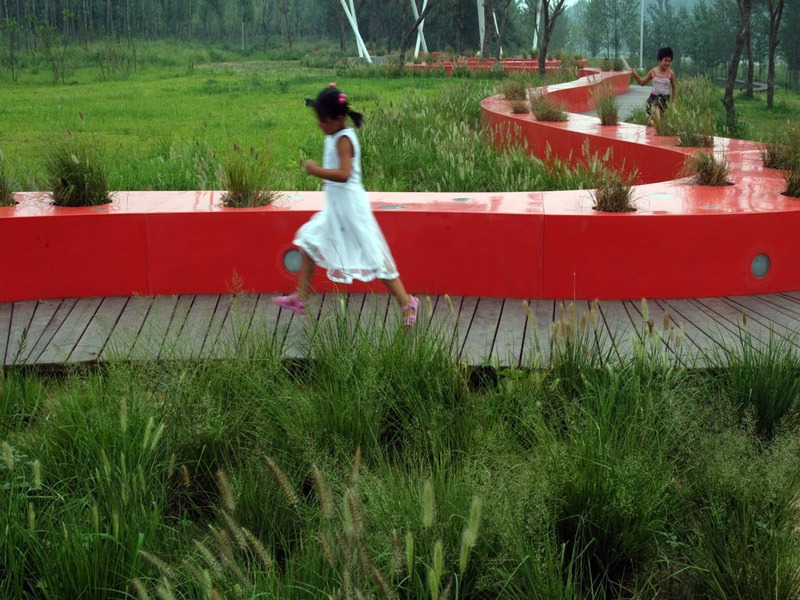
Having criticized the lack of context-sensitive landscape architecture in China, it was a pleasure to find a contrary example: the Tanghe River Park Red Ribbon project:
- it is beautiful
- it is undeniably of its own time
- it is in sync with a long tradition of Chinese landscape architecture: the red colour, the dragon curves, the composition of walks with planting and water
So: well done to Professor Kongjian Yu of Turenscape 俞孔坚教授土人!
Old China had elegant concubines with bound feet strolling in lang corridors. New China can have fleet-of-foot girls bursting with energy as they race through the urban landscape.
Context-sensitive design is a problem for every country – or rather, one should say, for every region. Samuel Johnson remarked, on April 7th 1775, that patriotism is “the last refuge of a scoundrel”. Little did he know how nationalism was going to ravage civilization in the next two centuries. For landscape architecture, it is not so much that it should be “Chinese” in China as that it should be regional: there should be different approaches in Jiangsu, Guangdong and Xinjiang, relating to culture, climate, history, vegetation, geology, hydrology and habits concerning the social life of outdoor space. There can be no part of the world with such a severe shortage of landscape architects as China.
See also: landscape architecture competition for Tiananmen Square, Beijing, China 2009-2010
It is good review on an outstanding design. However, I am not sure it is a “context-sensitive” design. For me, it is a more like a contemporary landscape with pop art.
It looks nice but I don’t think it’s “Context-sensitive”. The symbol of red ribbon is not so Chinese in my opion. It’s more like explanation of modern art to make it feel Chinese.
Though tempted to give way to two Chinese commentators, I would like to ask a few questions first: (1) surely the bold use of red is Chinese – and the flowing line reminds me of a brush-stroke (2) the design of a route as a ‘place in itself’, rather than a mere connection between A and B, also seems characteristic of Chinese parks and gardens, (3) apart from sentimental re-creations of historic ideas, what would make a design sensitive to the cultural context of modern China?
I think that the use of dominant red color and the long curve in a Chinese Park is culturally interesting. A curve and meandering path in a park is something that makes Eastern gardens different from the Western ones. This rared curved elevated walkway protects ecological continuity of the context while providing an entertaining venue.
I believe the design is both ecologically and culturally sensitive.
It is a beautiful modern landscape surely! It is popular in global vision. But I would say it is different conception for Chinese and other country’s people. The design adopt the same visual art methods of great film conductor-Zhang Yimou, who conduct the opening ceremony of 2008 Olympic games. the red, flowing and stretching long are the main characteristic. In fact, the traditional landscape responding to the cultural context can be shown in everyday life, such as shopping, festival celebrating, and folk activities and so on.
Universal Truths
Blind patriotism and rampant nationalism often lead people to do ugly things – this week’s Olympics saw the home supporters heckle the Japanese volleyball team every time they had control of the ball as they played against China.
Sports is meant to be a celebration of the human spirit – when Western missionaries taught Australian aboriginal children how to play football, they found it hard to understand why the winning side always let the losing side equalise before they ended the game.
Design is a celebration of both the human spirit and the universal spirit – in short a celebration of life.
Good design embraces what life should be – creativity, love, joy, passion and beauty…
Good design is an expression of universal truths.
In the Tanghe River Park the beauty that is Nature is preserved, protected and highlighted. People can experience, enjoy and contemplate this beauty on the physical level, the conscious level and the subconscious level. In so doing, universal truths are revealed.
The red ribbon design while using cultural references which are very obviously Chinese is also drawing upon forces which are more primaeval – the curves of the ribbon play against the proportions of the golden mean, the vibrancy of the red resonates with the very forces of life itself. Bold and subtle at the same time, universal truths are revealed.
How can one judge a design without being there? Picture only can show a small part of the design which probably not be able to use to judge whether it is sustainable, whether it is popular and whether it is as good as it is in the photographs.
When we use a excellent camera such as Canon 5D, even a dirty pond could be pretty in the photograph. It is a little bit like female’s makeup.
Several points (1) it is always best to visit the place, and better still to make lots of visits at different times of day and in different seasons (2) but you tell a lot from photographs and even more if you look at lots of photographs of the same place (3) yes, it is possible to take a beautiful photograph of an ugly or a context-insensitive place.
I have not crossed the equator, but I am convinced that the Sydney Opera House is a good example of context-sensitive design.
And I don’t think I need to leave home to be confident that this building did not have a context-sensitive architect http://v5.cache3.c.bigcache.googleapis.com/static.panoramio.com/photos/original/43167459.jpg?redirect_counter=1 (it is Buenos Aires Edificio Alas)
Please do not forget, Landscape design and different from architecture design. Architecture work is make of concrete, but landscape design work is made of ‘alive’ vegetation and will change as time goes by. Therefore, your contrastive photos of Sydney Opera House and that ugly building can not illustrate the phenomenon happened in landscape.
What do you think about (1) planting masses of Australian trees in Israel eg Eucalyptus (2) planting strips of lawn between wide roads in the Gulf (eg Kuwait)? (3) making shadeless parks with floral bedding in the Gulf? (4) making baroque parterres beside roads in China? (5) planting Sitka spruce in old chestnut woods in the fringe of London (eg Joydens Wood)?
I am not saying any of these things are necessarily wrong. BUT I do think the relationship with the context requires serious consideration in each and every case.
Tom, could you please focus on the argument when you discussing with me? The topic you talked about seems not the one I was talking. I agree that the context sensitive design can apply in both architecture and landscape architecture, my idea is that you use architecture example to illustrate landscape issue, which seems not work very well.