
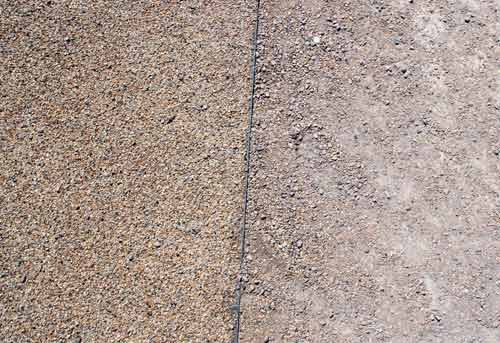
The University of Greenwich has re-done much of its paving with resin-bound gravel on its Maritime Campus. It has one the most scenic campuses in Britain and certainly needs to be ‘paved with care’. But was resin-bound gravel the best choice?
Some of the pedestrian paving, usually adjoining buildings, is done with a beautiful riven sandstone. It comes from Yorkshire and has the local name Yorkstone. This is an excellent material. Other pedestrian paving, often running through grass areas, is ungraded gravel. This too is a good choice, though it is hard to fathom why they used granite instead of the local flint.
Most of the new paving on the campus is resin bound and uses a small-diameter flint gravel aggregate (2-4mm). For the central roadway this was a good choice. A bitumen macadam basecourse supports the weight of vehicular traffic. But the road is used as much by pedestrians as by vehicles and it was well worth the extra expenditure on resin bound gravel to hide the bitumen.
But I can’t see the point of having used resin-bound gravel for purely pedestrian walks or for the new car parks: (1) it costs a lot more money (2) it is impermeable and therefore works against Sustainable Urban Drainage System (SUDS) objectives (3) it does not have that nice crunchy sound you get from gravel (4) it looks phoney – like a plastic imitation of gravel (5) it is out of keeping with the historic character of the Maritime Campus – where unbound flint gravel is the traditional material.
I have to disagree with your comments regarding resin bound paving.
You have incorrectly stated that resin bound paving is an impermeable product, when in fact it is a permeable product.
The image that you have added to your blog looks to me like a bonded system rather than a bound system. If this is the case then you would be correct in stating that it is an impermeable product.
Resin bound paving is a more expensive option, however you do not get the draw backs of having loose gravel. You don’t have to sweep away the gravel that has migrated to other areas and you don’t usually get weed growth through the paving. Providing you use a reputable company, with experience in the resin bound paving sector, you will not need to replace the surface as quickly as you would with a loose aggregate.
One other factor is that access for wheelchair users is not restricted. Have you ever tried to push a wheelchair or pushchair through loose gravel? I have and I can tell you that it is not easy. Having a smooth surface enables easy access.
I agree that it is important to try to encapsulate the heritage of an area and to use products that are in keeping with the surroundings, that is why some suppliers of resin bound paving can use aggregates local to the project, it’s just a matter of finding one that are able to do this for you.
Thank you for the comment. I watched them laying the resin-bound gravel at Greenwich. It is on a bitmac basecourse which is itself impermeable. You are right about wheelchairs and I know they are hard to push.
Hi Tom,
I was wondering if you know of any systems or construction methods for having a gravel driveway that can withstand vehicular traffic without it needing to be resin bound? I’m currently looking at replacing a long tarmac driveway as it has worn out, and I’d prefer to replace it with gravel as the house is in a classical style in bathstone, however after searching through different websites on the internet I haven’t yet found anything that looks appropriate or for vehicular traffic. Is there any type of construction you can recommend?
Thanks,
Bernard
I think you only need a standard Macadam construction. Wiki gives the following information on how Macadam built heavy duty roads: “McAdam’s method was more simple and yet more effective at protecting roadways: he discovered that massive foundations of rock upon rock were unnecessary, and asserted that native soil alone would support the road and traffic upon it, as long as it was covered by a road crust that would protect the soil underneath from water and wear. Unlike Telford and other road builders of the time, McAdam laid his roads as level as possible. His thirty foot wide road required only a rise of three inches from the edges to the center. Cambering and elevation of the road above the water table enabled rain water to run off into ditches on either side. Size of stones was central to the McAdam’s road building theory. The lower 200 mm road (7.8 inches) thickness was restricted to stones no larger than 75 mm. (2.9 in) The upper 50 mm (1.9 in) layer of stones was limited to 20 mm size (.787 in ) and stones were checked by supervisors who carried scales. A workman could check the stone size himself by seeing if the stone would fit into his mouth. The importance of the 20 mm stone size was that the stones needed to be much smaller than the 100 mm width of the iron, Carriage tires which traveled on the road.” For a private drive you could have a shallower depth and less hardcore.
There are many advantages for the use of resin bonded and resin bound gravel surfaces, but none equally match the use of loose gravel, which has it’s inherent problems of migrations. However there are now many products on the market which are designed to stop the migration of gravel when used in the car park, driveway and pathway applications in the form a plastic grid systems. which are pecifically designed to withstand high compression loads and give ghigh levels or water permeability, allowing the surface water to migrate to the water table below. I believe that these types of ground reinforcement offer a solution which is a more realistic surface that also adds to the charms of a particular property increasing character without the disadvantages of resin bonded products.