The most interesting garden in Naples itself is that of the Santa Chiara Cloister. The streets of Naples probably have more of the air of a Roman town than any other town in Italy but the gardens for which the city was once famed have not survived. Naples is however a good base for visits to gardens on the islands of Capri (San Michele), Ischia (La Mortella), and also for visits to the famous gardens of Caserta, and Pompeii (where the best-preserved domestic gardens from Europe’s classical age are to be found).
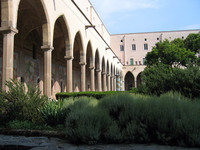 Santa Chiara Cloister
Santa Chiara Cloister »
The old cloister was transformed after 1742 (by Domenico Vaccaro) through the construction of octagonal pillars, pergolas and seats with ceramic tiles (majolica) showing 64 scenes (landscapes, masquerades, mythological scenes etc). Two octagonal fountains were also built. The cloister is lush and luxurious, a notable departure from the plain grass lawns of early monastic cloisters. Yet it is a calm place in contrast with the bustle of Neapolitan streets.
Read more on Santa Chiara Cloister
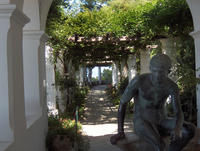 Villa San Michele - Axel Munthe Garden
Villa San Michele - Axel Munthe Garden »
This is the focus of Axel Munthe's The Story of San Michele published in 1929 and reprinted ever-after. It has perhaps the most dramatic location of any garden in Europe and is one of the most-visited gardens in Italy. Munthe said that the villa 'had no architect and that so far I did not know in what style the house was going to be built, all that would settle itself as the work went on' (Ch 21). Bruce Chatwin is hard on Munthe (in 'Among the ruins' in Anatomy of Relstlessness) writing that 'There was indeed a loggia peopled with statues - genuine and fake - of gods and emperors, and fragments of ancient marble, some salvaged from the imperial villa, were stuck into the walls like nuts in no.....
Read more on Villa San Michele - Axel Munthe Garden
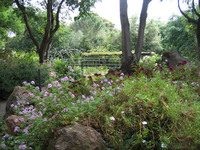 La Mortella (on Ischia)
La Mortella (on Ischia) »
"La Mortella" means the place of the myrtles. The garden was made by the English composer, William Walton and his Argentinian wife, Susana. Walton loved the isolation and composed there for 35 years. His wife believed there was a connection between music and gardening.
Read more on La Mortella (on Ischia)
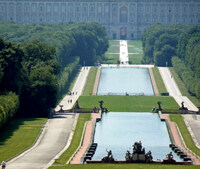 Caserta Palazzo Reale La Reggia
Caserta Palazzo Reale La Reggia »
Caserta is often seen as an Italian Versailles, though its Neapolitan designer thought otherwise. Luigi Vanvitelli, an Italian patriot, was well-read in literature and philosophy and worked closely with his Bourbon patron. Charles III, his patron, wished to be an absolute but enlightened monarch. He was encouraged by a local philosopher, Giambattista Vico, who later became very famous. Vico saw monarchy as a necessity and myth as a key to understanding society. Caserta has a great sculpture programme based on the myths in Ovid's Metamorphosis. Critics may have been less than fair in judging Caserta 'a colossal monument to miniscule glory' (E Crankshaw, p 135). Yet its main axis is over 3 km i.....
Read more on Caserta Palazzo Reale La Reggia
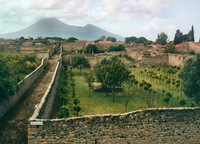 Pompeii Gardens
Pompeii Gardens »
The eruption of Vesuvius in 79 AD was a disaster for the citizens of Pompeii. Yet it was a boon for garden historians: about 500 domestic gardens were preserved. The 1942 bombing of Pompeii was a disaster for garden historians. Still, much survives and more is being excavated each year. Pompeii had been a Greek city and a Samnite city before it was colonised in 80 BC by another Italian tribe, known to us as The Romans. Many Pompeian buildings pre-date the Roman conquest. Town houses have several types of garden space:
Atrium: a small paved court, allowing light to enter and smoke to escape, since houses did not have windows.
Peristyle court: a paved courtyard surrounded by a roofed colonade .....
Read more on Pompeii Gardens