Marrakech, in Morocco, with a dramatic position at the meeting point of the Sahara desert and the Atlas Mountains, is a city of palaces, palm groves and gardens. The gardens are Islamic but unlike other Islamic gardens (e.g. those of Persia, India or Spain). Their combination of pools and lush vegetation make one wonder if they resemble another group of North African gardens: those of Ancient Egypt. In any event, they are well worth visiting in the course of a Garden Short Break: Majorelle Gardens, Ben Youssef Medersa and Saadian tombs, Badi Palace, Jardin Agdal, Bahia Palace and Menara gardens.
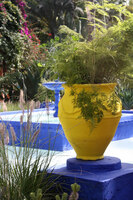 Majorelle Garden
Majorelle Garden »
The garden was made in the 1920s by the French painter Jacques Majorelle, with marble pools, raised pathways, banana trees, groves of bamboo, coconut palms and bougainvilleas. Perhaps unsuprisingly as the garden was designed by a painter, the garden is composed and coloured like a painting. Many of the built features were painted in a dark blue ('Majorelle Blue') which works very well with the soil, climate and plants. In fact, Majorelle's garden rather than his paintings was his masterpiece. Water is an important feature of the garden - there are channels, lily-filled ponds and fountains. Majorelle was an avid plant collector. After years of neglect, the garden was then taken over and restor.....
Read more on Majorelle Garden
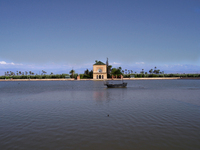 Menara Garden
Menara Garden »
The Menara Garden was established in the 12th century as an orchard of palm, olive and fruit trees. It has a formal pool overlooked by a pavilion (minzah) previously used by the sultan and his family. The present pavilion dates from the nineteenth century but is believed to be on the site of an earlier (16th-century) Saadian structure. An orchards, pools and pavilions are the primary components of Islamic gardens.
Read more on Menara Garden
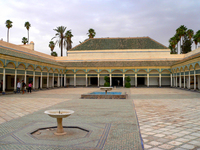 El Bahia Palace and Gardens
El Bahia Palace and Gardens »
The Bahia palace and gardens were built in the late 19th century, intended to be the greatest palace of its time. The name means 'brilliance'. As in other buildings of the period in other countries, it was intended to capture the essence of the nations style: Moroccan and Islamic. There is a 2 acre garden with rooms opening onto courtyards.
Read more on El Bahia Palace and Gardens
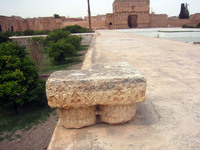 Badi Palace
Badi Palace »
The Badi' Palace was built in the Qasba during the reign of Muhammad al-Shaykh al-Mansur (1578-1603). It has a symmetrical plan with chambers and pavilions round a central courtyard with water and planting. Four gardens open off the courtyard.
Read more on Badi Palace
 Agdal Gardens (Aguedal Park Gardens)
Agdal Gardens (Aguedal Park Gardens) »
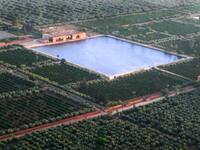
<p>The name "Agdal" comes from the Berber langauge and means "meadow on the banks of a wadi encolsed with a stone wall". The Almoravids laid out the orchard garden in Marrakech during the 12th century. Water was brought from the Ourika Valley by a network of underground channels and ditches. Agdal comprises several linked gardens, with one leading on to the next, including an orange grove and an olive plantation. In the nineteenth century the gardens were enlarged and enclosed with pise walls. A lake, called the Tank of Health, is probably as old as the orchards old but was re-shaped at this time with pavilions overlooking the water. Geometrically and functionally, the ancient gardens of Meso.....
Read more on Agdal Gardens (Aguedal Park Gardens)
 Ben Youssef Medersa Garden
Ben Youssef Medersa Garden »
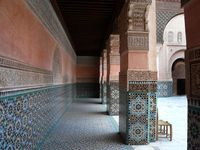
Ben Youssef Medersa (or Bin Yousuf Madrassa) was built, as a theological college, in the 16th century. It is named after a 12th century sultan. It has 130 student cells round a courtyard with a classically Islamc pool. It was one of the largest theological colleges in Africa but colleges of this type can be found all along the road from Morocco to India. (Note: for the film Hideous Kinky, Kate Winslet was filmed here.)
Read more on Ben Youssef Medersa Garden