London is the gardening capital of the world. No other great city can have nearly as many keen gardeners and and good gardens. It has some wonderful public gardens and public parks but there are no private 'gardens open to the public' of the type which are so common in other parts of England. We therefore recommend (1) looking for gardens open on specific days under the National Gardens Scheme (2) staying in a Garden Hotel for the two Short Breaks recommended below (3) doing additional Garden Short Breaks to gardens in the Home Counties: Sussex, Kent etc.
2009 Open Garden Squares Weekend will take place 13th-14th June 2009 - if you can time your visit right, it is a great opportunity to see many of London's gardens and squares that are not normally open to the public.
The best time of year for a gardener to visit Central London is during the Chelsea Flower Show (last full week in May). You have to book well in advance, and its a squash, but its also the gardening world's answer to a World Cup Final. Even if you can't get a ticket, you can spend over two hours/day watching the show on TV in your hotel room! If this does not appeal, we recommend visiting London in June. Its more reliably warm and the roses should be excellent in Regent's Park and Hyde Park. You can also see the best roof garden in England (Kensington Roof Garden), and, in our editor's view, the best small urban park in the world: St James's Park. To experience something of the medieval approach to garden design you can visit Westminster Cloister, Chelsea Physic Garden and the world's first Museum of Garden History. Kensington Gardens has the best water garden and the best children's playground in London. Holland Park has a good flower garden, which survives from the once-very-famous Holland House Garden.
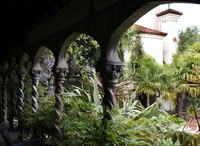 Kensington Roof Garden
Kensington Roof Garden »
<p>London's oldest and best roof garden, still known to many as 'Derry and Toms Roof Garden', recalling the name of the department store which commissioned the garden. The garden covers 1.5 acres and are 100ft above street level. It has ponds, bridges, walks, trees, shrubs and sitting areas. The design style is somewhere between the <a href="https://www.gardenvisit.com/history_theory/garden_landscape_design_articles/historic_design_styles/mixed_garden_design_style">Victorian Mixed Style</a> and the <a href="https://www.gardenvisit.com/history_theory/garden_landscape_design_articles/historic_design_styles/arts_crafts_garden_design_style">Arts and Crafts</a> style. There is an English Woodland .....
Read more on Kensington Roof Garden
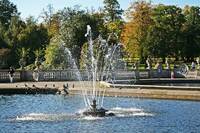 Kensington Gardens (Park)
Kensington Gardens (Park) »
<p>The greenspace called 'Kensington Gardens' was the deer park acquired by Henry VIII. It belonged to <a href="http://www.gardenvisit.com/garden/kensington_palace_garden">Kensington palace</a> - and there is a good case for calling it 'Kensington Park'. <a href="http://www.gardenvisit.com/book/london_parks_and_gardens_1907/chapter_2_hyde_park/kensington_palace_henry_wise_and_charles_bridgeman">William III bought Nottingham House for £20,000 and converted it into Kensington Palace</a>. 'Kensington Park' was made on land taken from Hyde Park by Queen Caroline (Caroline of Brandenburg-Ansbach, the wife of King George II). She employed <a href="https://www.gardenvisit.com/biography/c.....
Read more on Kensington Gardens (Park)
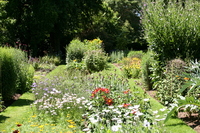 Chelsea Physic Garden
Chelsea Physic Garden »
<p>A rare and wonderful enclosed garden dating from the seventeenth century. It was begun, in 1673, as a garden in which to grow plants for medicinal purposes. Though it remains a garden for botany, the Physic Garden has the appearance of an ornamental garden with straight walks at right angles to each other. The garden's position near the Thames was chosen to allow non-native plants to grow in the warmer microclimate created by the river. The first <a href="https://www.gardenvisit.com/history_theory/garden_landscape_design_articles/historic_design_styles/early_renaissance_garden_design_style">renaissance</a> botanical garden was the <a href="https://www.gardenvisit.com/gardens/giardino_botan.....
Read more on Chelsea Physic Garden
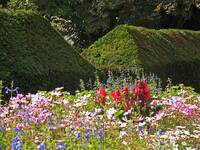 Holland Park
Holland Park »
<p>The formal gardens and a large area of woodland came into public ownership after Holland House was bombed during the Second World War. The park is now open to the public. Its spatial qualities were analysed by <a href="https://www.gardenvisit.com/biography/dame_sylvia_crowe">Dame Sylvia Crowe</a> in her book <em>Garden Design</em>. (she lived nearby). A Japanese 'Kyoto' Garden was opened in 1991. Nearby was the former Commonwealth Institute with its grounds designed by Dame Sylvia. It is now the Design Museum and the grounds have been re-designed. The eighteenth century planting by Charles Hamilton has also gone.</p>
<p><iframe src="https://www.youtube.com/embed/CrbPmN4rlek?start=356" wid.....
Read more on Holland Park
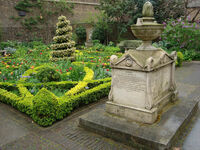 Garden Museum (formerly Museum of Garden History)
Garden Museum (formerly Museum of Garden History) »
<p>A small re-created seventeenth century knot garden in a former churchyard. It commemorates two famous gardeners whose tomb is also there. <a href="https://www.gardenvisit.com/biography/john_tradescant">John Tradescant</a> and his son were gardners to Charles I and II - and were adventurous plant hunters. The garden adjoins the Garden Museum. It has a sweet modern courtyard with a cloister-like character, designed by Dan Pearson.</p>
<p>The Garden Museum is on the <a href="http://www.gardenvisit.com/londongardenswalk">London Gardens Walk</a> and included in the <em><a href="http://www.amazon.co.uk/London-Gardens-Walk-history-ebook/dp/B007L110K0/ref=sr_1_1?ie=UTF8&qid=1332048606&sr=.....
Read more on Garden Museum (formerly Museum of Garden History)
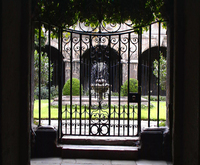 Westminster Abbey - Garden and Cloisters
Westminster Abbey - Garden and Cloisters »
<p>The Abbey has two remarkably good cloister garths. In the large cloister, the covered walkway is the delight. The lawn is dull and would be better managed as a wildflower meadow. The greenspace with a foutain, in the small cloister, is charming.</p>
<p>The original West Minster was founded in 605, enriched by Edward the Confessor and dedicated by him in 1065, one year before the Norman Conquest. The monastry was run by the Benedictine order until the dissolution in 1540. Much of the present church was built by Henry III between 1245 and 1272. Gardeners will be interested to see the Cloister, which is a plain rectangle of grass in the traditional manner, the Little Cloister and the College.....
Read more on Westminster Abbey - Garden and Cloisters
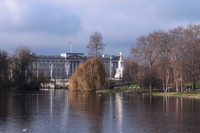 St James's Park
St James's Park »
<p>A Royal Park and one of the most romantic urban landscapes in Europe. The area was originally a swamp, subject to flooding from the Tyburn stream which still flows through the lake. Its 23 hectares were first made into a park with a rigidly formal design in 1660. Charles II had a long canal excavated from the watery land and introduced the geese, pelicans and waterfowl which are still there today. The park was completely re-designed by <a href="https://www.gardenvisit.com/biography/john_nash">John Nash</a> (1828) in the English landscape style (see note on <a href="https://www.gardenvisit.com/history_theory/garden_landscape_design_articles/historic_design_styles/serpentine_garden_des.....
Read more on St James's Park