Last updated on 24 October 08
Do you run this garden?

Jardines de las Reales Alcazares

  4.0/5 (1 ratings)
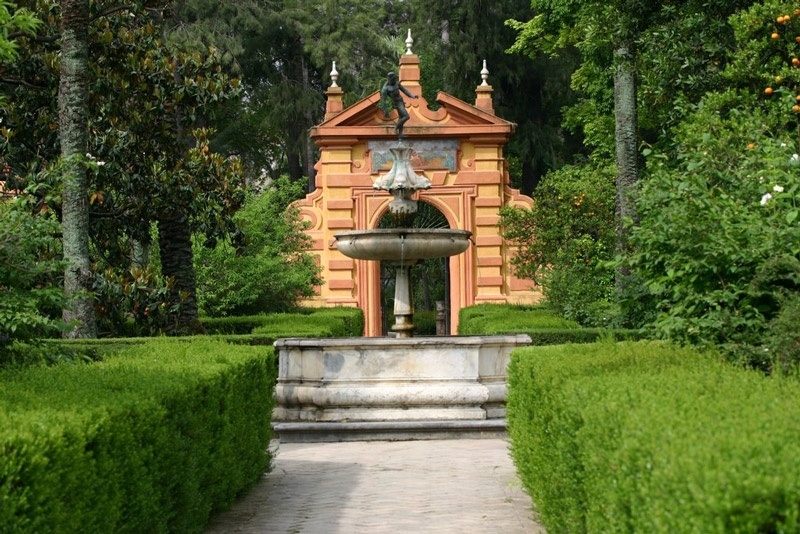
  • Orange Tree, Jardines de las Reales Alcazares Photograph © GardenVisit.com
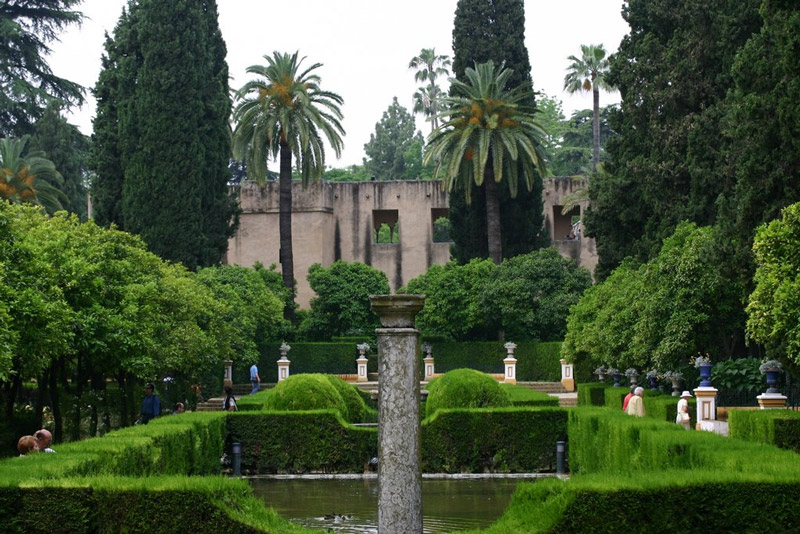
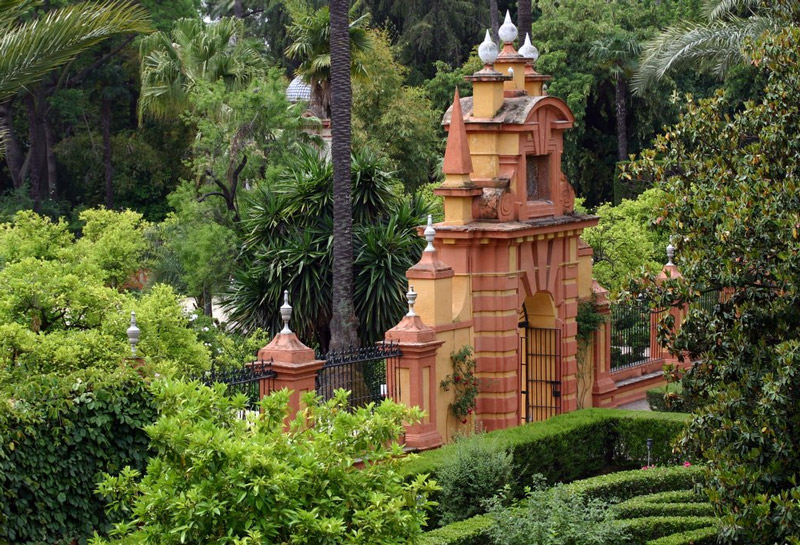
  • Jardines de las Reales Alcazares, Spain Photograph © GardenVisit.com
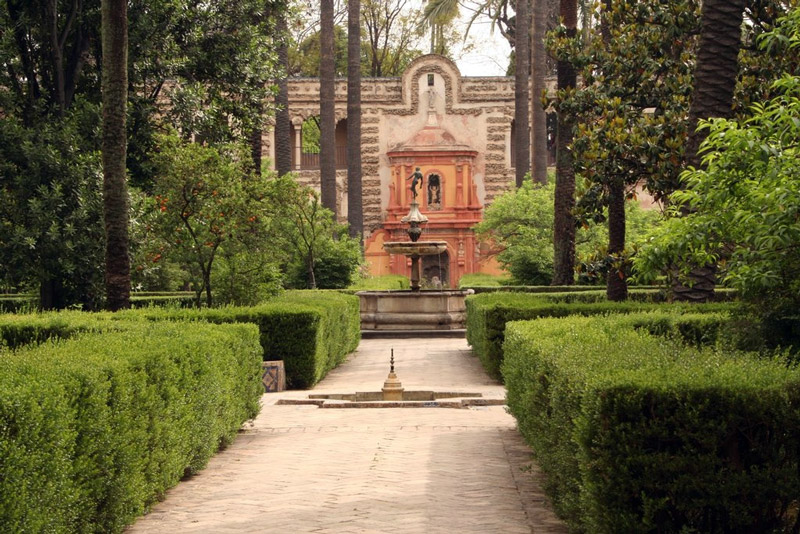
  • Jardines de las Reales Alcazares, Seville Photograph © GardenVisit.com
  • Jardines de las Reales Alcazares, Andalucia Photograph © GardenVisit.com
  • Jardines de las Reales Alcazares, May Photograph © GardenVisit.com

Gardenvisit Editorial

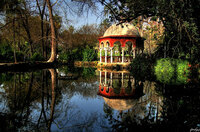
The palace of the Kings of Seville has the largest late-medieval garden in Europe. Seville was ruled by the Moors from 711 to 1248. After the Christian reconquest, their influence, and their craftsmen, created what became known as the Mudejar style (from an Arabic word meaning 'allowed to remain'). Peter I ruled from 1350-69. His Alcazar (fortress) garden was built upon Moorish remains and has typically eastern courtyards bounded by arcades and sequestered behind high walls. The oldest spaces are in and around the palace. We find small courtyards with glittering pools, fountains, and recessed seats. As in ancient Egypt, they give protection from the harshness of the outside world. Decorative grilles enhance lush views. There is a tank garden. The planting is of palm, cypress, myrtle, mulberries, magnolia, orange and lemon trees. Glazed and unglazed tiles are characteristic of arab building. When Seville was the richest city in Spain, during the sixteenth century, changes were made. The old garden spaces survived, but Charles V's designers were influenced by Renaissace styles when making a large labyrinth and a very fine pavilion (c1543). In spring, the orange trees drop their fruit and the ground smells of marmalade. A New Garden was made in the early twentieth century. Like Arts and Crafts gardens elsewhere in Europe, its designers drew upon the national style of the locality. The plan resembles a glazed tile.

Address - Alcazar, Plaza del Truinfo, Seville, Andalucia, Spain
Opening times - All year. Daily. Opens 9:30am.
Website - Visit the Jardines de las Reales Alcazares website

Local Hotels

Hotels within 30km as the crow flies from this garden.

Nearby Gardens

Gardens within 30km as the crow flies from this garden.

Luxury Garden Hotels

Nearby Recommended Garden Hotels

Reviews and Comments

Have you visited this garden?

  • 11 months ago Kate Jury said

    Paradise indeed.

    If you want to understand the long-term influence of the Islamic garden on European garden styles, a visit to the Real Alcazar of Seville will give you both a master class in design history and a walk-through lesson that will stimulate all your senses.

    The Real Alcazar (‘Real’ meaning royal, as in the football team Real Madrid, and pronounced ‘ray-al’) was built in the 14th century, on the site of the 10th century Moorish palace, by King Peter 1, who had been raised in the original palace (Alcazar Bendito). Like much of historic Seville it was built in the Mujedar style (Mujedar meaning ‘allowed to remain’), fusing Spanish Christian gothic and Moorish Islamic styles.

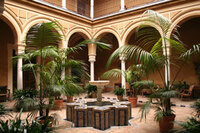
    In the tradition of Moorish architecture, internal courtyards and gardens are a fundemental element of the palace design. Tiled rooms and corridors offer glimpses, through archways, of cool greens and the sound and smell of water. Inside the palace there is the Maidens’ Patio, a central, open, space of a still pool, arcaded walks, and reflective, shining leaves; in the immediate vicinity of the palace the private rooms of the royal family give onto galleries and steps leading down to the sheltered courtyards of the historic gardens – The Princes Garden, the Garden of Flowers, the Garden of the Gallery, The Garden of Troy, the Garden of the Dance, and the Pond Garden.

    Each of these gardens has its own style, but they are unified by a common sense of purpose – enclosed by the high walls of the inner palace grounds they offer light and shade, delight of the five senses, and privacy; stairs, benches, pools, and fountains decorated with the elaborate patterns of Mujedar tiles; paving of patterned brickwork and tiles; predominantly evergreen planting with the occasional and seasonal bursts of flowering colour or fallen fruit; the cooling sound, feel, and sight of running water and still pools; everywhere, and even louder than the patter of the tour guides, the sound of birdsong.

    If for humans the Islamic garden was said to be a glimpse of Paradise, for the birds of the Real Alcazar these gardens must be Paradise indeed.

    In the historic gardens the layout of paths and beds is strictly geometric – the archetypical divided quadrant of the Persian garden is the dominant motif, with rectangles of green planting intersected by water or paths. At the crossing centres there are sometimes fountains, sometimes patterned paving. In these gardens the views are not long, the eye is drawn along but also upwards and sideways. The one exception to this is the dramatic jet of water at the end of the series of historic gardens, where a huge waterspout erupts from some 20 m high to splash into the Pool of Mercury/Pond Garden.

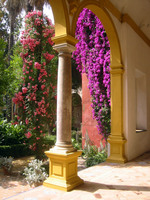
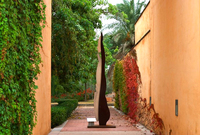
    The gardens are colourful without being gaudy. Everywhere there is the green of glossy leaves, set off against the orchres and dull red (oxblood) tints of the plaster and bricks. Amongst these steady colours there are the brighter and repeated patterns of the tiles, a predominance of blue, but also sage greens with dull golds and earth browns. From the plants there is the bright red stab of Hibuscus flower, the sky blue of Agapanthus, and pitted orange of fallen fruits, echoing the colours of tiles, brick, and sky. And not to be forgotten, climbing against the sky and pitted against the earth, are the slender patterned columns of the date-palms, rich earth-grey, and the huge, carved trunks of the magnolias, almost slate in their solidity.
    What strikes me about these gardens – those within the palace and in its immediate vicinity – is their modernity. Every time I design a small urban courtyard garden, or the slightly larger suburban ‘back garden’, this is what I am aiming for – a seamless integration from house to outdoors, so that the eye continues its journey: an extension of textures and colour, gradually substituting the man-made for the natural; a geometry which is true to the angular geometry of buildings, but softened by the natural symmetry of plants: a view which is constrained by the surrounding buildings to a certain extent sheltered from them, but occasionally exploded by a trompe l’oeil ; and a sense of privacy, belonging, and enclosure that city-dwellers need as a retreat from the bustle around them.

    In Seville gardens shelter the people, birds, and many small mammals and insects from the searing heat of summer: in England we need to design gardens that will shelter us from occasional heat, and much more frequent rain, but still allow us to feel that we have a safe and enticing outdoor space to retreat to.

    We don't need to mimic the planting of the southern Spanish/Moorish garden to embrace the concept - the outdoor room, the continuation of our living space, not at odds with but merging with our environment, helping us to enjoy and live with the environment we have.

    (4.0/5)

See all the reviews of Jardines de las Reales Alcazares

The reviews and ratings originate in all cases from third parties. Gardenvisit is in no case responsible for the correctness or accuracy of the reviews. Reviews and similar information are not an expression of Gardenvisit’s opinions.