Vienna feels like the capital city of German civilization – which is what it was until the nineteenth century – and has some of the best ‘German’ gardens: Belvedere Vienna, Burggarten, Heldenplatz, (Hero's Square), Schonbrunn Garden, Schwarzenberg Palace Garden, Vienna University Botanic Garden, Volksgarten.
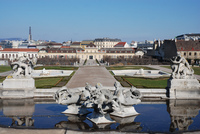 Belvedere Vienna
Belvedere Vienna »
Vienna's Belvedere Palace has a fine prospect of the old city from a beautiful garden. Belvedere means 'a place from which to see beauty'. Though his parents were born in Italy, Prince Eugene was a Frenchman and well-aquainted with Versailles. Spurned by Louis XIV, he became military commander of the Holy Roman Empire, and then 'the most grandiose and influential private patron in Europe'. Eugene was austere and taciturn, but a close friend and comrade of the Duke of Marlborough. They defeated Louis XIV's armies and were rewarded with palaces - one can compare the Belvedere with the original layout of Blenheim. The two generals were known as 'one soul with two bodies' - but they also had two .....
Read more on Belvedere Vienna
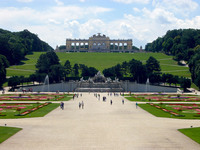 Schonbrunn Garden, Vienna
Schonbrunn Garden, Vienna »
Like so many of its predecessors, the baroque garden at Schönbrunn was made as a demonstration of power and an ambition 'to outshine Versailles'. Maria Teresa took control of the Holy Roman Empire at the age of 23, in 1740, apparently too young and too beautiful for her responsibilities. As Archduchess of Austria, Queen of Hungary and Queen of Bohemia, she rulled a tottering Empire with her French husband. Schönbrunn's palace and garden were built during and after a series of disastrous wars with Frederick of Prussia. Work began on the palace in 1744 and on the park in 1753. Its colour is known as 'Vienna Yellow' or 'Maria Teresa Yellow'. The cares of empire and mothering 16 childre.....
Read more on Schonbrunn Garden, Vienna
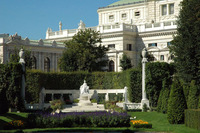 Volksgarten, Vienna
Volksgarten, Vienna »
The People's Garden (Volksgarten) was opened in 1820, on the site of the Burgbastei which Napoleon's army destroyed. It was designed in the manner of the Luxembourg garden in Paris and continues to function as an elegant and popular town garden with rose benches, shady alleys and comfortable park chairs and benches. The great protective railings give one a feeling of quiet security.
Read more on Volksgarten, Vienna
 Botanical Garden of the University of Vienna
Botanical Garden of the University of Vienna »
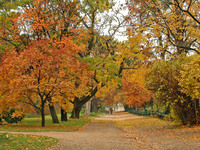
The Empress Maria Teresa bought the site in 1754. It became a royal botanic garden and is now run by the University's botany department. The garden originally had regular flowerbeds but now as a more serpentine style. It also has a famous Alpine Garden.
Read more on Botanical Garden of the University of Vienna
 Burggarten, Vienna
Burggarten, Vienna »
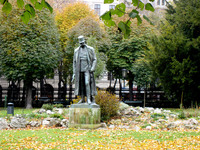
The Hofburg (court palace) was the seat of of Habsburg power. The Burggarten (court garden), like the Volksgarten, was made after Napoleon's army demolished the defensive structures which previously occupied the land. Designed by Franz Antoine, the court gardener, it served a private royal garden for the Habsburg family, from the time of its design (1818) until the end of the empire in 1918. Kaiser Franz II occasionally worked in the garden himself. The 'English' layout makes it popular with office workers who wish to relax on the grass. There is a Mozart Memorial on the southwest of the garden, with bedding plants used to draw a musical clef. Northeast of the garden is the Palm House, design.....
Read more on Burggarten, Vienna
 Heldenplatz, (Hero's Square)
Heldenplatz, (Hero's Square) »
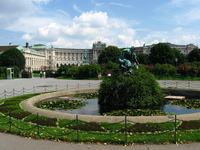
The Heldenplatz (Hero's Square) was designed in conjunction with the last wing of the Hofburg, the Neue Burg, completed in 1913). Like the building, its character is bombastic. This gave the place a natural appeal to Adolf Hitler who, in 1938, used the central balcony of the Neue Burg to proclaim to the crowd in the Heldenplatz that 'As Fuhrer and Chancellor of the German nation and the German Reich, I hereby announce to German history that my homeland has entered the German Reich'. One must detest everything which followed the Anschluss - but recognize the speaker's discrimination with regard to the location for his speech. Unquestionably, it is a place of power.
Read more on Heldenplatz, (Hero's Square)
 Schwarzenberg Palace Garden
Schwarzenberg Palace Garden »
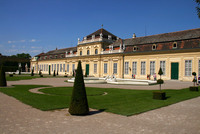
Adjoining the Belvedere garden and now belonging to the Hotel im Palais Schwarzenberg. Geoffrey Jellicoe was here in the 1930s and wrote that 'The Schwarzenberg was also laid out by Fischer von Erlach, and it is worth while entering the gardens at the rear of the palace even though it is only to enjoy the melancholy of decay. Old prints show the garden in the height of its glory, and there is a kind of sad beauty in the tall, untidy trees and the derelict fountains and pools'. Some restoration has taken place but there is more to be done.
Read more on Schwarzenberg Palace Garden