Istanbul has a wonderfully scenic location, built on hills and surrounded by water. As Constantinople, it had the greatest gardens in the western hemisphere. They have gone but one can sense their character in the Hippodrome (now At Meydani), between Hagia Sophia and the Sultan Ahmet Mosque and, above all, in the grounds of Topkapi Palace. Places to visit: Great Palace, Constantinople, Hagia Sophia, Hippodrome, Constantinople, St Saviour in Chora, Suleymaniye Mosque, Sultan Ahmet Mosque, Topkapi Palace (Sarai) Garden, Walls of Constantinople.
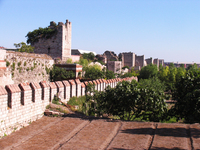 Walls of Constantinople
Walls of Constantinople »
The original walls were built in the 8th century BC and protected only the Greek acropolis. Constantine moved the walls further out and the present alignment was set by Theodosius II in the 5th century AD. They extend 6.5 km from the Golden Horn to the Sea of Marmara. As in most walled cities, some land inside and outside the walls was used for fruit and vegetable gardens. This land use can still be seen outside the Theodosian walls, which is now managed as city greenway-park.
Read more on Walls of Constantinople
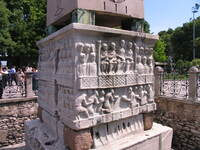 Hippodrome, Constantinople
Hippodrome, Constantinople »
The Hippodrome was a 'Ben Hur type' stadium used for horse and chariot racing. It survives as a green open space in Istanbul, with the 3 oblisks which were there in Byzantine times, but with the ground level now some 2 metres higher than in Constantine's time. The proximity of the Hippodrome to the emperor's Great Palace is equivalent to the Roman relationship between the Emperor's Palace on the Palatine Hill and the racetrack in the Circus Maximus.
Read more on Hippodrome, Constantinople
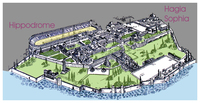 Great Palace, Constantinople
Great Palace, Constantinople »
The Sultan Ahmet (Blue Mosque) was built on the site of Byzantium's equivalent of the Emperor's Palace in Rome. The only remains to be seen are the floors in the Great Palace Mosaic Museum (Buyuk Saray Mozaikleri Muzesi). In accordance with surviving descriptions, they show the Great Palace to have had peristyle courts with mosaic flooring - like other buildings throughout the Roman world. It is likely there are other physical remains beneath the Blue Mosque and fragments are also being found in the basements of buildings between the Blue Mosque and the Sea of Marmara.
Read more on Great Palace, Constantinople
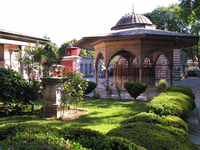 Hagia Sophia
Hagia Sophia »
The Church of the Holy Wisdom (Hagia Sophia) was once the greatest church in Christendom. The Turks added minarets and it served as a mosque for several centuries, before becoming the museum it is today. There was a cloister to the north east of the church and it would be interesting to know whether it contained water and/or planting. If so, it is probably that they had functional, decorative and symbolic roles.
Read more on Hagia Sophia
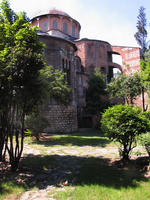 St Saviour in Chora
St Saviour in Chora »
The small church of St Saviour (Chora means 'in the country' in Greek) is one of the best places in Istanbul to see the character which the city had in Byzantine times. It is also known as the Kariye Mosque (Kariye Camii in Turkish). Inside, it is richly decorated with mosaics and frescos which show how buildings like this related to each other, to open spaces and to vegetation. The character is recognizably Roman - but with a distinctly eastern flavour: one is aware of being on the road to a West Asian city.
Read more on St Saviour in Chora
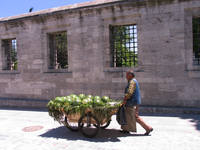 Suleymaniye Mosque, Istanbul
Suleymaniye Mosque, Istanbul »
The Suleymaniye Mosque was designed by the greatest Ottoman architect, Sinan, for his patron Suleyman [The Magnificent]. It stands on a slope overlooking the Golden Horn and was built in the garden of a Christian palace. The mosque forms part a complex which included schools, mausoleums, a hospital and a hostel. It is an enclosure within an enclosure within an enclosure. The court and the domed mosque have separate identies.
Read more on Suleymaniye Mosque, Istanbul
 Sultan Ahmet Mosque
Sultan Ahmet Mosque »
The mosque was commissioned by Sultan Ahmet I, designed by the architect Mehmet Aga, and built between 1609 and 1616. The popular name 'Blue Mosque' comes from its painted decoration and blue tilework. There is a paved courtyard outside the main entrance and the mosque is set in gardens, now laid out in a rather inappropriately European style.
Read more on Sultan Ahmet Mosque
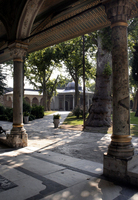 Topkapi Palace (Sarai) Garden
Topkapi Palace (Sarai) Garden »
<p>Topkapi Palace was built by the Ottoman sultans (after 1453) in a Byzantine olive grove on the Seraglio hill overlooking the Sea of Marmara and the Bosphorous. Many of the buildings survive and there are some records of the gardens in which they were set. The form of the gardens appears to have drawn more from the paradise gardens of Persia than from the Greek-Roman courtyard gardens of Constantinople. There were geometrical pools with flowers and garden pavilions and the remains of the olive groves were kept as woodland. But the overall layout of Topkapi was governed by the organisation of a tented encampment - see <em>Architecture, Ceremonial and Power: The Topkapi Palace in the Fi.....
Read more on Topkapi Palace (Sarai) Garden