Munich is warm, dignified and vibrant. There is something of North Europe and something of South Europe in the city’s character and in its gardens. For a garden short break, there is a rapid train service from the airport and excellent public transport within the city. Places to visit: Englischer Garten, Munich, Nymphenburg Schlosspark, Schleissheim, Munich Botanic Garden, Munich Olimpiapark.
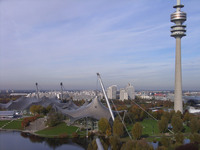 Munich Olympiapark
Munich Olympiapark »
<p>A remarkable modern landscape, made for the 1972 Olympics. Previously, the site was dull and flat, surrounded with ugly buildings and strewn with heaps of rubble cleared from the 1945 bombing of Munich. It was transformed into a sinuous web of tented structures. The roof flows with the land and the landform sweeps into the water. Geometrically, there were two varieties of abstract modernism: rectilinear and curvelinear. The Olympiapark is a superb example of curvilinear modernism. Behnish were the architects, Frei Otto designed the tented structures, Günter Grizmek was the landscape architect. As throughout history, successful projects require the professions to be united. Of all the .....
Read more on Munich Olympiapark
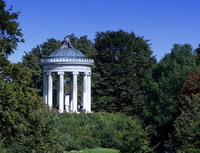 Englischer Garten, Munich
Englischer Garten, Munich »
<p>The oldest public park in Germany was promoted by Count Rumsfeld (an American - Benjamin Thompson) and designed by Friedrich von Sckell in the Serpentine Style. The central feature is the circular Monopteros Temple. It stands on a mound and overlooks the park (and is pinpointed by the marker on the location map below - visible if you zoom in). Von Skell was the court gardener to the garden-loving Elector Carl Theodor. It was intended to be, and is, a real people's park 'for the purpose of exercise and recreation'. Today it is one of Europe's largest city parks (5km by 1.5km) and is a popular area for nude sunbathing.</p>
Read more on Englischer Garten, Munich
 Munich Botanic Garden
Munich Botanic Garden »
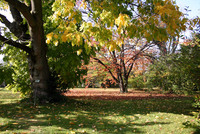
An excellent botanic garden, visually pleasing in the Arts and Crafts style and well stocked with plants. The botanic garden started in 1812 by the Bavarian Academy moved to its present site in 1914. English visitors might see it as 'the Wisley of Germany'.
Read more on Munich Botanic Garden
 Nymphenburg Schlosspark
Nymphenburg Schlosspark »
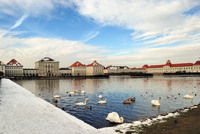
Max Emanuel's other park, 2 km from the centre of Munich, has a baroque heart. Like Schleissheim, it was designed by Zuccali and Girard with a great central canal, on which a gondola service used to operate. Canaletto painted the garden in 1761. At the end of eighteenth century, the baroque garden was fringed with a landscape park. The classical and romantic geometries work well together. The three elegant baroque pavilions once had geometrical gardens: the Pagodenburg (1716), the Badenburg (1719) and a hermitage known as the Magdalenenklause (1725). Now, they appear as temples in a landscape park. Max Emanuel's son added the Amalienburg in 1739. The landscape park was designed (c1800) by Ger.....
Read more on Nymphenburg Schlosspark
 Hofgarten Schleissheim
Hofgarten Schleissheim »
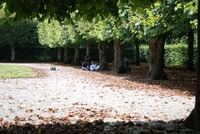
The best-preserved Baroque garden in South Germany was made by the Elector of Bavaria, Max Emanuel. His taste had developed while living in Holland and France: Schleissheim has a baroque geometry brought to life with a Dutch zest for canals. Max Emanual commissioned Enrico Zuccalli to design two new palaces (Schloss Lustheim,1684 and the Neues Schloss, 1701) with an axial relationship to the old palace (Altes Schloss, 1623). Dominique Girard, trained at Versailles, designed the parterres (1717). A circular canal surrounds Schloss Lustheim and a straight canal forms the axis to the Neues Schloss. The parterres were restored by King Ludwig I in the nineteenth century. Like his contemporaries, t.....
Read more on Hofgarten Schleissheim