Known as the ‘Garden of France’ the Loire Valley has attracted builders of great chateaux and makers of large gardens. The central section of the valley was declared a World Heritage Site in 2000. An airport and car-hire facility at Tours combined with a network of good quiet roads makes it an attractive destination for a fly-drive vacation. Garden visitors are attracted to: Château de Chenonceau, Château de Villandry, Chaumont and Chateau Amboise.
 Chaumont-sur-Loire
Chaumont-sur-Loire »
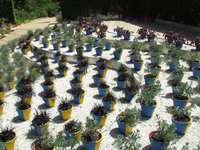
The garden festival at Chaumont-sur-Loire is south of the chateau. It has two walks, the Vallon des Brumes and Sentier des Fers Sauvages, but most of the site is used for annual display gardens, many influenced by Pop Art.
Read more on Chaumont-sur-Loire
 Chateau Amboise
Chateau Amboise »
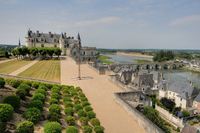
The early renaissance castle garden as it exists today is very similar to the garden shown in the du Cerceau drawing of 1576. Before that, Amboise probably had a medieval herber. The castle is on a rocky plateau with spectacular views of the River Loire. As Henry James wrote in 1900: 'The platforms, the bastions, the terraces, the high-niched windows and balconies, the hanging gardens and dizzy crenellations, of this complicated structure, keep you in perpetual intercourse with an immense horizon'. Also see http://www.renaissance-amboise.com.
Read more on Chateau Amboise
 Chateau de Villandry
Chateau de Villandry »
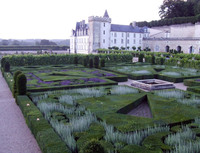
An imaginative twentieth century re-creation of a renaissance castle garden. The moated Chateau dates from c1536 and had a formal garden in the eighteenth century. The present garden dates from the years after 1906 when it was bought by a Spaniard, Dr Joachim Carvallo. Inspired by the Arts and Crafts movement, he wished the garden to have a sixteenth century character. Great horticultural skill was deployed, especially in the use of vegetables. An arbour of grape vines leads to a great parterre, conceived as a Garden of Music. On the other side of the canal is a Garden of Love. Symbolising the moods of love, it looks rectangular from the chateau but is actually trapezoid. The aesthetically de.....
Read more on Chateau de Villandry
 Château de Chenonceau
Château de Chenonceau »
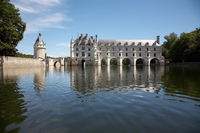
During the Middle Ages, French castles were often built in lakes or surrounded by moats. Chenonceaux's planners obtained a comparable effect by placing a chateau in the River Cher. In peaceful times, the river could be used for mock naval battles and other entertainments. In dangerous times, it gave secutiry to the inhabitants. The garden plan is an example of the cinquecento Italian renaissance style, adapted to French conditions. Diane de Poitiers, Henri II's mistress, made a rectangular garden which is protected from floods and intruders by a moat and ramparts. Philibert de l'Orme, an inventive designer who could blend medieval craftmanship with classical forms, had the brilliant idea of l.....
Read more on Château de Chenonceau
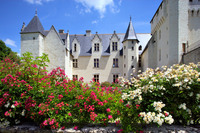 Château du Rivau Garden
Château du Rivau Garden »
The garden of Chateau Rivau is composed of 12 different gardens inspired by legends of the middle ages. A pleasant walk in the shadow of the Rivau Fortress will take you through the enchanted forest, the flowery meadow, the secret garden and Gargantua's kitchen garden. There is a collection of more than 300 ancient scented roses like the simple but beautiful rose "le chateau du Rivau" obtained by Andre Eve, an impressive collection of David Austin's roses and rare
plants of the middle ages (all labeled).
Read more on Château du Rivau Garden