Japanese gardens are popular around the world there would seem to be no let up in the rate at which they are being made. But in Japan itself, the garden visitor is fortunate that most of the famous gardens are in a single city: Kyoto. This is because it was Japan's capital for over a thousand years and both temple and aristocratic gardens were grouped around the court. For planning a Garden Short Break to Japan, we recommend:
* fly to Kansai Airport (outside Osaka) and take the train to Kyoto. The journey from Narita Airport (oustide Tokyo) is longer and more expensive, but still perfectly convenient
* buy a copy of the excellent Guide to the Gardens of Kyoto, by Marc Treib and Ron Herman
* book your accommodation with Japanese Guest Houses. They have good places to stay, often with traditional gardens, are very efficient and offer a free booking service.
The best times for a visit are spring and autumn, and since this is when most Japanese book their visits, it is wise to make bookings 3-6 months in advance.
Kyoto Garden Short Break: Ryoan-ji, Kinkaku-ji, Tenryu-ji, Daisen-in Zen Garden, Daitoku-ji, Ginkaku-ji, Sento Gosho Palace Garden, Katsura Imperial Palace Garden, Saihoji Temple, Nanzen-ji Zen Temple Garden, Heian Jingu, Murin-an Residential Garden
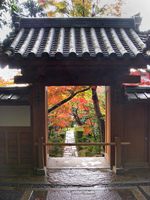 Ryoan-ji Zen Garden
Ryoan-ji Zen Garden »
<p>Ryoan-ji is the most famous and most austere Zen Buddhist garden. A rectangular space is bounded on two sides by a verandah and on the other two sides by walls. Within, the space is covered by raked quartz. Raking produces a pattern around 15 rocks in 5 groups in a significant mathematical relationship They are of 5, 2, 3, 2 and 3 rocks, which link the observer to an abstract conception of nature.</p>
<p>See blog post discussion on<a href="http://www.gardenvisit.com/blog/2013/04/23/what-is-a-zen-buddhist-garden-and-is-the-idea-japanese-chinese-or-western/"> whether Ryoanji is correctly classified as a 'Zen garden'</a>.</p>
Read more on Ryoan-ji Zen Garden
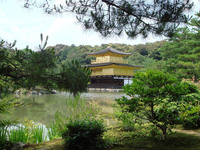 Kinkaku-ji (Golden Pavilion Temple Garden)
Kinkaku-ji (Golden Pavilion Temple Garden) »
This was designed as a paradise garden in which to stroll and meditate, remembering that Buddha had lived and preached in a grove. The garden has symbolic buildings and features, including a flying crane lake and a tortoise island which divides the lake into two sections. The shore of the lake is dotted with rocks. The garden was formerly the North Hill Villa. It became a Deer Park (named after Buddha's Deer Park of Isipatana, but without deer) when acquired by Shogun Yoshimitsu. The gilded temple is Chinese in style but has an un-Zen-like gaudiness.
Read more on Kinkaku-ji (Golden Pavilion Temple Garden)
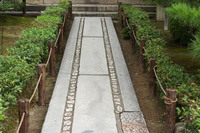 Daisen-in Zen Garden
Daisen-in Zen Garden »
This is a Zen Buddhist contemplative garden, within the Daitoku-ji temple complex. One part of the garden is an allegory; the other is designed for meditation. Rocks symbolise mountains. Quartz stones symbolise a river. A boat-shaped stone represents a human journey through the the troubled waters of life (symbolised by quartz) and towards Nirvana.
Read more on Daisen-in Zen Garden
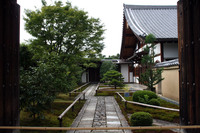 Daitoku-ji
Daitoku-ji »
Daikokuji is the Rinzai Zen Buddhist sect's chief temple complex, destroyed and rebuilt on several occasions. The Daisenin temple has a famous rock garden. The Kotoin temple is famous for its maple trees in autumn. The abbot's garden (hojo garden) is a large rectangle more than half covered with white sand and bordered by a ground mount set with rocks and a symbolic stream, raked every day to suggest rippling water. Together, the composition forms a symbolic landscape.
Read more on Daitoku-ji
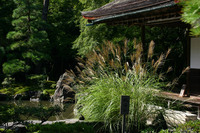 Ginkaku-ji (Silver Pavilion Garden)
Ginkaku-ji (Silver Pavilion Garden) »
The garden was designed as a country house for the Shogun Yosimasa and then became a temple garden. It is approached by a narrow walk lined with bamboo. The space then opens to show a large treasure pond which has two islands. The roof of the pavilion was intended to be covered with silver leaf. A low mound has white quartz, raked to symbolise waves and designed to be viewed by moonlight. The garden has a sho-in (scholar's seat) belonging to the Muromachi Period (1333 - 1573).
Read more on Ginkaku-ji (Silver Pavilion Garden)
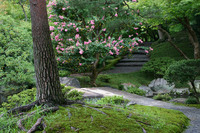 Sento Gosho Palace Garden
Sento Gosho Palace Garden »
Sento' means retirement and this palace garden, near Katsura and designed at the same time, was made for a retired emperor (Gomizunoo). It is a stroll garden with three sections. The long narrow lake has a tortoise island, an arched bridge and a beach with carefully positioned Odaware stones. There was also a model farm, made to teach the emperor's children about agricultural life.
Read more on Sento Gosho Palace Garden
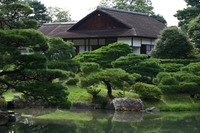 Katsura Imperial Palace Garden
Katsura Imperial Palace Garden »
Katsura Imperial Villa was built in the early Edo Period for Prince Toshhihito (1579-1629) and work began when he was 40. The prince himself was the main designer, working with Kobori Enshu, a tea master, government official and garden designer. A lake (1.25 ha) was dug, hills and islands formed, beaches made, pavillions built and planting undertaken. The result was a pleasure landscape of the kind described by Lady Murasaki in the Tale of Genji, 620 years earlier. There are 16 bridges. The lake could be used for boating parties and the surrounding land as a stroll garden, in effect a tea garden on an enormous scale. The 'Katsura Tree' (Cercidiphyllum japonicum) was associated with the God of.....
Read more on Katsura Imperial Palace Garden
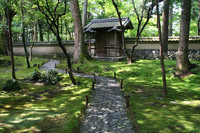 Saihoji Temple (or Koke-dere, or Moss Garden)
Saihoji Temple (or Koke-dere, or Moss Garden) »
<p>The oldest important garden of the Muromachi Period was re-designed by a Zen Buddhist priest, <a href="http://www.gardenvisit.com/biography/muso_soseki">Muso Soseki</a>, who also designed the Tenryu-ji garden in Kyoto. It is a stroll garden, set in a dark forest and designed for meditation. The garden was originally designed to represent the Western Paradise (or Pure Land) of Amida Buddhism. It was re-designed by Soseki when it passed to the Zen Buddhist sect The chief feature of the garden is the 'golden pond' with pavilions scattered on its shore and connected by a path which allows controlled views of the garden. The pond is shaped like the Japanese character for 'heart' or 'spirit'. It.....
Read more on Saihoji Temple (or Koke-dere, or Moss Garden)
 Nanzen-ji Zen Temple Garden
Nanzen-ji Zen Temple Garden »
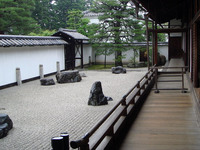
<p>Nanzen-ji is a Zen Buddhist temple in Kyoto. It began as a detached palace in 1264 but was repeatedly destroyed by fire and most of the old garden was lost. A new Zen garden, called the Leaping Tiger Garden, was made after 1611 and is a good example of the karesansui (dry garden) style. . It has a large sand rectangle enclosed by a buildings on two sides and a sloping bank on another side. The bank has rock compositions at its foot which can be seen as tiger cubs or as a turtle and a crane (animals associated with the Isles of the Immortals). Nanzenji is now the headquarters of the Nanzen-ji branch of Rinzai Zen.</p>
Read more on Nanzen-ji Zen Temple Garden
 Heian Jingu (Heian Shrine Garden)
Heian Jingu (Heian Shrine Garden) »
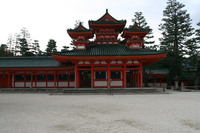
This garden, made to celebrate the eleven hundredth anniversary of the founding of Kyoto, is a re-creation of a Heian Shrine garden. A problem was that while a Shinto shrine was a symbolic and sacred space, the re-creation had to be a place where the public could walk afer visiting the shrine. This detracted from its authenticity but encouraged a new era of gardening building, in the twentieth century. The four sections are the Nishi Shin'en (West Garden), Minami Shin'en (South Garden), Naka Shin'en (Middle Garden), Higashi Shin'en (East Garden).
Read more on Heian Jingu (Heian Shrine Garden)
 Murinan Residential Garden
Murinan Residential Garden »
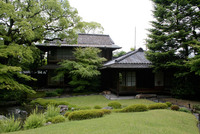
Murinan is the former home of Yamagata Aritomo, a Meiji statesman. It shows western influence and has a lawn, two streams, stones and clipped shrubs. There is a distant view of Higashiyama Hill.
Read more on Murinan Residential Garden