Egypt has the oldest recorded gardens in world history. Only the temple gardens survive in recognisable form but there is a great deal to interest the garden visitor in the Estate of Amun at Luxor. For a garden short break, it is best to take a direct flight to Luxor and a taxi to your hotel. The New Winter Palace Hotel is a conveniently located to hire a bicycle. The bicycle can easily be taken on the Nile ferry and you can ride around the West Bank at your pleasure. Places to visit: Domain of Amun, Medinet Habu, Ramesseum, Temple of Hatshepsut, Temple of Karnak, Temple of Luxor, Temple of Mentuhotpe II.
 Domain of Amun
Domain of Amun »
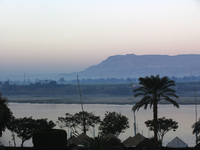
The Domain of Amun was a network of cult and mortuary temples linked by processional routes. Processions were held to mark festivals. They began in the land of the living, on the Nile's east bank, crossed the river by royal barge and went to the mortuary temples in the land of the dead, on the west bank. Routes were treated in various ways: canals, roofed causeways and pavements lined with trees or statuary (eg sphinxs). Temples were built on the margin of the black land (within the flood zone and therefore available for agriculture) and the red land (mountain and desert).
Read more on Domain of Amun
 Medinet Habu
Medinet Habu »
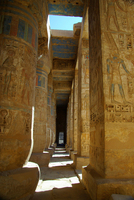
The mortuary temple of Ramesses III stands in a group of royal temples on the edge of the Nile Valley. The last great king of the New Kingdom, Ramases temporarily revived Egypt's glory. There are remains of houses and vaulted stores built of mud brick. The eastern perimeter wall is battlemented and there is a palace beside the temple. A sacred pond is described by Ramesses III, in Papyrus Harris I: 'In front of it [the temple] I dug a pool copious with water, planted with trees and verdant as the Deltaï¾… It was surrounded by arbors, courtyards, and orchards laden with fruit and flowers for thy [Amon's] countenance. I built there pavilionsï¾… and I excavated a pool before them, adorned with l.....
Read more on Medinet Habu
 Ramesseum
Ramesseum »
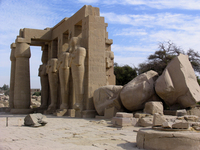
The temple and palace of Ramesses II ('Ramesses the Great' ) was the greatest project of one of Egypt's greatest builders. His throne name, User-Maat-Re, was rendered by Diodorus Siculus as Ozymandias and used by Shelley in his famous lines: 'My name is Ozymandias, King of Kings:/Look on my works, ye Mighty, and despiar'. A great deal of the temple's structure was destroyed. Stone was removed for building, statues were smashed, the site was used as a church; foundations were undermined by the Nile floods. Yet the heroic structure of the layout survives. The head of a colossal statue lies on the ground with its nose the size of a man. The colossus was cut from a single block of limestone, brou.....
Read more on Ramesseum
 Temple of Hatshepsut
Temple of Hatshepsut »
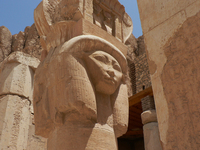
<p>Hatshepsut's temple is the most ancient masterpiece of western <a href="/landscape_architecture">landscape architecture</a>. Her temple and its setting are one. The temple was known as Djeser-Djeseru 'Holiest of the Holy' to the Ancient Egyptians and is now known as Deir el-Bahri, 'Monastery of the North' after the Coptic monastery which used the site from the 5th century to the 19th century AD. Hatshepsut (also known by her throne name Maat-ka-Re, 'Justice is the soul Re') ruled from 1479 to 1458 as Queen of Egypt and 'God's Wife' (high priestess) of Amun. As became common in the New Kingdom, Hatsheput's mortuary temple and tomb are in different locations. Her tomb, where the treasure lay.....
Read more on Temple of Hatshepsut
 Temple of Karnak
Temple of Karnak »
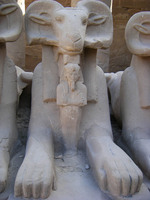
The temple precincts of Karnak and Luxor lie on the east bank of the Nile, 670 km upstream from Cairo in the town once known as Thebes. Their importance in the history of garden design cannot be doubted. Excepting fortifications, these are the greatest walled enclosures that survive from ancient times. It is the largest religious structure ever made. The temple compounds were linked by processional routes lined with sphinxes. Some of the land within the precincts was roofed, as temple buildings and dwellings for priests. Large areas were treated as gardens for growing food and for relaxation. Temples were used by the priesthood for the religious and sexual rites on which the continued stabili.....
Read more on Temple of Karnak
 Temple of Luxor
Temple of Luxor »
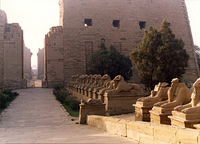
The Temple of Luxor was formerly known as Opet (meaning 'the harem'). It is the place where Amun-Re celebrated his divine marriage during the Festival of Opet The festival took place once a year and was a marriage between king (pharaoh) and god-king (Amun-Re). The temple front was built by Ramesses II and carries a relief showing his great victory against the Hittites at the Battle of Kadesh. The axis of the layout is approximately east-west but makes two slight changes direction twice along the route from the pylon gate to the inner sanctum. Reliefs beside the walkway illustrate the festival procession from Karnak to Luxor, along the great processional route which joined the two temples. The.....
Read more on Temple of Luxor
 Temple of Mentuhotpe II
Temple of Mentuhotpe II »
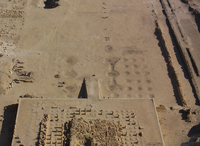
<p>Mentuhotpe's mortuary temple is a good place to begin the history of garden design as a fine art. Inspired by Osiris grave, the temple precinct was made below the Western Mountain where the edge of the Sahara Desert touches the Nile Valley. Thebes, now called Luxor, was the religious capital. Egyptians lived on the east bank of the Nile and were buried on the west bank, in 'the city of the dead'. Metuhotpe II reunited Upper and Lower Egypt, inaugurating an era of great cultural achievement, known as the New Kingdom. He ruled for 51 years (<span class="st">2046 BCE – 1995 BCE)</span>. A ramp, a platform and his tomb chamber survive. In the forecourt, 100m wide and 200m long, one can s.....
Read more on Temple of Mentuhotpe II