The soft gentle air of the Cotswolds is encapsulated in its gardens: Hidcote Manor, Kiftsgate Court, Mill Dene, Sezincote. The local stone is honey-coloured and the gardens are notably sweet.
The Cream of Cotswold Gardens, 3 Nights
Visit Hidcote, Kiftsgate, Mill Dene, Painswick Rococo, Batsford Arboretum and Sezincote accompanied by author Tony Russell. Next departures 11th May and 6th July 2009. See full itinerary.
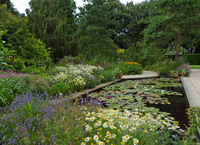 Hidcote Manor Garden
Hidcote Manor Garden »
<p>A famous <a href="https://www.gardenvisit.com/history_theory/garden_landscape_design_articles/historic_design_styles/arts_crafts_garden_design_style">Arts and Crafts garden</a>, made c1905. <a href="https://www.gardenvisit.com/biography/lawrence_johnston">Lawrence Johnston</a> was a keen plantsman with a strong sense of artistic composition. Yew, holly and beech hedges are used to define a series of garden rooms. One room is occupied only by a circular raised pool. Others have a character deriving from their inspired planting. The standard of building craftsmanship is high and the number of plants which have the name 'Hidcote' point to Johnston's expertise.</p>
<p>Were it nearer London, t.....
Read more on Hidcote Manor Garden
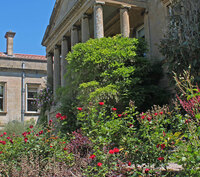 Kiftsgate Court Gardens
Kiftsgate Court Gardens »
<p>A nineteenth century with a twentieth century <a href="https://www.gardenvisit.com/history_theory/garden_landscape_design_articles/historic_design_styles/arts_crafts_garden_design_style">Arts and Crafts</a> garden. It was made by Heather Muir with much help from <a href="https://www.gardenvisit.com/biography/lawrence_johnston">Major Johnston</a> of Hidcote. A woodland garden steps down the hillside to a half-moon swimming pool. Many features are typical of the Arts and Crafts period: herbaceous borders, a four square garden, a white garden, a yellow border, a rockery, lawns and a bluebell wood.</p>
<p>The Kiftsgate Water Garden, called the New Garden, has with a bronze leaf scupture by Si.....
Read more on Kiftsgate Court Gardens
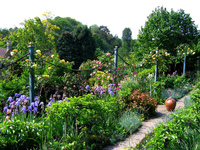 Mill Dene Garden
Mill Dene Garden »
<p>Established in 1965, the garden surrounds a Cotswold watermill with stream and millpond. It is a garden of many rooms - a cricket lawn, innovative fruit garden, rose walk, and herb potager with the village church as a back drop. Alkaline/neutral clay and Cotswold brash soil - steeply sided valley running East-West, a frost pocket at the bottom by the water, sunlit hills at the top three weeks ahead of the rest of the garden.</p>
<p>See Mill Dene Gardens on Instagram <a href="https://www.instagram.com/explore/tags/milldenegarden/">#milldenegarden</a></p>
Read more on Mill Dene Garden
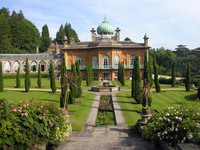 Sezincote Garden
Sezincote Garden »
<p>An Indian style house (1810) with an eastern 'Hindu' garden. Architecturally, the house is Mughal and Muslim, rather than Hindu. The project was inspired by Humphry Repton and was followed by his 1808 book Designs for the <a href="https://www.gardenvisit.com/gardens/royal_pavilion_brighton">Pavilion at Brighton</a>. Repton favoured the style partly for its novelty and partly because neither the Grecian nor the Gothic styles, then popular, were associated with palaces. Sezincote has a temple with a figure of the goddess Souriya, a bronze serpent, Brahmin bulls, a mushroom-shaped fountain, a conservatory with minarets and an unusual curved orangery. Graham Stuart Thomas advised on the planti.....
Read more on Sezincote Garden