To Americans and Europeans, China may seem a long way for a short break. But it is amazing how much one can see in a week and China is a 'must see' country for gardeners. It has one of the longest garden-making traditions in the world. You will also have time to try China's excellent cooking and see its gleaming and well-run modern cities with excellent cycle lanes. Hiring a bicycle is the best way to get around within a Chinese city and rail is the best way to travel between cities. Street names and station signs are in both English and Chinese. Travel is much easier than you might think!
China is a vast country but the famous gardens are well-concentrated, around Shanghai and around Beijing. Since China's internal rail and air services are excellent, it is perfectly possible to see China's best gardens in a single week. We recommend planning to see the following: Shanghai: Yuyuan, Taipingqiao Park. Suzhou: Lion Grove Garden, The Humble Administrator's Garden, The Surging Waves (or Blue Waves) Pavilion (Cang Lang Ting). Bejjing: Beihai Park, Forbidden City, Summer Palace. A week visiting these gardens should persuade anyone that the best gardens in China are at least as good Europe's best gardens. The best times of year for a visit (ie when there are leaves on the trees and the weather is neither too hot nor too sticky) are spring and autumn.
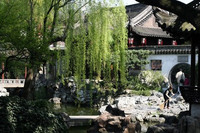 Yuyuan Garden
Yuyuan Garden »
The Yuyuan, or Garden of Contentment, is one the best gardens in China. It is near a famous old tea house with a zigzag bridge in heart of the old city of Shanghai. The garden was originally made, in 1559, for a retired scholar-administrator, but has often been damaged and rebuilt. Many of the garden features are excellent: the dragon wall, the moon gate, the long roofed corridor-bridge and a brilliant collection of garden windows and doors. The artificial mountain, made of yellow rocks, is thought to survive from the original design and to be the work of Zhang Nanyang.
Read more on Yuyuan Garden
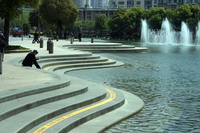 Taipingqiao Park, Xintiandi
Taipingqiao Park, Xintiandi »
<p>Taipingqiao Park in Central Shanghai is a fine example of an early twenty-first century Chinese park, built in an amazingly short time (6 months!) in 2001. It is part of a 52 ha redevelopment planned by SOM, an American firm of architects and landscape architects. The park is built of top of an underground car park with 200 spaces. Curving steps form one edge of the lake, reminiscent of the surging coping on a traditional dragon wall. The flowers on the facing edge of the lake look as though they might not have part of the original design, but they are popular and decorative. Fountains are particularly welcome in the heat of a Shanghai summer.</p>
Read more on Taipingqiao Park, Xintiandi
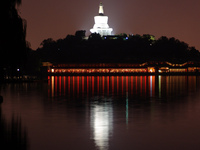 Beihai Park (or Pei Hai or Northern Sea)
Beihai Park (or Pei Hai or Northern Sea) »
The Northern Lake is a section of the Celestial Sea (or Park of the Sea Palaces). It was excavated in the 12th century and the material used to make an artificial island (Qionghua Isle) with a hill. As described by Marco Polo, Kublai Khan embelished the island. The Ming and Ch'ing dynasties did likewise. Most of the present character dates from the 17th century. Beihai is now a public park. There is a number of pavilions on the island and on the shore of the Lake, including the Limpid Mirror Studio, Circular City, Five-Dragon Pavilions, Nine-Dragon Wall and Pavilion for Quiet Meditation.
Read more on Beihai Park (or Pei Hai or Northern Sea)
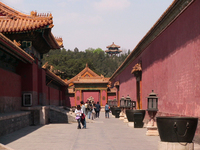 Forbidden City (Palace Museum)
Forbidden City (Palace Museum) »
<p>The former palace of the Ming and Qing dynasties was forbidden to the commoners for 500 years. It is the largest palace complex in the world, with over 800 buildings and almost 10,000 rooms. It is bounded by 10 meter walls and a 52-meter wide moat. The building layout is absolutely geometrical (a complete contrast with the Imperial Garden within the palace). The city plan, Geoffrey Jellicoe wrote in The Landscape of Man, was 'laid out according to cosmic calculation, heaven being considered a round and the earth counterpart to be a square' (p69) so that there is a 'system of boxes one within another.. the geometry is Confucian and the inconsequential penetration of natural form is Taoist; .....
Read more on Forbidden City (Palace Museum)
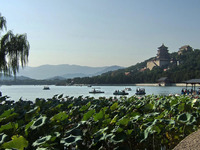 Summer Palace (I Ho Yuan or Yi He Yuan)
Summer Palace (I Ho Yuan or Yi He Yuan) »
A vast Chinese landscape of hills, water, and temples, once the private recreation area of the imperial family. The area was the site of a Yuan Dynasty monastery before it became an imperial garden in the eighteenth century. Damaged in 1860 (the Opium War), restored in 1888, damaged again in 1900 (the Boxer Uprising), it became a public park after the 1911 revolution. There are over 30 classical structures on the Longevity Hill and around the Kunming Lake. Causeways, like those at Hangchow divide the lake into sections. There are marble bridges, a stone boat and a 'Garden of Harmonious Interest'. The 17-arched 150m bridge crosses to the South Lake Island (Nanhu Dao). The Temple of Sea Wisdom .....
Read more on Summer Palace (I Ho Yuan or Yi He Yuan)
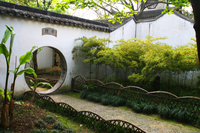 The Surging Waves (or Blue Waves) Pavilion (Cang Lang Ting)
The Surging Waves (or Blue Waves) Pavilion (Cang Lang Ting) »
The Pavilion of Surging Waves is a classical garden made during the Sung Dynasty. Its name came from the poet Su Shunqin, who wrote that: 'If the water of the Tsang Lang river is clean, I wath the ribbons of my official hat in it; if it is dirty, I wash my feet'. The garden 'borrows' the nearby canal. Trees form a canopy above the garden and there are bamboos outside the windows, filtering the light and making it flicker.
Read more on The Surging Waves (or Blue Waves) Pavilion (Cang Lang Ting)
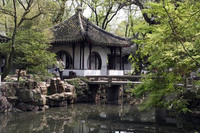 The Humble Administrator's Garden (Zhou Zheng Yuan)
The Humble Administrator's Garden (Zhou Zheng Yuan) »
Also known as the 'Garden of the Unsuccessful Politician' and listed by UNESCO. The administrator became humble after being accused of corruption. This is the largest classical garden in Suzhou and one of the most famous gardens in China. It was a scholar garden during the T'ang dynasty and a monastery garden during the Yuan dynasty. It then changed hands many times. The structures are grouped round a labyrinthine lake, rather like a Chinese water village. The Hall of Distant Fragrance is on the south shore of the lake and looks to an island with the Pavilion of Fragrant Snow.
Read more on The Humble Administrator's Garden (Zhou Zheng Yuan)
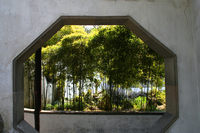 Lion Grove Garden (or Stone Lion Grove) (Shi Zi Lin),
Lion Grove Garden (or Stone Lion Grove) (Shi Zi Lin), »
<p>
This one of the 4 Suzhou gardens listed by UNESCO. It was founded by a Buddhist monk (Tien Ru) during the Yuan (Mongol) Dynasty and is famous for the rock work around the lake. Some of the rocks resemble lions and thus gave the garden its name. The lake also has a roofed (lang) walkway.
</p>
<h3>Quotation(s)</h3>
<p>
Source: <em>Classical Chinese Gardens</em>, China Building Industry Press, Beijing<br />
<br />
Lion Grove Garden was first built in the Zhi Zheng period of the Yuan Dynasty. It was originally part of the Puti Zhengzong Temple. Inside the garden there are many rockeries in the shape of a lion (shizi), hence the name Lion Grove, or Shizi Lin in Chinese. The celebrated p.....
Read more on Lion Grove Garden (or Stone Lion Grove) (Shi Zi Lin),