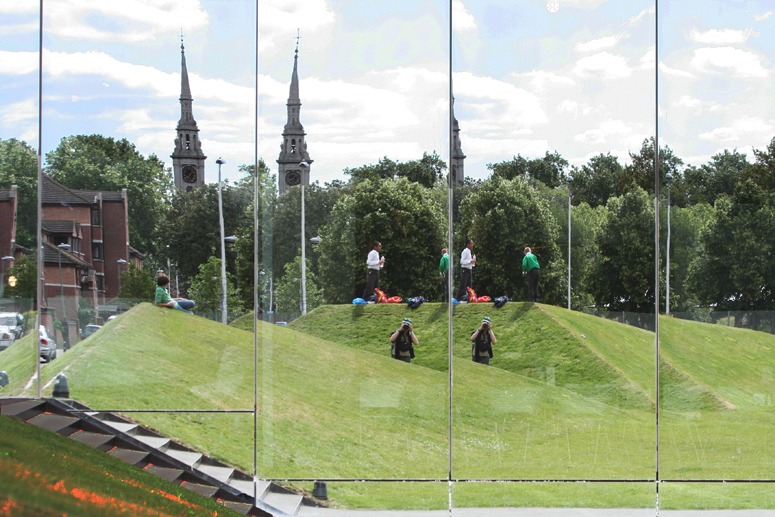
Lady Boothroyd wants to get rid of her garden mole problem

by Tom Turner @ 7:56 am December 30, 2011 -- Filed under: Garden Design   

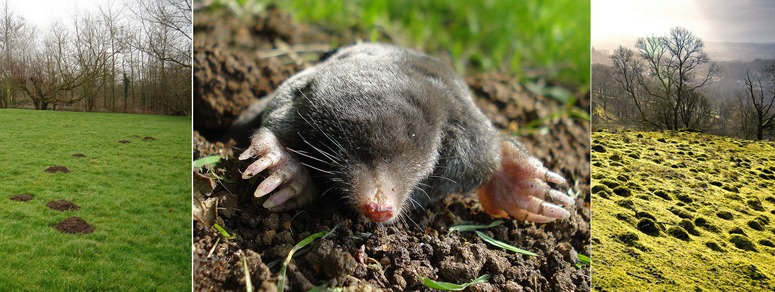
Garden molehill problem?

The former Speaker of the House of Commons was on Radio 4′s Today programme this morning, asking for advice on her garden mole problem. She said they are mole mountains, not molehills. BBC staff found ‘experts’ who recommended poison gas and mole traps. They also advised that when a mole dies, another mole ‘comes to his funeral’: they re-use the tunnel system. So here is my advice to Lady Boothroyd: get rid of ‘the mole problem’ by re-conceptualizing it! Forget about ‘How to be a lawn expert’. Retire from the field of battle. Learn to love your enemies: the ‘little gentlemen in a black velvet waistcoat‘. Admire those beautiful mounds they make in the laughing meadows of Olde England. Cast your mind back to 1970: it was European Conservation Year. Say HAPPY NEW YEAR to the animal kingdom, as Gardenvisit.com does to its readers.
Images courtesy: zoer, Mick E. Talbot, alh1

Tim Mowl’s Youtube garden history lecture on Claremont and William Kent

by Tom Turner @ 5:38 pm December 27, 2011 -- Filed under: garden history   

Congratulations to Tim Mowl for providing the best garden history content on Youtube (one can’t be quite sure: The FAQ says ’48 hours of video are uploaded every minute, resulting in nearly 8 years of content uploaded every day’). The lecture was given at Claremont Landscape Garden and was about the history of this garden and William Kent. Though Tim Mowl obviously knows more about the period than me, I offer the following comments:

  • Mowl mentions Renaissance Italy and Ancient Rome, in relation to the development of England’s eighteenth century gardens, but I wish he had said more about them.
  • In my view, Mowl over-emphasises the concepts of ‘nature’ and ‘geometry’ in explaining the ‘great revolution in taste’. Since most English garden historians do this, one can hardly complain. Conceptually ‘Nature’, belongs more to the history of philosophy than the history of art.
  • I would have like to have heard more about the transition from Baroque to Neoclassical, in art, literature and gardens. Conceptually, the links between these topics are closer than then link between gardens and philosophy. There is however no doubt about the importance of ‘Nature’ as a philosophical concept (rather than as a geometrical concept).
  • I agree about the eclectic character of the first (Augustan) phase of the English landscape garden, but see it as a consequence rather than a cause of the revolution in taste. The cause was a desire to see, know, understand, learn from and represent the classical world. ‘Eclectic’ is almost a term of abuse and ‘Historicist’ may be a more useful term.

See also:

Conceptual gardens, folding, Deleuze and landscape design

by Tom Turner @ 4:31 am December 17, 2011 -- Filed under: Garden Design   

What is a conceptual garden? - and what is a folded landscape?

The RHS has a conceptual gardens category, at the Hampton Court Flower Show, which has produced excellent work, pathetic work – and much confusion. (See: Hampton Court Conceptual Garden Applications for how the RHS explains the Concept Gardens idea). So let’s take the Folded Landscape, by Voght for the Laban Centre as an example.

  1. Conceptual art foregrounds ideas, with visual imagery taking a backseat.
  2. Gilles Deleuze put forward a set of ideas which derive from deconstruction, and which have almost superseded deconstruction as an influence on design theory. The underlying principle is monist: the world is only one thing (which Spinoza identified with God) and it constantly folds into new forms. The One becomes the Many; the Many is always the One (is there a Buddhist resonance here?)
  3. Voght designed a Folded Landscape for the Laban Centre. It is a prime example of a Conceptual Garden Design – with room for fruitful debate as to whether the visual image is the foreground, background or reflected ground.

The folding concept, though explained by its advocates with the greatest possible linguistic obfuscation, is an attractive principle for the re-integration of architectural design with garden and landscape design – after modernism rent them asunder.

Gardenvisit.com welcomes the Christmas (selling) season

by Tom Turner @ 6:05 am December 15, 2011 -- Filed under: Garden Design   
Buy an illuminated Santa for your Balcony TM ™ ® Gardenvisit.com Inc. Pvt. Co. Ltd. GmbH ©

Buy an illuminated Santa for your Balcony TM ™ ® Gardenvisit.com Inc. Pvt. Co. Ltd. GmbH ©


Our blog analysis of Santa Claus’ garden potential leads us to offer a unique Illuminated Santa Claus, ideal for use on balconies and specially tailored for Postmodern East Asian Christian Christmas markets. Buy now! This may be a once-in-a-lifetime opportunity.The special Gardenvisit.com prices are $10 in plastic or $10m with Damien Hirst style diamond encrustation and, you must agree, much more cheerful imagery (Paypal is our preferred payment gateway but gold bars are an acceptable substitute, if delivered to our Zurich vault anonymously).

[With thanks to M J Hop for help with product placement etc]

Greenwich landscape architecture urban design project 2011

by Tom Turner @ 2:25 pm December 9, 2011 -- Filed under: Landscape Architecture,London urban design   


The Isle of Dogs to Silvertown reach of the River Thames is becoming de-industrialised. This project looks 300 years back, 3 years forward, 30 years forward and 300 years forward. It has a musical theme, reflected in the cello playing, which envisages a succession of waterfront areas, with the tempo moving from fast to slow as the river flows east. The zones are linked by two greenway corridors: (1) a modulating waterfront greenway-blueway (2) an inland service corridor with a Highline-style greenway above, for sustainable green transport, shopping and leisure.
The project was done by University of Greenwich MA Landscape Architecture students in the autumn of 2011.

Do all good gardeners believe in Santa Claus?

by Tom Turner @ 2:04 pm December 4, 2011 -- Filed under: Garden Visiting,Greenwich Park London   

Of course they do!

Concepts of sacredness and beauty

It is likely that the history of Japanese gardens finds its origins in Shinto traditions. In particular the sacred nature of rocks: “from the ancient remains of rock arrangement” of the fifth century AD, we find a resemblance to existing Japanese gardens. “However it appears they were used for the spiritual rituals and not designed as a stone arrangement for the beauty of gardens.”

The earliest known Japanese gardening texts are a medieval text, Sakuteiki, and an illustrated text dating from the Muromachi period (1333-1573). The origins of Japanese garden design principles are said to be traceable back to these two texts. The location of Shinto shrines were near striking natural formations, waterfalls, caves, rock formations, mountain tops or forrest glens reflecting the idea that kami spirits were located in nature. The earliest shrines were mounds, caves or groves. Kami occur in two categories (object kami) and mythical and historical persons (active kami). Illustrated is off-shore rock kami.

The following story is related of an off-shore rock just off Oshima:
“The kami enshrined here is Ichikishimahime, daughter of Susano, and eldest of the three Munakata princesses. Just off Oshima is a large rock protuding from the sea. The story is when Ichikishimahime heard she was going to be enshrined on Oshima, she was really excited and proud because Oshima means ‘Great Island’, but when she got here and saw just how small it really was, her tears formed the rock.”

With the introduction of Buddhism into Japan the earliest interaction saw local kami asking to be saved from their kami-state by means of Buddhist ritual.

除计成外,中国另一位获得世界认可的风景园林理论家在哪里?Besides Cheng Ji, where is another international well known Chinese landscape theorist?

by Jerry @ 2:40 pm November 24, 2011 -- Filed under: Garden Design   

Ji Cheng's Yuanye (园冶), is the first monograph dedicated to garden architecture in the world. His work has been translated into many languages.

I am glad that Wikipedia has kindly had a record of the most important Chinese landscape architect and theorist- Jicheng.

Ji Cheng (计成) (1582 – c. 1642) was a Ming dynasty garden designer. Ji Cheng was born in the Ming Wanli Reign 10th year (1582) in Tong Li township, Wujiang county, Suzhou. As a youth, Ji Cheng made a name for himself as a landscape painter and private garden designer, he worshipped two North Song painters: Guan Tong (关仝) and Jing Hao (荆浩) During his lifetime, he designed numerous private gardens in Southern China. In his late years, he summarized his lifetime experience into a monograph on landscape design: (园冶), Yuanye: The Craft of Gardens, 1631. Ji Cheng’s Yuanye (园冶), is the first monograph dedicated to garden architecture in the world. His work has been translated into many languages.  ”The garden is created by the human hand, but should appear as if created by heaven.” (虽由人作,宛自天开)

I must thank Chengji very much, because his book really influenced me and led me to study landscape architecture. It could be very easy to remember that after I saw his book in Chinese, I gave up listening to any lectures in class in 2006. What I did was crazy in most of people’s opinion: taking ChengJi’s  book all the time with me, saving all my pocket money to pay for traveling for gardens on my own, obviously, most of the lectures were quit by me, which I must say ‘sorry’ to the lecturers in that term! Even now, I do not know why I could be so brave like that.  But I clearly know that I admire him because of  his amazing theory in Chinese landscape. And also thanks to some other translators having translated this book into lots other languages and made him a famous  Chinese landscape theorist during 17th Century.

Time flies!  It is 21st century  now. But who could tell me of another international well known Chinese landscape theorist? It is said in Tom‘s post: in 19th century- Olmsted, in 20th century-Repton and 21st century-Alexander… Why there is nobody in the country which provided the first landscape theorist- China, a country has long history and the world’s biggest population?  What did those  landscape gentlemen do in the past centuries?  Are they planning to use ChengJi’s idea to support their design and planning idea in the 21st century? Are they going to teach their lovely students how to do a landscape plan in the city by ChengJi’s  idea  in 21st century? 

Christopher Alexander and Humphry Repton as landscape design theorists – UDG lecture

by Tom Turner @ 10:15 am -- Filed under: context-sensitive design,Urban Design   

Christopher Alexander and Humphry Repton as landscape architecture theorists

Who is the most important landscape architecture theorist of the nineteenth century? Humphry Repton, through his influence on John Ruskin, Frederick Law Olmsted, Patrick Geddes – and most other landscape planners and garden designers in the century after his death.
Who is the most important design theorist of the twentieth century? Christopher Alexander, through his influence on urban design, architecture, computer programming and, through Ian Mcharg, on landscape planning and the develoment of Georgraphical Information Systems?
Are there any similarities between between the design theories of Repton and Alexander? Yes.
The photographs on the left, above, were taken at last night’s Kevin Lynch Memorial lecture, organised by the Urban Design Group. The lower left photograph shows Alexander and his opening slide. It was on display for a good while, because Alexander likes to show slides in rapid-fire (2.5 seconds each) and with no talking [unluckily for me, my tummy chose to rumble while the audience listened in silence]. The photgraph made me think he was going to talk about the fact that a City is no a Tree. But no. He wished to argue, as in his forthcoming book [The Battle for the Life and Beauty of the Earth: A Struggle between Two World-Systems by Christopher Alexander, Hans Joachim Neis and Maggie Moore (OUP Jul 2012) - on the Eishin Campus in Japan] that (1) a design should be done on the spot (2) buildings should be positioned in the landscape with the aid of flags (3) the design process must be continuous and should constantly aim for ‘wholeness’ (4) the current system of producing a full set of working drawings before work starts on site is disastrous.
The first two points are 100% Repton. Repton argued that ‘The plan should be made not only to fit the spot, it ought actually to be made upon the spot’. The Repton drawings, on the right above, show the use of ranging poles to set out tree positions at Bristol – and he used the same system for positioning buildings. Alexander’s third point is also Reptonian, though he would have used the word ‘harmony’ instead of ‘wholeness’. As for the fourth point, Repton was a gentleman and never produced working drawings, so there is every likeliehood he would have agreed.
It was disappointing that Alexander spoke to slowly (though I have no expectation of being any faster when I am 75) but it is great that he still has the energy to work as a ‘building contractor and architect’. We must hope he lives long enough, like another great design theorist sill working (Charles Jencks), to give his full attention to landscape architecture and garden design. Let us pray.

Repton's design for Bayham Abbey and, right, his use of ranging poles to position the building: THIS is landscape architecture

The Chinese ‘Mountain and water’ Garden 中国“山水”园林

by Tian Yuan @ 3:46 pm November 23, 2011 -- Filed under: Garden Design   

Inspired by the comments about mountain and water (山水)idea from the post for Jingqing garden, I would like to give another further thinking about the Chinese garden design philosophy for myself. I remember that my supervisor used ‘geography’as the main idea to talk about the difference between Chinese garden and English Garden last year when I attended his garden history class the first time. After one year, I could say that I agree with him in this point. Chinese Mountain and water idea is a ‘plot’ of Chinese people, the paining and garden design has grow up basing on the natural love of Mountain and water. “The benevolent love the mountain and wise delight in the water”, which is a quote from ‘The Analects of Confucius’. And this implies that the love of mountain and water is also a virtue in Chinese view.

Therefore, in Chinese Garden artificial mountains and lakes were usually there and artificial mountain-making and lake-digging became the most important skill of Chinese gardener in the ancient time. That is why Chinese garden is totally different from the English garden which is mainly focus on planting design.Or could I make a brave guess that there are not as many high mountains and big lakes in Europe as in China. That is why it is hard for most of the westerners to appreciate Chinese garden without visiting China, though they are also benevolent and wise. The left picture is a Chinese painting in Qing Dynasty.

Newer Posts »